Can I Siphon Water Over a 9.5m Barrier Without Pumps?

  • Thread starter Thread starter CalvinandHobbes
  • Start date Start date
  • Tags Tags
    Water
Click For Summary

Discussion Overview

The discussion revolves around the feasibility of siphoning water over a 9.5-meter barrier without the use of pumps. Participants explore the mechanics of siphoning, the necessary conditions for effective operation, and the design considerations for a siphon system in a specific application involving a large reservoir.

Discussion Character

  • Exploratory
  • Technical explanation
  • Debate/contested
  • Mathematical reasoning

Main Points Raised

  • One participant questions whether raising the intake level of the first reservoir to the top of the siphon drain would be effective, noting the importance of the siphon only working if the water is deposited lower than the intake.
  • Another participant clarifies that a siphon will only function if the free surface levels of the two reservoirs are at the same height and if the lifting distance is less than approximately 10 meters.
  • Concerns are raised about the potential for reduced flow and loss of siphon effect if the design does not maintain proper height differentials and pipe priming.
  • Some participants suggest that a larger second reservoir may help maintain the necessary height difference, while others express skepticism about the practicality of the proposed pipe dimensions.
  • A later reply emphasizes the challenges of filling a large diameter pipe without air remaining, suggesting that a pump may ultimately be necessary despite the siphon principle being theoretically applicable.
  • One participant asserts that siphoning without a pump is possible, citing common practices in agricultural settings, and provides specific conditions for successful siphoning.

Areas of Agreement / Disagreement

Participants express a mix of agreement and disagreement regarding the feasibility of the siphon design. While some believe it can work under certain conditions, others argue that practical challenges may necessitate the use of a pump. No consensus is reached on the overall effectiveness of the proposed system.

Contextual Notes

Participants highlight various assumptions regarding pipe dimensions, air entrapment, and the importance of maintaining height differentials. The discussion remains unresolved regarding the optimal design and practical implementation of the siphon system.

CalvinandHobbes
Messages
4
Reaction score
3
TL;DR
If lift water 9,5m high (initially with a pump till it reaches bend), can I raise the level to which 2nd reservoir is filled by installing a siphon drain inside 1st reservoir and empty reservoir no1?
I have no engineering background so apologies if I'm trying to create alchemy without pumps.
I need to empty 10 000l reservoir 4 times a day into a larger vessel, which is slightly lower, but I first have to cross a 9,5m high barrier (site is located about 15m above sea level)
I gather the siphon will only work to deposit the water lower than the intake. Would it be possible to raise the intake level of reservoir no 1 to the top of a siphon drain (a funnel located inside a larger pipe that is closed 1 end) [explanation is just to clarify what i mean as I don't have the correct terminology], or does it remain at the bottom of lowest point of the pipe)?
Is there a risk that the siphon drain can reduce the flow to much and therefore loose the siphon effect of the total installation and makes it counter productive?
Attach a simple sketch to try and illustrate
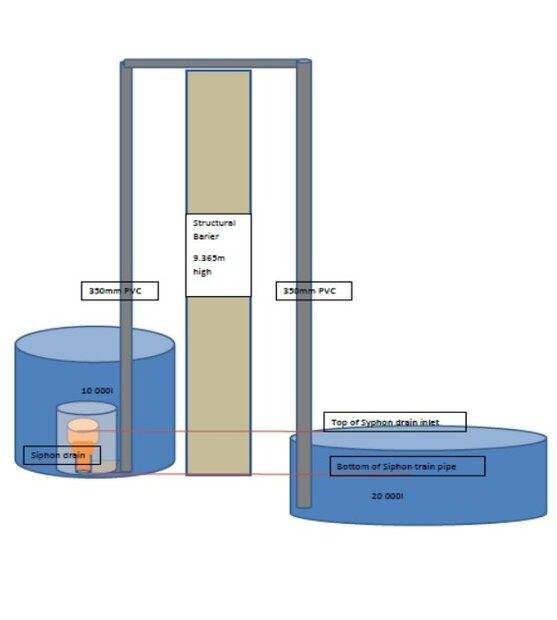
Siphon Tank discharge.jpg
 
Engineering news on Phys.org
A siphon will only transport water until 1) the free surface level of the two reservoirs are at the same height and 2) only if the lifting distance (i.e. the distance from the highest surface to the top of the pipe at any given time) is less than around 10 m which is the maximum height you can "suck up" water through a pipe via vacuum pumps.

From your description it appears that your setup may be at or very near either of those conditions.
 
Filip Larsen said:
A siphon will only transport water until 1) the free surface level of the two reservoirs are at the same height and 2) only if the lifting distance (i.e. the distance from the highest surface to the top of the pipe at any given time) is less than around 10 m which is the maximum height you can "suck up" water through a pipe via vacuum pumps.

From your description it appears that your setup may be at or very near either of those conditions.
Thank you Filip for your advice. If I understood you correct, the design will work as is, as long as the 2nd reservoir is much wider (as my sketch) to ensure the 2nd reservoir’s surface stays below 1st reservoir? It seems from your advice that the suction of the siphon drain is waste in this design and won't contribute to “lift” the level of the 1st reservoir?
 
CalvinandHobbes said:
I understood you correct, the design will work as is, as long as the 2nd reservoir is much wider (as my sketch) to ensure the 2nd reservoir’s surface stays below 1st reservoir?
That is correct. As long as that is valid, and you are below the height limit of a siphon you should be good. Of course, the pipe also have to be primed somehow and then keep airtight, but that is more of a practical concern.

Note that the less the difference in height between the two surfaces is, the less mechanical power will be available for transporting the water through the pipe. Since there is a some energy loss from the flow in the pipe itself, the flow may slow down to a crawl somewhat before the difference in height becomes exactly zero.

Also note that if you can choose the dimensions or exact placement of the 2nd tank you may want to choose such that the flow actually stops due to this constraint before the air gets into the pipe, thus avoid having to prime the pipe again. You can also later adjust this limit up/down by adjusting the intake level of the pipe in the 1st tank.

CalvinandHobbes said:
the suction of the siphon drain is waste in this design and won't contribute to “lift” the level of the 1st reservoir?
Correct, it will not change the lifting limit as that is considered from the free surface level, not from the deepest pipe level.

Of course you may want to include a small raised section of the pipe in the 1st tank to avoid it sucking in any material that may settle at the bottom of the tank or to make a water lock to avoid air gets in near its lower limit, but that is a different set of concerns.
 
CalvinandHobbes said:
the design will work as is
Erm. I don't think so. It's really hard to fill up a 35cm (diameter? radius?) pipe without air remaining, and: without air continuously gathering in the upper section. I think the task described will require a pump.
 
  • Like
Likes   Reactions: russ_watters
Rive said:
It's really hard to fill up a 35cm
Good point, that does indeed sound unnecessarily or even unrealistic large.

The pressure of 1 atmosphere corresponds to roughly 1 kg/cm2, so for 35 cm inner diameter pipe with its 962 cm2 area that is up to nearly one tonne of water weight that needs to be lifted while priming. Assuming the water has to be primed from 1st tank only, I also imagine priming a 35 cm turn-over point will require quite a high flow in order to "fill it up" (get it air free) such that water doesn't simply leak into the drain side.

I would think 35 mm or even less would be more a far more sensible diamter, which also would allow for a (somewhat) flexible hose instead of a pipe, and flexible hoses are good when priming a siphon when there is no access to a pump. Perhaps the 350 mm is a typo, if not I wonder why the OP choose that size.
 
Filip Larsen said:
I would think 35 mm or even less would be more a far more sensible diamter,
The story is about ~ 40m3 water daily, so with low flow rate (and limited flow time: guess something like 'four times one hour' or so) the diameter might be right. But IMO unlikely to work.

I would use a (low pressure, high throughput) pump, and use the siphone effect only to conserve power.

Also, check this topic.
 
  • Like
Likes   Reactions: russ_watters and Filip Larsen
calvin
yes you absolutely can siphon great amounts of water WITH NO PUMP REQUIRED.

This is done all the time on farm ponds. Simply use plastic pipe with cap ( or valve ) on the discharge end and a fill plug at the top most point. Fill the pipe with water. The discharge pipe is capped or has valve shut off and the air trapped inside the pipe is minimal and does not effect the suction. As long as the fill plug is level and a section of pipe going to the suction side is level you have enough vacuum to create suction. No power or pump required.
Note- the pipe length on the suction side not having water must be less than 1/3 the total pipe length. When you open the drain valve the open suction area must drag water over the top of the hill so flow will be maintained. You also may have a problem trying this vertical with no slope.

Most of the time 100 mm diameter plastic pipe is used with rubber connectors..
really no limit as gravity and siphon principle does not care about pipe size...one case in life where size does not matter..haha

 
Last edited:
  • Informative
  • Like
Likes   Reactions: jrmichler, berkeman and anorlunda
Thank you for your advice!
 
  • Like
Likes   Reactions: berkeman and Ranger Mike

Similar threads

  • · Replies 15 ·
Replies
15
Views
4K
Replies
10
Views
11K
  • · Replies 4 ·
Replies
4
Views
3K
  • · Replies 11 ·
Replies
11
Views
8K
  • · Replies 17 ·
Replies
17
Views
19K
Replies
17
Views
3K
  • · Replies 8 ·
Replies
8
Views
3K
  • · Replies 6 ·
Replies
6
Views
5K
  • · Replies 39 ·
2
Replies
39
Views
15K
  • · Replies 1 ·
Replies
1
Views
5K