MHB Linear Approximation: Check Your Answer

Click For Summary
The discussion focuses on verifying a linear approximation for the function f(x) at the point 2.8, with an initial approximation of -2.8. Participants explore how to determine if this value is an overestimate or underestimate by using the derivative formula f'(x)=sqrt(x^2+7). The linear approximation is identified as the tangent line to f(x) at the point (3,-2). Additionally, the sign of the second derivative f''(3) is questioned for its implications on the behavior of f(x) at x=3. Understanding these derivatives is crucial for assessing the accuracy of the approximation.
jaredjjj
Messages
5
Reaction score
0
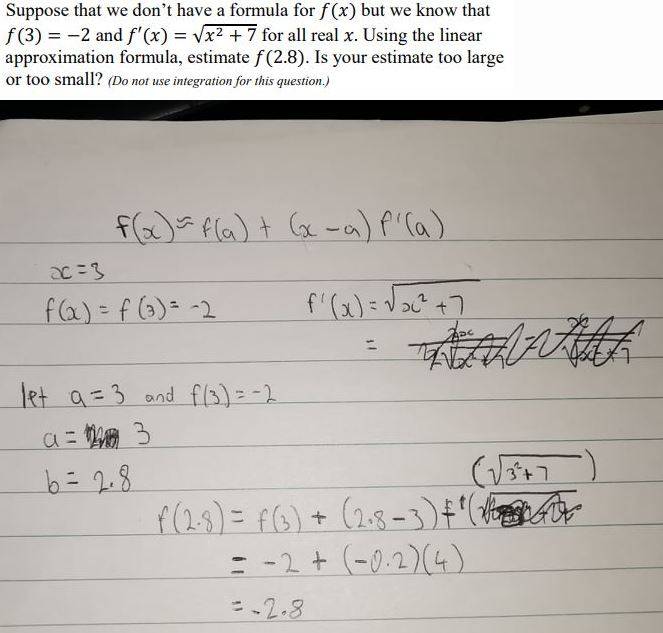
Have I solved this linear approximation question correctly?
Qqq6.JPG
 
Physics news on Phys.org
yes, $f(2.8) \approx -2.8$

now, how to determine if that value is an over or under estimate?
 
skeeter said:
yes, $f(2.8) \approx -2.8$

now, how to determine if that value is an over or under estimate?
To answer the second half do I have to use the formula f'(x)=sqrt(x^2+7) which would mean -2.8 would be approximately equal to 3.852 which is the same as 2.8.
 
jaredjjj said:
To answer the second half do I have to use the formula f'(x)=sqrt(x^2+7) which would mean -2.8 would be approximately equal to 3.852 which is the same as 2.8.

?

The linear approximation is a line tangent to $f(x)$ at the point $(3,-2)$.

What does the sign of $f''(3)$ tell you about the behavior of $f(x)$ at $x=3$ ?
 

Similar threads

  • · Replies 14 ·
Replies
14
Views
2K
  • · Replies 30 ·
2
Replies
30
Views
3K
  • · Replies 3 ·
Replies
3
Views
2K
  • · Replies 2 ·
Replies
2
Views
2K
  • · Replies 1 ·
Replies
1
Views
3K
  • · Replies 1 ·
Replies
1
Views
2K
  • · Replies 3 ·
Replies
3
Views
2K
  • · Replies 12 ·
Replies
12
Views
1K
  • · Replies 8 ·
Replies
8
Views
3K
Replies
2
Views
2K