Linear measurement of a curved part

Click For Summary

Discussion Overview

The discussion revolves around methods for measuring the diameter of a curved part proposed for manufacturing. Participants explore various physical and optical measurement techniques, considering the challenges posed by the curvature of the part.

Discussion Character

  • Technical explanation
  • Debate/contested
  • Experimental/applied

Main Points Raised

  • One participant notes that traditional vernier calipers are inadequate for measuring curved surfaces and inquires about alternative methods.
  • Another suggests using a granite surface plate with a digital height stand or a Coordinate Measurement Machine (CMM) for accurate measurements.
  • A point micrometer is proposed as a potential solution for measuring the diameter at the midpoint of the part.
  • Building a jig to position the part under a Dial Indicator is also mentioned as a viable approach.
  • Concerns are raised about the practicality of using a micrometer due to potential cumbersome handling.
  • A participant questions the necessity of a CMM, suggesting that an optical profilometer could suffice for measuring roughness and diameter.
  • Discussion includes the feasibility of using laser distance sensors for accurate measurements along the edge of the part, with considerations of cost-effectiveness based on production volume.
  • One participant shares their experience with CMMs and optical profilometers, asking for specific dimensions and accuracy requirements needed for the measurement.
  • Another participant describes the part as a round bar with a reduced diameter and suggests the creation of a Go/NoGo profile template for measurement.
  • A later reply details a successful measurement using a profilometer, emphasizing the use of a V block and computer-controlled table for precise positioning.

Areas of Agreement / Disagreement

Participants express a range of opinions on the best measurement techniques, with no consensus reached on a single method. Some advocate for traditional methods like CMMs, while others propose optical solutions or simpler mechanical setups.

Contextual Notes

Participants mention various assumptions regarding the production volume and accuracy requirements, which may influence the choice of measurement method. The discussion reflects uncertainty about the optimal approach given the part's specific geometry.

Who May Find This Useful

Manufacturers, engineers, and quality control professionals interested in measurement techniques for curved parts may find this discussion relevant.

vin300
Messages
602
Reaction score
4
Below is a part proposed to be manufactured. The inspection of this part poses a problem, because vernier callipers only measure distances between parallel surfaces.
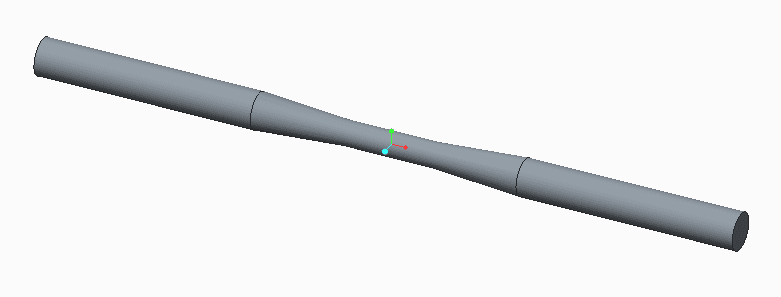
3d.PNG
I know there is some photographic method of measuring distances, however I would like to know is there no way of physically measuring the diameter along the curvature.
 

Attachments

  • 3d.PNG
    3d.PNG
    3.4 KB · Views: 877
Engineering news on Phys.org
classic method would be an open set up using granite surface plate and a digital height stand to measure various points along the long axis. Coordinate measurement machine is the typical solution. google CMM.
 
  • Like
Likes   Reactions: Asymptotic
If you just want to measure the diameter in the middle, you could use a point micrometer:
upload_2018-3-18_17-35-34.png
 

Attachments

  • upload_2018-3-18_17-35-34.png
    upload_2018-3-18_17-35-34.png
    43.4 KB · Views: 562
Build a jig to keep the product directly under a Dial Indicator .

g9849-4601194499897ab30da5db941816d63b.jpg
 

Attachments

  • g9849-4601194499897ab30da5db941816d63b.jpg
    g9849-4601194499897ab30da5db941816d63b.jpg
    21.6 KB · Views: 562
Thanks. I'll have to enquire about the feasibility of these methods. I think using the micrometer would be cumbersome.
 
Are you manufacturing hundreds of these parts? And would they all need to be measured for accuracy? If so then then a Tom.G suggested, having some kind of jig built would be my suggestion, though I would use two laser distance sensors to give an accurate thickness, or in this case diameter, in this case I assume you would have to make multiple measurements along the edge. The cost of such a setup would only really be feasible if you are producing enough quantities to justify, also greater accuracy = greater price.
 
I'm being told the CMM isn't absolutely necessary, an optical profilometer that is used to measure roughness would do fine. I'm about to find out soon if it does.
Tolklein said:
Are you manufacturing hundreds of these parts? And would they all need to be measured for accuracy? If so then then a Tom.G suggested, having some kind of jig built would be my suggestion, though I would use two laser distance sensors to give an accurate thickness, or in this case diameter, in this case I assume you would have to make multiple measurements along the edge.
It is a large quantity but I'm only going to inspect some samples.
In the beginning I had mentioned physical measurement, but I'm seeing what works.
 
Last edited:
i have sold cmms since 1980 and was product manager for the original Profilometer. patented product.
what dimensions do you need to measure and to what accuracy?
it total measurement time a consideration?
 
It looks to me like a round bar is machined to a reduced diameter over a length near the centre, with a conical transition on either side.
I see no reason why a Go/NoGo profile template cannot be made. Exactly what shape it it?
What is the material, is it machined in a lathe or injection moulded? How about putting some dimensions on it.
 
  • #10
Done. They were skeptical at first. Then one person used the profilometer. The bar was kept on a V block over the device table. The table could be controlled by a computer and joystick on two axes. By taking reference of the end face, diameter at any distance was measured by focusing the image.
Baluncore said:
It looks to me like a round bar is machined to a reduced diameter over a length near the centre, with a conical transition on either side.
It is not conical but circular.
 

Attachments

  • Like
Likes   Reactions: Tom.G

Similar threads

Replies
11
Views
2K
  • · Replies 8 ·
Replies
8
Views
1K
Replies
2
Views
901
  • · Replies 10 ·
Replies
10
Views
2K
  • · Replies 4 ·
Replies
4
Views
4K
  • · Replies 1 ·
Replies
1
Views
2K
  • · Replies 11 ·
Replies
11
Views
1K
  • · Replies 29 ·
Replies
29
Views
3K
  • · Replies 12 ·
Replies
12
Views
3K
  • · Replies 13 ·
Replies
13
Views
3K