Lower and Upper bound proof in R

Click For Summary
SUMMARY

The discussion centers on the proof regarding lower and upper bounds in real numbers, specifically addressing the assertion that there are 10 numbers sharing the same kth digit as a given number x. This conclusion is derived from the properties of decimal representation in base 10, which inherently allows for 10 distinct digits (0-9) at each positional value. The participants emphasize the importance of understanding this base 10 system to grasp the proof fully.

PREREQUISITES
  • Understanding of base 10 numeral system
  • Familiarity with concepts of lower and upper bounds in mathematics
  • Basic knowledge of real number properties
  • Ability to interpret mathematical proofs
NEXT STEPS
  • Explore the properties of decimal representation in base 10
  • Study examples of lower and upper bounds in real analysis
  • Learn about the significance of positional notation in number systems
  • Review mathematical proof techniques and structures
USEFUL FOR

Mathematics students, educators, and anyone interested in understanding proofs related to real numbers and their properties in the context of base 10 systems.

MotoPayton
Messages
96
Reaction score
0
I am getting lost in the proof in the 5th line when it says there are 10 numbers that have the same kth digit as x. Why 10? I don't understand where this number is coming from and it doesn't seem arbitrary.
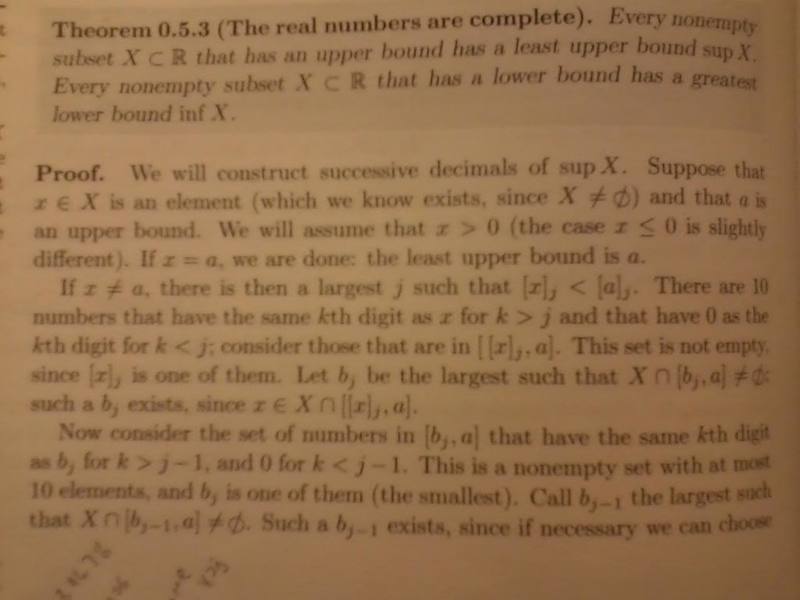
0306132311a.jpg

the rest of the proof
http://i603.photobucket.com/albums/tt113/KtmPayton/0306132314.jpg
 
Physics news on Phys.org
From the fact that the decimal expression is in base 10.
Walk through the proof with a specific example.
 

Similar threads

  • · Replies 2 ·
Replies
2
Views
2K
Replies
11
Views
3K
Replies
4
Views
4K
  • · Replies 8 ·
Replies
8
Views
5K
  • · Replies 1 ·
Replies
1
Views
2K
  • · Replies 4 ·
Replies
4
Views
3K
  • · Replies 8 ·
Replies
8
Views
2K
Replies
22
Views
13K
  • · Replies 0 ·
Replies
0
Views
4K
  • · Replies 4 ·
Replies
4
Views
7K