Masonary Wall Design for water tank

Click For Summary

Discussion Overview

The discussion revolves around the design considerations for a masonry wall used in constructing an above-ground rectangular water tank with a capacity of approximately 25 m3. Participants explore the feasibility, economic implications, and structural integrity of using masonry versus reinforced concrete (RCC) in the tank's construction, including potential hybrid designs.

Discussion Character

  • Exploratory
  • Technical explanation
  • Debate/contested
  • Mathematical reasoning

Main Points Raised

  • Some participants inquire about design resources for masonry wall construction specific to water tanks.
  • There is a discussion on whether masonry alone is economical for the tank size proposed, or if RCC becomes necessary above a certain dimension.
  • Participants suggest the possibility of a hybrid design using reinforced concrete columns with masonry wall sections.
  • One participant emphasizes that the dimensions of the tank significantly affect the construction approach, noting differences between various tank dimensions.
  • Another participant raises the question of whether the tank will be free-standing or partially buried, indicating that both options are acceptable as long as most of the tank remains above ground.
  • There is a consideration of using a tamped earth bund for additional support around the tank.
  • Concerns are raised about the structural integrity of masonry under hydrostatic loading, with some participants noting that masonry is strong in compression but weak in tension.
  • It is mentioned that many tanks, particularly those below ground, typically incorporate re-bar to prevent flexing of the walls.

Areas of Agreement / Disagreement

Participants express various viewpoints on the feasibility and design of the tank, with no consensus reached on whether masonry alone is sufficient or if reinforced concrete is necessary. The discussion remains unresolved regarding the optimal design approach.

Contextual Notes

Participants highlight the importance of dimensions and structural considerations, but there are unresolved assumptions regarding load-bearing capabilities and the specific design requirements for the proposed tank.

rollingstein
Messages
644
Reaction score
16
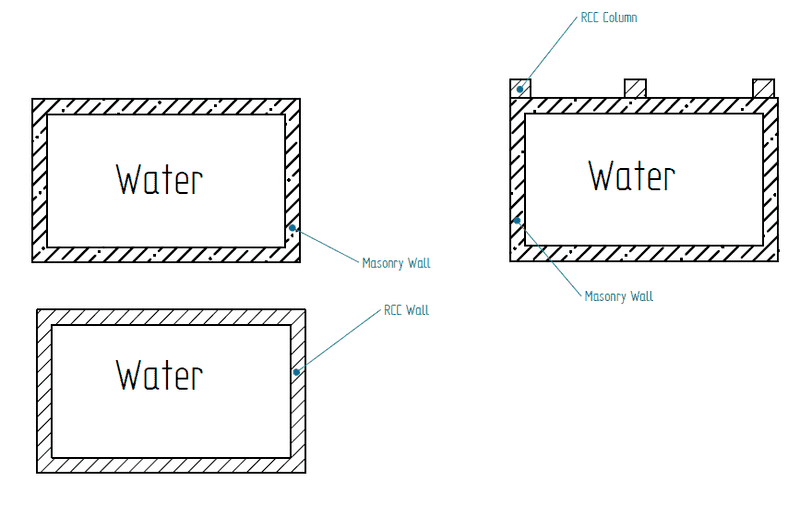
Are there any good design resources on masonary wall design? Specifically, I was considering an above-ground, open-to-sky, rectangular tank storing approx. 25 m3 of water in it.

Is it possible / economical to build such a tank out of masonary alone or does an RCC construction become economical above a certain size? Is there a hybrid design possible with reinforced concrete columns with masonary wall sections spanning the area between vertical columns?
mlmmxpC.png


PS. Note that the final design will be done and approved by a certified civil engineer but I only wanted a preliminary design estimate at the moment for costing & initial design purposes.
 
Last edited:
Engineering news on Phys.org
rollingstein said:
Are there any good design resources on masonary wall design? Specifically, I was considering an above-ground, open-to-sky, rectangular tank storing approx. 25 m3 of water in it.

Is it possible / economical to build such a tank out of masonary alone or does an RCC construction become economical above a certain size? Is there a hybrid design possible with reinforced concrete columns with masonary wall sections spanning the area between vertical columns?

mlmmxpC.png


PS. Note that the final design will be done and approved by a certified civil engineer but I only wanted a preliminary design estimate at the moment for costing & initial design purposes.
Just eyeballing this project, with no civil engineering experience whatsoever, the construction of this tank is going to depend on the dimensions to a certain extent. The construction of a tank which measures 1m tall by 5 m wide by 5 m long is going to be somewhat different from a tank which is 1 m wide by 1 m long by 25 m tall.

Is this tank supposed to be free-standing, or will it be partially or completely buried in the earth?
 
Hmmm... 1 m x 5 m x 5 m, open to air, full of water... Hmmmm...

Think. Think. Think. I've seen one of these someplace before. Hmm... But the memory seems to be clouded by a diving board and some lawn furniture.
 
  • Like
Likes   Reactions: billy_joule
DEvens said:
Hmmm... 1 m x 5 m x 5 m, open to air, full of water... Hmmmm...

Think. Think. Think. I've seen one of these someplace before. Hmm... But the memory seems to be clouded by a diving board and some lawn furniture.
Even a lot of those "tanks" have reinforced construction ...
 
SteamKing said:
Is this tank supposed to be free-standing, or will it be partially or completely buried in the earth?

Both options are OK so long as a majority of the tank is above ground.

I was also considering a third option: Above ground with a tamped Earth bund all around it for support.

srBQxMi.png
 
SteamKing said:
Even a lot of those "tanks" have reinforced construction ...

Exactly. The idea is to see if the reinforced concrete can be either eliminated or at least reduced to its use for columns alone.

Basically, just like a house can be built on load bearing columns with the floor structure transmitting their load to the columns is a similar design possible for a tank wall? Can a masonry span transmit its load to periodic columns?
 
SteamKing said:
The construction of a tank which measures 1m tall by 5 m wide by 5 m long is going to be somewhat different from a tank which is 1 m wide by 1 m long by 25 m tall.

You are right.

I'd prefer a somewhat long tank rather than a square one for this purpose.

Something like a 6 x 2 by 2.5 tall (To allow some free-board without spillage over the top the total volume could be 30 m2 with a 25 m2 of actual water)
 
rollingstein said:
Exactly. The idea is to see if the reinforced concrete can be either eliminated or at least reduced to its use for columns alone.

Basically, just like a house can be built on load bearing columns with the floor structure transmitting their load to the columns is a similar design possible for a tank wall? Can a masonry span transmit its load to periodic columns?

Like concrete, masonry is good in compression, not so good in tension. Due to the nature of the hydrostatic loading on the masonry walls, even if columns are used, you can expect bending to occur between the columns and tensile loadings in the stone on the outside.

From what I understand, most pools built below ground use some type of re-bar to prevent the sides from flexing.
 

Similar threads

  • · Replies 2 ·
Replies
2
Views
6K
  • · Replies 2 ·
Replies
2
Views
2K
  • · Replies 15 ·
Replies
15
Views
6K
  • · Replies 4 ·
Replies
4
Views
9K