Math Manipulation: Why Does l Approach Infinity?

  • Thread starter Thread starter sparkle123
  • Start date Start date
  • Tags Tags
    Manipulation
Click For Summary
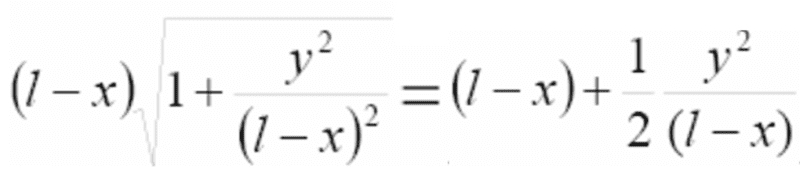
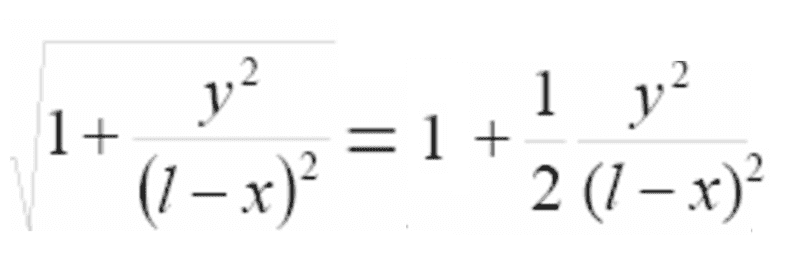
The discussion focuses on the behavior of the function as l approaches infinity, particularly in relation to the Taylor series expansion of sqrt(1+r). It explains that for small values of r, the approximation sqrt(1+r) ≈ 1 + r/2 becomes increasingly accurate as l increases. As l approaches infinity, the term y^2/(l-x)^2 diminishes, leading to a better approximation of the function. Participants are encouraged to test this with progressively smaller values of x to observe the convergence. The conversation emphasizes the mathematical principles behind these approximations and their implications as l approaches infinity.
sparkle123
Messages
172
Reaction score
0
Why does
86072215.png

when l approaches infinity?
This would mean that
ef174ec5.png
but I don't understand why that would be true.
Thanks!
 
Physics news on Phys.org
sqrt(1+r)=1+r/2-r^2/8+... That's the Taylor series expansion of sqrt(1+r). If r is small, then 1+r/2 is a good approximation. And as l->infinity then y^2/(l-x)^2 becomes very small. The sides aren't equal for any finite l. But the approximation becomes better and better as l->infinity.
 
Try it: Calculate the square root of 1+x with smaller and smaller x-values. For example, √1.2=1.095, √1.02=1.0099, √1.002=1.000999...

\sqrt{1+x} \approx 1+x/2

ehild
 
Thank you Dick and ehild! :)
 

Similar threads

Replies
11
Views
2K
  • · Replies 4 ·
Replies
4
Views
1K
  • · Replies 6 ·
Replies
6
Views
2K
  • · Replies 14 ·
Replies
14
Views
2K
  • · Replies 9 ·
Replies
9
Views
2K
Replies
9
Views
1K
  • · Replies 9 ·
Replies
9
Views
2K
  • · Replies 40 ·
2
Replies
40
Views
6K
  • · Replies 6 ·
Replies
6
Views
1K
  • · Replies 8 ·
Replies
8
Views
2K