Mathematical Structure and Mathematical Space Hierarchies

Click For Summary
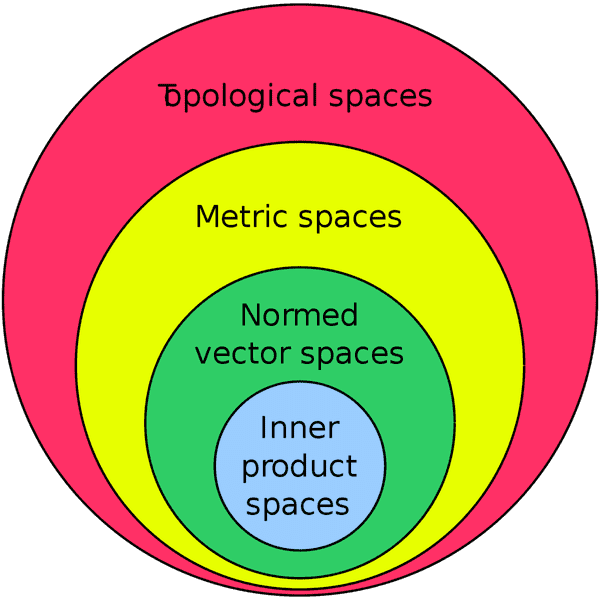
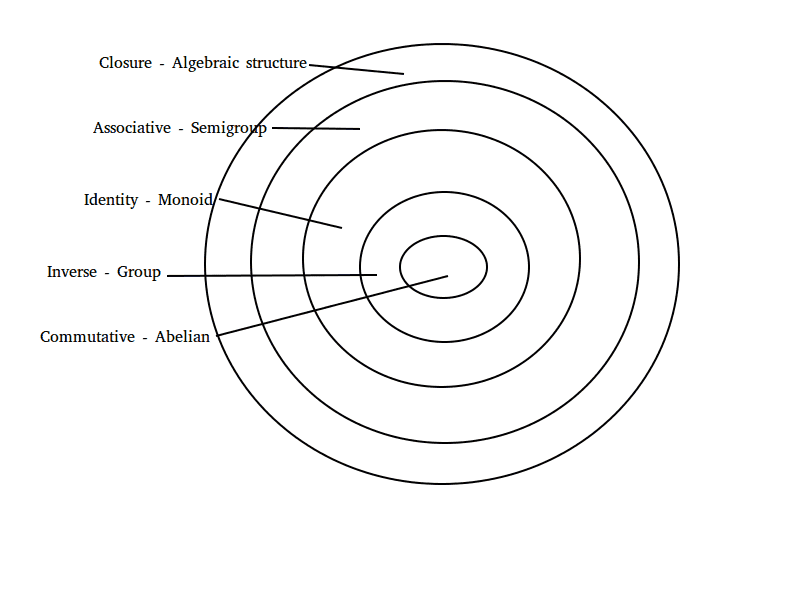
The discussion revolves around understanding the concepts of Mathematical Structure Hierarchy and Mathematical Space Hierarchy, which are not standard mathematical terms but may serve as educational tools to illustrate relationships between mathematical topics. Participants emphasize the importance of knowing the technical definitions behind these concepts, as they represent special cases of broader mathematical ideas. The diagrams referenced are visualizations that show how certain mathematical structures, like inner product spaces and normed vector spaces, relate to each other. Concerns are raised about the accuracy of terms used in the diagrams, highlighting the need for context when discussing algebraic structures. Overall, the conversation seeks clarity on the purpose and validity of these hierarchies in mathematics.
pairofstrings
Messages
411
Reaction score
7
Hi.
I am trying to understand the images that I have posted below.
space-hierarchy_zpsuchrw0k0.png


structure-hierarchy_zpszgf98yie.png

Each layer of Mathematical Structure Hierarchy in the image in this post and Mathematical Space Hierarchy in the image in this post are: statements.
1. What do these statements of each layer of these hierarchies in the images in this post let's me do?
2. Do these statements let's me build something?
3. What if there is no Mathematical Structure Hierarchy and Mathematical Space Hierarchy?
4. Why did somebody create Mathematical Structure Hierarchy and Mathematical Space Hierarchy?
5. Do these Mathematical Structure and Mathematical Space Hierarchies exist to describe something?
6. Why each layer of Mathematical Structure Hierarchy and Mathematical Space Hierarchy be in the order as they are shown in the images above? Can they be jumbled?

I have asked these questions to know what Mathematical Space Hierarchy is and what Mathematical Structure Hierarchy is.

- Trying to connect dots.

Thanks!
 

Attachments

  • space-hierarchy_zpsuchrw0k0.png
    space-hierarchy_zpsuchrw0k0.png
    18.6 KB · Views: 1,811
  • structure-hierarchy_zpszgf98yie.png
    structure-hierarchy_zpszgf98yie.png
    14.9 KB · Views: 2,212
Mathematics news on Phys.org
pairofstrings said:
Hi.
I am trying to understand the images that I have posted below.
Where did you find these diagrams?

Have you studied the definitions of the things presented in the diagrams? The concepts of "Mathematical Space Hierarchy" and "Mathematical Structure Hierarchy" are not standard concepts of mathematics. They may be concepts invented by someone in field of mathematics education in order to give an overview of mathematical topics.

If you have studied the mathematical definitions of the things presented in the diagram, you should see that each thing is a special case of the other things that contain it. To understand why that is so, you need to know the technical definitions of each of the things.

The things in the diagrams are important mathematical concepts because they have theoretical and practical uses. Historically, each of the concepts was developed without any reference to a "Mathematical Space Heirarchy" or "Mathematical Structure Heirarchy".
 
  • Like
Likes pairofstrings
Stephen Tashi said:
Where did you find these diagrams?

They used to live in Wikipedia's "Space" and "Structure" pages.
 
They are equivalent to statements like "every inner product space is a normed vector space" and so on. Just a graphical visualization. The set of inner product spaces is a subset of the set of normed vector spaces.

If you can show something is an inner product space then you can apply every theorem for normed vector spaces, every theorem for metric spaces and every theorem for topological spaces as well.
 
While I agree with the first, where there are actual inclusions, I think the second is highly questionable. "algebraic structure" isn't defined without context. It should at least be "binary operation", and "Abelian" is plain wrong, if the word "group" isn't attached to it within the context given. And it is a bit of an arbitrary property in group theoretical considerations. Why not "simple" or "finite"? Abelian refers to the binary operation in question and isn't exclusively related to groups.
 
Here is a little puzzle from the book 100 Geometric Games by Pierre Berloquin. The side of a small square is one meter long and the side of a larger square one and a half meters long. One vertex of the large square is at the center of the small square. The side of the large square cuts two sides of the small square into one- third parts and two-thirds parts. What is the area where the squares overlap?

Similar threads

  • · Replies 1 ·
Replies
1
Views
2K
Replies
2
Views
1K
  • · Replies 2 ·
Replies
2
Views
539
  • · Replies 10 ·
Replies
10
Views
2K
  • · Replies 12 ·
Replies
12
Views
3K
  • · Replies 1 ·
Replies
1
Views
2K
  • · Replies 3 ·
Replies
3
Views
2K
  • · Replies 5 ·
Replies
5
Views
2K
  • · Replies 12 ·
Replies
12
Views
2K
  • · Replies 2 ·
Replies
2
Views
2K