Mathematically expressing field driven water autoionization

  • Thread starter Thread starter HelloCthulhu
  • Start date Start date
  • Tags Tags
    Field Water
Join the discussion
Ask a follow-up here, or get your own question answered by working scientists, mathematicians and engineers — people, not an autocomplete.
Real named experts · corrections over time · the nuance an AI answer skips
5 replies · 2K views
HelloCthulhu
Messages
150
Reaction score
3
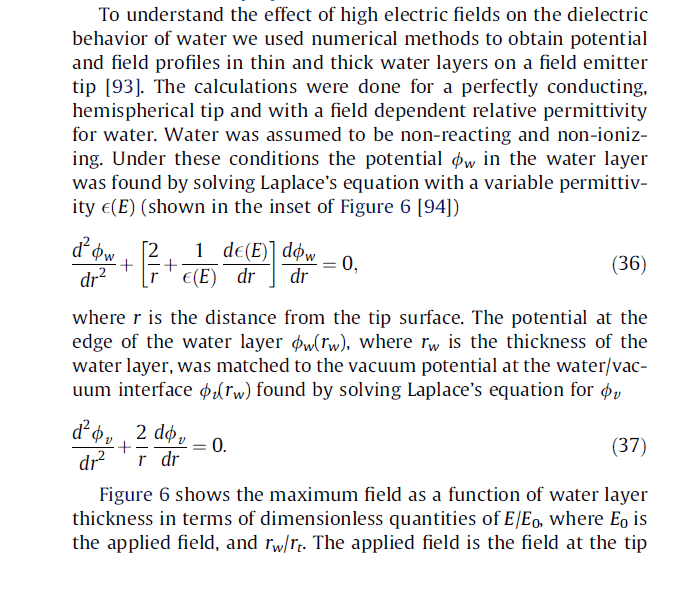
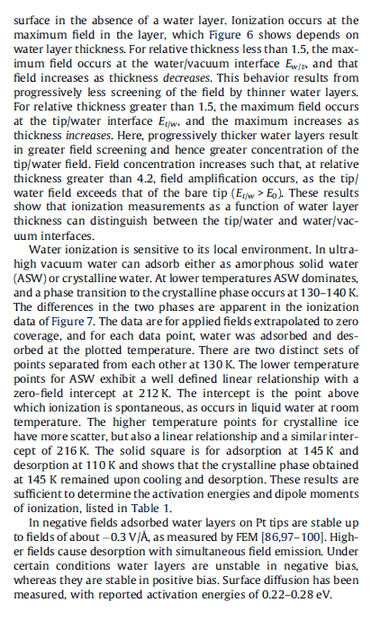
I recently read a paper on using an electric field to drive water autoionizaton. I'm trying to figure out how to use the Laplace equation on pg 9; 4th paragraph; to solve for voltage. I'm also interested in how this equation would change if I replaced the hemispherical tip with a parallel plate. Anyone strongly familiar with this subject matter? Any help is greatly appreciated!
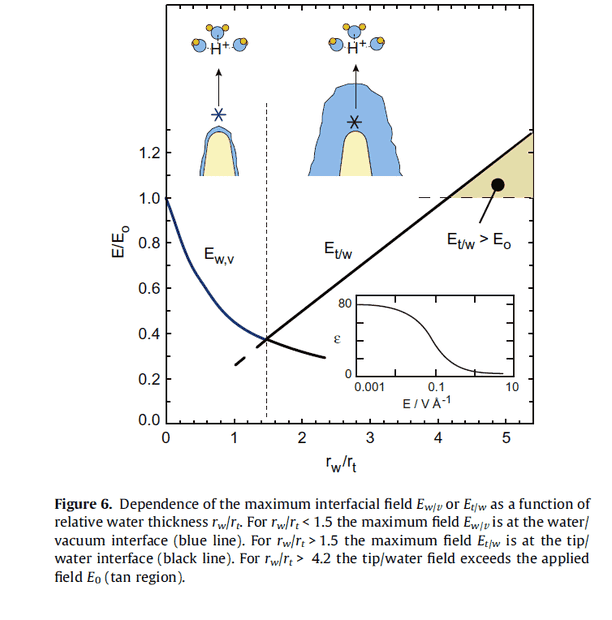
fig 6.png
maths.png
data.png


https://www.sciencedirect.com/science/article/abs/pii/S0009261411011511
 
Chemistry news on Phys.org
I haven’t run through the math specifically, but it’ll be the Poisson equation no matter what, but the boundary conditions will change. So for parallel plates, you’ll want to look at the Laplacian in Cartesian coordinates instead of spherical coordinates as your starting point.
 
Reply
  • Like
Likes   Reactions: HelloCthulhu
Thank you for the response! I still have some questions about the variables. I know how to use Figure 6 to find the values for maximum interfacial field Ew/v or Et/w and water thickness rw/rt, but I'm still not sure what to do with (E), d, or how to solve for ϕw or ϕv.

maths 2.png


In the end, all I'm really trying to figure out is what the electric the field between the molecules and the electrode has to be in order to cause water to ionize. Some of the fundamentals seem comparative to Paschen's Law (Electric Field = voltage x distance). As for adjusting that equation for parallel plates I think I've found an explanation on what it should look like, but I'm still far too ignorant about electrostatics for it to make any real sense to me yet. Thank you for your input so far, I hope you can continue to help me with this.

http://jsa.ece.illinois.edu/ece329/notes/329lect07.pdf
 
It’s unclear how much background knowledge you have and if this problem is at the right level for you. For instance, I don’t see a ##d## being used as a variable in any of these images. The only ##d##’s I see denote derivatives.

To get the potential (aka the voltage), you would solve the Poisson/Laplace equation for ##\phi##, given the appropriate boundary conditions. I doubt there’s an analytical way to do it without a really simple functional form for ##\epsilon(E)##, but it should be possible to write a code to get a numerical solution. To get the electric field, you take the gradient of the potential (assuming the system is time-invariant).
 
Reply
  • Like
Likes   Reactions: HelloCthulhu
TeethWhitener said:
It’s unclear how much background knowledge you have and if this problem is at the right level for you. For instance, I don’t see a d being used as a variable in any of these images. The only d’s I see denote derivatives.
It's far beyond anything I have experience with. I've solved derivatives in the past, but wasn't familiar with second derivatives. To be honest, I'm in way over my head on these subjects. But even so I'd like to keep working on trying to understand them. Thank you so much for your help.
 
HelloCthulhu said:
It's far beyond anything I have experience with. I've solved derivatives in the past, but wasn't familiar with second derivatives. To be honest, I'm in way over my head on these subjects. But even so I'd like to keep working on trying to understand them. Thank you so much for your help.
I would advise you to learn single and multivariable calculus as well as vectors before trying to tackle E&M.
 
Reply
  • Like
Likes   Reactions: HelloCthulhu