Mathematics to understand Quantum Scattering Theory

Click For Summary
SUMMARY

The discussion centers on the mathematical prerequisites for understanding Quantum Scattering Theory, particularly in relation to David Griffith's "Introduction to Quantum Mechanics." Participants recommend several key texts, including "Mathematical Methods for Physicists" by Boas and Arfken, as well as Taylor's and Merzbacher's works, which provide necessary mathematical foundations. The importance of mastering vector calculus, complex variables, and Green's functions is emphasized, as these concepts are crucial for grasping scattering theory. Additionally, the discussion highlights the varying levels of mathematical rigor in different textbooks, suggesting that students should choose resources that align with their current understanding.

PREREQUISITES
  • Vector Calculus (div, grad, curl)
  • Complex Variables
  • Green's Functions
  • Partial Differential Equations (PDE)
NEXT STEPS
  • Study "Mathematical Methods for Physicists" by Boas and Arfken
  • Read "Quantum Mechanics" by Merzbacher for advanced treatment of scattering
  • Explore "Scattering Theory" by Taylor for functional analysis applications
  • Investigate "Messiah's Lectures on Quantum Mechanics" for a comprehensive approach to scattering
USEFUL FOR

Students of physics, particularly those in their third and fourth years, as well as anyone seeking to deepen their understanding of Quantum Scattering Theory and its mathematical foundations.

bignsud
Messages
1
Reaction score
0
Homework Statement:: Mathematics to understand Quantum Scattering Theory
Relevant Equations:: Suitable math book to understand Quantum Scattering Theory

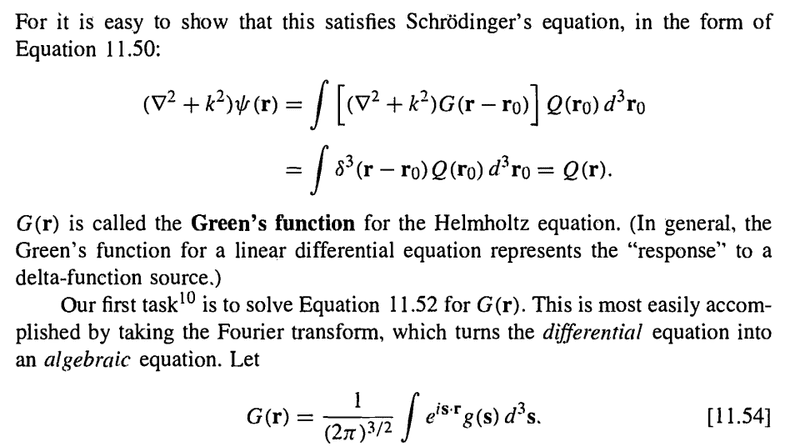
I need to study Scattering theory from Introduction to Quantum Mechanics by David Griffith. But I think I need to study mathematics first because I only studied: Basic Mathematics, Algebra and Geometry, Calculus, and Differential Equations. I need to study some math but I do not know what book will be suitable for me and what chapters I must study. please help me with some recommendations. Thanks.
sddd.png
 
Physics news on Phys.org
A book on mathematical methods for physicists would probably be the best choice. Two common choices are Arfken and Boas.

I moved the thread since you're asking for book recommendations rather than help on the problem itself.
 
  • Like
Likes dextercioby and vanhees71
I would recommend Taylor's Scattering theory. He covers the small additional amount of functional analysis needed to describe scattering theory but wouldn't be covered in a typical QM course. It's also very well-written and clear in general.
 
  • Like
Likes vanhees71
Merzbacher, Quanum Mechanics treats scattering in a similar way to the treatment in Griffith you presented. Merzbacher is mostly a graduate textbook, as are Boas (already mentioned) and Arfken/Weber (already mentioned). Griffith has aimed at undergraduates in the third and fourth year, and slipped in mathematics which may not be taken yet. The courses you mention are generally from the first two years.
The Green's function derivation in the book Merzbacher uses Complex Variables. This is usually put in a 3rd or 4th year undergrad curriculum in physics, and is not one of the courses you mentioned. I used Saff and Snider for Complex Variables (undergrad) and Copson (graduate), but there are many other textbooks.
 
Another good treatment of scattering theory is also in Messiah and, of course, Weinberg's Lectures on Quantum Mechanics.

I'm not so sure about Griffith's quatnum textbook. I've the impression that whenever a student is confused about some mathematical aspect of QT in this forums it's due to this book ;-)). SCNR.
 
mpresic3 said:
Merzbacher, Quanum Mechanics treats scattering in a similar way to the treatment in Griffith you presented. Merzbacher is mostly a graduate textbook, as are Boas (already mentioned) and Arfken/Weber (already mentioned).
Both Boas and Arfken are intended for, among others, physics majors in their third and fourth years. Boas, in particular, "is intended for students who have had a two-semester or three-semester introductory calculus course" (from the description on Amazon).
 
  • Like
Likes PhDeezNutz and vanhees71
vela said:
Both Boas and Arfken are intended for, among others, physics majors in their third and fourth years. Boas, in particular, "is intended for students who have had a two-semester or three-semester introductory calculus course" (from the description on Amazon).
When I was at Virginia, I think I remember Weber teaching graduate Mathematical Methods out of Arfken, before his name was associated with the text. I could be wrong though. I have a copy of Boas. I have not read the preface yet to see what the readership was. In any case, maybe Griffith delays writing the chapters in his book for potentially concurrent courses to catch up.
I would be suprised if all off Griffith's undergraduate readership are comfortable with complex variables and Greens functions, generalized functions and Fourier transforms.
 
  • #10
What you need is vector calculus (div grad curl) and basic PDE (in that order). Any of the references mentioned will cover the latter fairly well. Interestingly I learned those things exactly from Griffiths textbook (that was my first time seeing green's function). Anything in there in particular about his explanation you found confusing?

There are quite a few different levels that could be confusing:
- Do you know div/grad/curl?
- Do you know what a Fourier transform is? (If you are reading the scattering chapter I assume you must know position and momentum representation are Fourier transforms of each other? That's covered in earlier chapter of griffiths).

If you know both, the only new concept introduced is that of a green function.
 
  • #11
A very good book for intro scattering theory is Messiah.
 
  • Like
Likes Frabjous

Similar threads

  • · Replies 9 ·
Replies
9
Views
3K
  • · Replies 20 ·
Replies
20
Views
2K
  • · Replies 14 ·
Replies
14
Views
4K
  • · Replies 17 ·
Replies
17
Views
3K
  • · Replies 1 ·
Replies
1
Views
3K
  • · Replies 36 ·
2
Replies
36
Views
4K
  • · Replies 8 ·
Replies
8
Views
4K
  • · Replies 4 ·
Replies
4
Views
2K
  • · Replies 6 ·
Replies
6
Views
4K
  • · Replies 15 ·
Replies
15
Views
1K