[MATLAB] Modeling response of a particle in an anharmonic potential

Click For Summary

Discussion Overview

The discussion revolves around modeling the response of a particle in an anharmonic potential using MATLAB. Participants explore the relationship between potential energy and position, the calculation of the period as a function of energy, and the numerical solution of differential equations related to the system's motion.

Discussion Character

  • Technical explanation
  • Mathematical reasoning
  • Experimental/applied

Main Points Raised

  • One participant seeks to model the response of a particle in an anharmonic potential and asks how to derive a function for the period T as a function of energy E, noting that T is dependent on amplitude.
  • Another participant provides a reference link and inquires if the goal is to plot a potential versus displacement curve.
  • A participant confirms the goal of plotting a potential versus displacement curve and questions the feasibility of this given the complexity of the functions involved.
  • One participant shares MATLAB code attempting to define functions and calculate integrals related to the potential energy.
  • Another participant suggests that plotting position as a function of time might provide more insight and discusses the associated differential equation derived from Lagrangian mechanics.
  • A later reply proposes a method to numerically solve the second-order differential equation by converting it into a system of first-order equations and provides a sample MATLAB function for this purpose.
  • One participant expresses uncertainty about the accuracy of their plot, suggesting it appears more harmonic than anharmonic.

Areas of Agreement / Disagreement

Participants do not reach a consensus on the best approach to model the system or the accuracy of the results, indicating multiple competing views and ongoing uncertainty regarding the modeling process.

Contextual Notes

Participants express concerns about the complexity of the equations and the potential challenges in obtaining a clear model of the particle's response. There are unresolved aspects regarding the assumptions made in the modeling process and the implications of the results obtained.

baouba
Messages
40
Reaction score
0
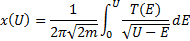
I'm trying to model the response of a particle in an anharmonic potential in MATLAB. I know that writing position, x as a function of potential energy U is,
upload_2015-4-8_16-54-10.png


where T is the period, m is mass, and E is the energy of the system. How would I get a function for T(E) since it's not independent of amplitude obviously. As a starting point, I'm using the anharmonic potential of

upload_2015-4-8_17-0-7.png

Where a and b are constants. Does anybody know how I could program this in matlab?

Thanks
 
Physics news on Phys.org
Yes my goal is to plot a potential vs. displacement curve. Is this even possible considering the number of functions in the first equation above?
Here's some of my code: For simplicity, I assume period T(E) = 1%Define Functions

%For a,b = 1

%U = ax^2 + bx^3

%Assuming T(E) = 1
U = @(x) x^2+x^3

fun = @(E,U) T/(sqrt(U-E))^-1

int = @(E) integral(fun,0,U)

ezplot('(-x+(sqrt(2)*2*pi)^-1)*int')
 
I think something like this is a step closer, but I'm not convinced it's correct yet.

Code:
a=1;
b=1;
T=1;
U = @(x) a*x.^2 + b*x.^3;
A = (2*pi*sqrt(2))^-1;
I = [];

for n =0:0.1:10
  fun = @(E) T./(sqrt(U(n)-E));
  I = [I, A*integral(fun,0,U(n))];
end

plot(0:0.1:10, I)

The difference here is that I loop through possible values for U and evaluate the integral once for each one.
 
Thank you I'll try it. I'm wondering if it would be more beneficial/ shed more light if I plotted x as a function of time. In that case I solved lagrange
L = K - U = .5mv^2 - x^2 - x^3 since U = x^2 + x^3
the associated equation of motion is then ma = -3x^2 - 2x
I would then need to solve this differential equation to plot x(t). However I put this equation into wolfram alpha, and got a massive expression out and it makes me thing that it might not be possible to model this response.

Is this the case?
 
You can solve the second order differential equation numerically in MATLAB. Since the ODE functions only work with first order equations, you'll have to rewrite this second order equation

[tex] m \frac{d^2 x}{dt^2} = -3x^2-2x[/tex]

As an equivalent system of first order equations,

[tex] m \dot{y_2} = -3y_1^2-2y_1[/tex]
[tex] y_2 = \dot{x}[/tex]
[tex] y_1 = x[/tex]

You'll also need to define the initial conditions of the problem.

Take a look at the examples here:
http://www.mathworks.com/help/matlab/ref/ode45.html

Save the following function file, which defines the equations above (assume m=1):
Code:
function dy = anharmonic(t,y)
  dy = zeros(2,1);
  dy(1) = y(2);
  dy(2) = -3*y(1).^2 - 2*y(1);
end

Then set the time span and initial conditions before calling ode45:
Code:
tspan = [0 15];
y0 = [0; 0.25];
[t,y] = ode45(@anharmonic, tspan, y0);
plot(t,y(:,1),t,y(:,2))
legend('Position','Velocity')

?temp_hash=9239f5d362fbcfce69e50037841c7f57.png


You might want to check my work, because the plot looks more harmonic than anharmonic to me.
 

Attachments

  • anharmonic.png
    anharmonic.png
    10.5 KB · Views: 743
Last edited:

Similar threads

  • · Replies 2 ·
Replies
2
Views
4K
Replies
3
Views
2K
  • · Replies 6 ·
Replies
6
Views
4K
  • · Replies 2 ·
Replies
2
Views
3K
  • · Replies 5 ·
Replies
5
Views
4K
  • · Replies 1 ·
Replies
1
Views
3K
  • · Replies 6 ·
Replies
6
Views
4K
  • · Replies 8 ·
Replies
8
Views
3K
  • · Replies 4 ·
Replies
4
Views
3K
  • · Replies 2 ·
Replies
2
Views
2K