[Matlab] Simulation of Stochastic Process

Join the discussion
Ask a follow-up here, or get your own question answered by working scientists, mathematicians and engineers — people, not an autocomplete.
Real named experts · corrections over time · the nuance an AI answer skips
3 replies · 3K views
FrancescoMi
Messages
5
Reaction score
0
Hi all,
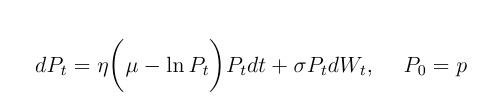
I have this dynamic:
2vwuyph.png

is a Mean Reverting process. I want to simulate the sde with MATLAB but I am a beginner and I have some problems. I show you the code that I have created:

Code:
%% Simulazione prezzo Geometric Ornstein-Ulenbeck

clear all
clc

%Parameters
mu = 0.5;
sigma = 0.12;
eta = 1;
T = 2;
N_t = 300; %Temporal Intervals
N = 1000; %Number of Simulations
t=linspace(0,T,N_t); %Temporal line

dt=T/N_t; %Temporal increments
P_t=zeros(N,N_t); 
P_t(:,1)=20; %First Price

%Model
for i=1:N
    for j=2:N_t
        dW = randn;
        P_t(i,j) = P_t(i,j-1) + eta*(mu-log(P_t(i,j-1)))*P_t(i,j-1)*dt+sigma*P_t(i,j-1)*dW;
    end
end

plot(t,P_t(1,:));

But I don't know if it is correct. Can you help me?
 
Physics news on Phys.org
kreil said:
The code seems to run fine and the plot looks reasonable. Is there some reason that you think it is wrong?

Because is my first work alone and I'm not sure of the cicle. Do you think it's ok?
 
It is not OK. The discretization of the Wiener increment is wrong. Here is the first link that I could find that explains how to do it correctly in Matlab:

http://www.caam.rice.edu/~cox/stoch/dhigham.pdf

To summarize: [itex]dW \approx \sqrt(dt)N(0,1)[/itex], so you forgot to multiply your dW by the square root of dt.

Also, the wikipedia entry for the first order scheme has some example code for exactly this problem:
http://en.wikipedia.org/wiki/Euler–Maruyama_method

Note that this is a first order discretization, there are also higher order methods that you can find in the literature, e.g. in the book of Kloeden and Platen. I highly recommend this book if you want to numerically solve stochastic differential equations. The basic idea of these methods comes from Ito calculus and the idea of stochastic Taylor expansion.