Undergrad Matrix Rings - Basic Problem with Meaning of Notation

Click For Summary
The discussion revolves around interpreting the notation and rules in Louis Rowen's "Ring Theory," specifically regarding matrix multiplication and the notation for matrix units. Participants clarify that the symbols r1 and r2 represent arbitrary scalars from a ring R, serving as coefficients for matrix elements expressed in terms of matrix units eij. The multiplication rule (r1 eij)(r2 euv) = δju (r1 r2) eiv is explained as a way to compute products of matrices using the distributive property. An example using specific matrices illustrates how to apply this rule, emphasizing the importance of understanding matrix representation in terms of the basis formed by eij. Overall, the conversation highlights the nuances of notation in matrix algebra and the relationship between scalars and matrix entries.
Math Amateur
Gold Member
MHB
Messages
3,920
Reaction score
48
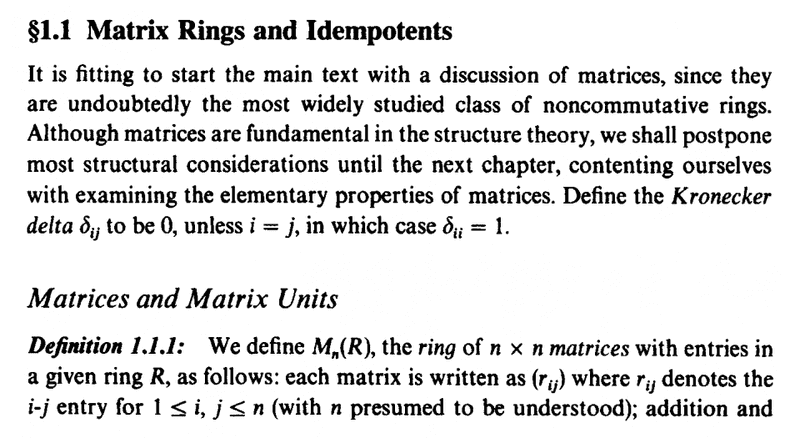
I am reading Louis Rowen's book, "Ring Theory" (Student Edition) ...

I have a problem interpreting Rowen's notation in Section 1.1 Matrix Rings and Idempotents ...

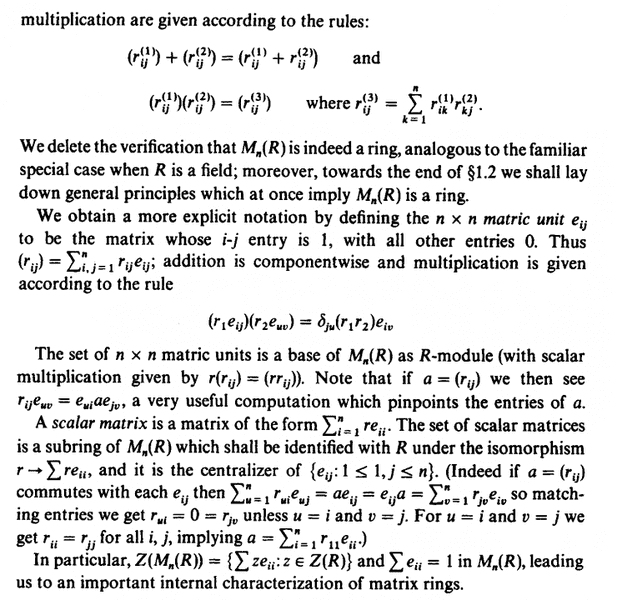
The relevant section of Rowen's text reads as follows:
?temp_hash=20c8a6acef6aba85cccfabc4dc6aef01.png

?temp_hash=20c8a6acef6aba85cccfabc4dc6aef01.png


In the above text from Rowen, we read the following:

" ... ... We obtain a more explicit notation by defining the ##n \times n## matric unit ##e_{ij}## to be the matrix whose ##i-j## entry is ##1##, with all other entries ##0##.

Thus ##( r_{ij} ) = \sum_{i,j =1}^n r_{ij} e_{ij}## ; addition is componentwise and multiplication is given according to the rule

##( r_1 e_{ij} ) ( r_2 e_{uv} ) = \delta_{ju} (r_1 r_2) e_{iv}##

... ... ... "
I am having trouble understanding the rule ##( r_1 e_{ij} ) ( r_2 e_{uv} ) = \delta_{ju} (r_1 r_2) e_{iv}## ... ...

What are ##r_1## and ##r_2## ... where exactly do they come from ...

Can someone please explain the rule to me ...?

To take a specific example ... suppose we are dealing with ##M_2 ( \mathbb{Z} )## and we have two matrices ...##P = \begin{pmatrix} 1 & 3 \\ 5 & 4 \end{pmatrix}##and ##Q = \begin{pmatrix} 2 & 1 \\ 3 & 3 \end{pmatrix}## ...In this specific case, what are ##r_1## and ##r_2## ... ... and how would the rule in question work ...?Hope someone can help ...

Peter
 

Attachments

  • Rowen - 1 - Matrix Rings - Section 1.1 - PART 1.png
    Rowen - 1 - Matrix Rings - Section 1.1 - PART 1.png
    39.7 KB · Views: 1,279
  • Rowen - 2 - Matrix Rings - Section 1.1 - PART 2  ... ... .png
    Rowen - 2 - Matrix Rings - Section 1.1 - PART 2 ... ... .png
    54.3 KB · Views: 807
Last edited:
Physics news on Phys.org
Math Amateur said:
" ... ... We obtain a more explicit notation by defining the ##n \times n## matric unit ##e_{ij}## to be the matrix whose ##i-j## entry is ##1##, with all other entries ##0##.

Thus ##( r_{ij} ) = \sum_{i,j =1}^n r_{ij} e_{ij}## ; addition is componentwise and multiplication is given according to the rule

##( r_1 e_{ij} ) ( r_2 e_{uv} ) = \delta_{ju} (r_1 r_2) e_{iv}##

... ... ... "
I am having trouble understanding the rule ##( r_1 e_{ij} ) ( r_2 e_{uv} ) = \delta_{ju} (r_1 r_2) e_{iv}## ... ...
What are ##r_1## and ##r_2## ... where exactly do they come from ...
Can someone please explain the rule to me ...?

To take a specific example ... suppose we are dealing with ##M_2 ( \mathbb{Z} )## and we have two matrices ...
##P = \begin{pmatrix} 1 & 3 \\ 5 & 4 \end{pmatrix}##
and ##Q = \begin{pmatrix} 2 & 1 \\ 3 & 3 \end{pmatrix}## ...

In this specific case, what are ##r_1## and ##r_2## ... ... and how would the rule in question work ...?Hope someone can help ...

Peter
In this case, ##r_1## and ##r_2## are simply two arbitrary scalars, i.e. elements of ##R##.
I wished you would have chosen an example with more zeros ...
So here we go:

##P = 1 \cdot e_{11}+ 3 \cdot e_{12} + 5 \cdot e_{21} + 4 \cdot e_{22}## and ##Q = 2 \cdot e_{11}+ 1 \cdot e_{12} + 3 \cdot e_{21} + 3 \cdot e_{22}## or

$$P= 1 \cdot \begin{pmatrix} 1 & 0 \\0 & 0 \end{pmatrix}+3 \cdot \begin{pmatrix} 0 & 1 \\ 0 & 0 \end{pmatrix} +5 \cdot \begin{pmatrix} 0 & 0 \\ 1 & 0 \end{pmatrix} + 4 \cdot \begin{pmatrix} 0 & 0 \\ 0 & 1 \end{pmatrix}$$
and
$$Q= 2 \cdot \begin{pmatrix} 1 & 0 \\0 & 0 \end{pmatrix}+1 \cdot \begin{pmatrix} 0 & 1 \\ 0 & 0 \end{pmatrix} +3 \cdot \begin{pmatrix} 0 & 0 \\ 1 & 0 \end{pmatrix} + 3 \cdot \begin{pmatrix} 0 & 0 \\ 0 & 1 \end{pmatrix}$$

And because matrix multiplication is row times column ##e_{ij} \cdot e_{kl} = \delta_{jk} \cdot e_{il}##.
The scalars ##r_1,r_2## or ##\{1,3,5,4\}## and ##\{2,1,3,3\}## in your cases may stand anywhere, usually left to the basis, as they are the coefficients of the matrices ##P,Q## regarded as elements of the ##\mathbb{Z}-##module ##\mathbb{M}_2(\mathbb{Z})## with the basis ## \{e_{ij}\}##. If you take a field instead of the integers, you get a vector space, which of course is still a ring and therefore an algebra.
 
  • Like
Likes Math Amateur
Math Amateur said:
I am having trouble understanding the rule ##( r_1 e_{ij} ) ( r_2 e_{uv} ) = \delta_{ju} (r_1 r_2) e_{iv}## ... ...

My guess for an example of that is:

##r_1 e_{22} = r_1 \begin{pmatrix} 0&0&0 \\ 0&1&0\\0&0&0 \end{pmatrix}##
##r_2 e_{23} = r_2 \begin{pmatrix} 0&0&0 \\ 0&0&1\\0&0&0 \end{pmatrix}##

##(r_1 e_{22})(r_2e_{23}) = \delta_{22} r_1 r_2 e_{23} = r_1 r_2 \begin{pmatrix} 0&0&0\\0&0&1\\0&0&0\end{pmatrix}##
## = \begin{pmatrix} ( 0&0&0\\0&0&r_1r_2\\0&0&0 \end{pmatrix}##

What are ##r_1## and ##r_2## ... where exactly do they come from ...

I think they are scalars. The notation is confusing - ##(a_{ij})## for a matrix but also ##(r_1 a_{ij})## for a scalar times a matrix. Why not denote a scalar times a matrix by ##r_1(a_{ij})##?
To take a specific example ... suppose we are dealing with ##M_2 ( \mathbb{Z} )## and we have two matrices ...##P = \begin{pmatrix} 1 & 3 \\ 5 & 4 \end{pmatrix}##and ##Q = \begin{pmatrix} 2 & 1 \\ 3 & 3 \end{pmatrix}## ...
I think you are expected to express each matrix as a sum - e.g:
## P = (1)\begin{pmatrix} 1&0\\0&0 \end{pmatrix} + (3)\begin{pmatrix} 0&1\\0&0\end{pmatrix} + ... ##

Then you multiply the matrices together using the distributive law for the sums. The result only involves products of form ##e_{ij} e_{uv}##. This is equivalent to the usual way of defining matrix multiplication.
 
  • Like
Likes Math Amateur
If you now multiply ##P \cdot Q## you get a summation of terms (distributive law) like
##(5 \cdot e_{21}) \cdot (2 \cdot e_{11}) = 5 \cdot 2 \cdot e_{21} \cdot e_{11} = 10 \cdot e_{21} \cdot e_{11} = 10 \cdot \delta_{11} \cdot e_{21} = 10 \cdot e_{21} ##.

Personally I like to think of ##e_{ij} \cdot e_{kl}=\delta_{jk} \cdot e_{il}## as

"Match the inner indices and forget it, if they aren't equal. If they are equal, drop them and take the outer indices as the new ones."
 
fresh_42 said:
In this case, ##r_1## and ##r_2## are simply two arbitrary scalars, i.e. elements of ##R##.
I wished you would have chosen an example with more zeros ...
So here we go:

##P = 1 \cdot e_{11}+ 3 \cdot e_{12} + 5 \cdot e_{21} + 4 \cdot e_{22}## and ##Q = 2 \cdot e_{11}+ 1 \cdot e_{12} + 3 \cdot e_{21} + 3 \cdot e_{22}## or

$$P= 1 \cdot \begin{pmatrix} 1 & 0 \\0 & 0 \end{pmatrix}+3 \cdot \begin{pmatrix} 0 & 1 \\ 0 & 0 \end{pmatrix} +5 \cdot \begin{pmatrix} 0 & 0 \\ 1 & 0 \end{pmatrix} + 4 \cdot \begin{pmatrix} 0 & 0 \\ 0 & 1 \end{pmatrix}$$
and
$$Q= 2 \cdot \begin{pmatrix} 1 & 0 \\0 & 0 \end{pmatrix}+1 \cdot \begin{pmatrix} 0 & 1 \\ 0 & 0 \end{pmatrix} +3 \cdot \begin{pmatrix} 0 & 0 \\ 1 & 0 \end{pmatrix} + 3 \cdot \begin{pmatrix} 0 & 0 \\ 0 & 1 \end{pmatrix}$$

And because matrix multiplication is row times column ##e_{ij} \cdot e_{kl} = \delta_{jk} \cdot e_{il}##.
The scalars ##r_1,r_2## or ##\{1,3,5,4\}## and ##\{2,1,3,3\}## in your cases may stand anywhere, usually left to the basis, as they are the coefficients of the matrices ##P,Q## regarded as elements of the ##\mathbb{Z}-##module ##\mathbb{M}_2(\mathbb{Z})## with the basis ## \{e_{ij}\}##. If you take a field instead of the integers, you get a vector space, which of course is still a ring and therefore an algebra.
Thanks for the help, fresh_42 ... BUT ...

You write:

"... ... In this case, ##r_1## and ##r_2## are simply two arbitrary scalars, i.e. elements of ##R##. ... ...But the formula ##( r_1 e_{ij} ) ( r_2 e_{uv} ) = \delta_{ju} (r_1 r_2) e_{iv}##"is supposed to represent the multiplication of two matrices and ##( r_1 e_{ij} )## does not seem to represent an arbitrary matrix ... ... ?

Note that regarding this problem I received some help from on the Math Help Boards ...

Evgeny writes:

" ... ... Evgeny.Makarov ... ... ##r_1## and ##r_2## are numbers, or, more precisely, elements of the ring ##R##. They are also coefficients, or coordinates, of a matrix in the basis consisting of ##e_{ij}##. If one matrix is ##\displaystyle\sum_{i,j=1}^nr^{(1)}_{ij}e_{ij}## and another is ##\displaystyle\sum_{i,j=1}^nr^{(2)}_{ij}e_{ij}##, then when you multiply them, you apply distributivity and get ##\displaystyle\sum_{i,j,u,v=1}^nr^{(1)}_{ij}e_{ij}r^{(2)}_{uv}e_{uv}##, and the formula in your quote says how to compute ##r^{(1)}_{ij}e_{ij}r^{(2)}_{uv}e_{uv}##. ... ... "

Does Evgeny's post look right to you ... ?

Peter
 
Last edited:
Stephen Tashi said:
My guess for an example of that is:

##r_1 e_{22} = r_1 \begin{pmatrix} 0&0&0 \\ 0&1&0\\0&0&0 \end{pmatrix}##
##r_2 e_{23} = r_2 \begin{pmatrix} 0&0&0 \\ 0&0&1\\0&0&0 \end{pmatrix}##

##(r_1 e_{22})(r_2e_{23}) = \delta_{22} r_1 r_2 e_{23} = r_1 r_2 \begin{pmatrix} 0&0&0\\0&0&1\\0&0&0\end{pmatrix}##
## = \begin{pmatrix} ( 0&0&0\\0&0&r_1r_2\\0&0&0 \end{pmatrix}##
I think they are scalars. The notation is confusing - ##(a_{ij})## for a matrix but also ##(r_1 a_{ij})## for a scalar times a matrix. Why not denote a scalar times a matrix by ##r_1(a_{ij})##?
I think you are expected to express each matrix as a sum - e.g:
## P = (1)\begin{pmatrix} 1&0\\0&0 \end{pmatrix} + (3)\begin{pmatrix} 0&1\\0&0\end{pmatrix} + ... ##

Then you multiply the matrices together using the distributive law for the sums. The result only involves products of form ##e_{ij} e_{uv}##. This is equivalent to the usual way of defining matrix multiplication.
Thanks for the help, Stephen ... ...

Still reflecting on this issue ... but see the contribution of Evgeny Makarov from the MHB forums ... I have cut Evgeny's post into my reply to fresh_42 ...

What do you think of Evgeny's interpretation ... ?

Peter
 
Math Amateur said:
" ... ... Evgeny.Makarov ... ... ##r_1## and ##r_2## are numbers, or, more precisely, elements of the ring ##R##. They are also coefficients, or coordinates, of a matrix in the basis consisting of ##e_{ij}##. If one matrix is ##\sum_{i,j=1}^nr^{(1)}_{ij}e_{ij}## and another is ##\sum_{i,j=1}^nr^{(2)}_{ij}e_{ij}##, then when you multiply them, you apply distributivity and get ##\sum_{i,j,u,v=1}^nr^{(1)}_{ij}e_{ij}r^{(2)}_{uv}e_{uv}##, and the formula in your quote says how to compute ##r^{(1)}_{ij}e_{ij}r^{(2)}_{uv}e_{uv}##.

Yes, it is right. The different naming of ##r_1## and ##r_2## refers to different views of the same thing.
##R## is the set, where our matrix entries come from. You might call them numbers, which I avoided, because it doesn't have to be numbers in the usual sense. It could be any ring, e.g. polynomials which usually are not called numbers. Since ##\mathbb{M}_n(R)## forms an ##R-## algebra, I had chosen the word scalar. In the end, they are simply ring elements of ##R##.
And because ##R## is not necessarily a field and ##\mathbb{M}_n(R)## therefore not necessarily a vector space, but only a finitely generated ##R-##module, I avoided the word coordinate, too. But the difference is marginal in this context. One might say coefficients as well, as the ##e_{ij}## are the generators of ##M=\mathbb{M}_n(R)## and the ##r^{(1)}_{ij}\; , \;r^{(2)}_{ij} \in R## coefficients at the ##e_{ij}##. In the case of ##R## being a field, we call the ##\{e_{ij}\}## a vector basis, ##\mathbb{M}_n(R)## a vector space (or an algebra) and their coefficients coordinates.

The difference between a vector space and an algebra is, that an algebra ##\mathcal{A}## doesn't need to have a field as scalar set ##R## and even more important, that it has two multiplications: a scalar multiplication ##R \,\cdot\,\mathcal{A}## like vector spaces and modules plus a inner multiplication ##\mathcal{A}\,\cdot\,\mathcal{A}## like rings.

Edit: Btw, coefficient literally means "number at".
 
  • Like
Likes Math Amateur
Thanks again for all your help, fresh_42 ...

Appreciate your guidance and help ...

Peter
 
Math Amateur said:
What do you think of Evgeny's interpretation ... ?

I agree with it. You text is talking about matrices whose elements belong to a ring so a "scalar" is an element of whatever ring is being discussed.
 

Similar threads

  • · Replies 2 ·
Replies
2
Views
2K
  • · Replies 1 ·
Replies
1
Views
2K
Replies
1
Views
1K
  • · Replies 7 ·
Replies
7
Views
3K
  • · Replies 8 ·
Replies
8
Views
2K
  • · Replies 7 ·
Replies
7
Views
2K
  • · Replies 12 ·
Replies
12
Views
2K
  • · Replies 3 ·
Replies
3
Views
2K
  • · Replies 2 ·
Replies
2
Views
3K
  • · Replies 2 ·
Replies
2
Views
1K