Maximizing angle ACB between two recording lights

  • Context:
  • Thread starter Thread starter Corey9078
  • Start date Start date
  • Tags Tags
    even Theta
Join the discussion
Registration is free. Ask a follow-up in this thread, or start your own.
2 replies · 2K views
Corey9078
Messages
1
Reaction score
0
View attachment 8059
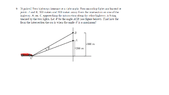
Two highways intersect at a right angle. Two recording lights are located at points A and B, 200 meters and 300 meters away from the intersection on one of the highway. A car, C, approaching the intersection along the other highway, is being tracked by the two lights.Let θ be the angle ACB(see figure below). Find how far from the intersection the car is when the angle θ is a maximum?
 

Attachments
  • awdawd.png
    awdawd.png
    23.1 KB · Views: 155
Physics news on Phys.org
Corey9078 said:
Two highways intersect at a right angle. Two recording lights are located at points A and B, 200 meters and 300 meters away from the intersection on one of the highway. A car, C, approaching the intersection along the other highway, is being tracked by the two lights.Let θ be the angle ACB(see figure below). Find how far from the intersection the car is when the angle θ is a maximum?
You may wish to start with five things:

Label the distance C-Intersection 'x'
Label the angle A-C-Intersection $\phi$

The lower triangle.

$\tan(\phi) = \dfrac{200}{x}$

The larger triangle.

$\tan(\phi+\theta) = \dfrac{300}{x}$

Trigonometry

$\tan(\phi+\theta) = \dfrac{\tan(\phi) + \tan(\theta)}{1-\tan(\phi)\tan(\theta)}$

You should have done this immediately - even if it doesn't lead anywhere. Don't let the easy parts get away from you because you have some fear about the entire solution. WRITE DOWN what you do know. Worry about what you don't know, later.
 
Alternatively,

Let the point of intersection of the two highways be $O$. Then

$$\angle{BCO}-\angle{ACO}=\theta$$

$$\arctan(BO/CO)-\arctan(AO/CO)=\theta$$

Using a well-known trigonometric identity (found here), we have

$$\theta=\arctan\frac{BO/CO-AO/CO}{1+AO\cdot BO/CO^2}$$

Now use values for $AO$ and $BO$ per the given information and you've got a function in terms of $CO$. Differentiate, set equal to 0 and solve for $CO$ for the final answer. (It's not as bad as it looks - you only need to set the numerator equal to $0$ and solve for CO - I get $100\sqrt{6}$).