Hello d4ncelife,
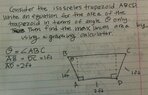
Let's begin with the well-known formula for the area of a trapezoid:
$$A=\frac{h}{2}(B+b)$$
We can see that $b=2\text{ ft}$, but $B$ and $h$ are functions of $\theta$.
Using the definition of the sine of an angle $$\sin(\theta)=\frac{\text{opposite}}{\text{hypotenuse}}$$, we may write:
$$\sin(\theta)=\frac{h}{1}=h$$
Using the definition of the cosine of an angle $$\cos(\theta)=\frac{\text{adjacent}}{\text{hypotenuse}}$$, we may write:
$$B=2+2\cos(\theta)$$
and so the area of the trapezoid as a function of $\theta$ is:
$$A(\theta)=\frac{\sin(\theta)}{2}\left(2+2\cos( \theta)+2 \right)=\sin(\theta)(\cos(\theta)+2)$$
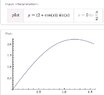
Graphing this function on $$0\le\theta\le\frac{\pi}{2}$$ we see:
View attachment 889
and it appears that the area is maximized for approximately $$\theta\approx1.2$$
Using differential calculus, we find:
$$A'(\theta)=\sin(\theta)(-\sin(\theta))+\cos(\theta)(\cos(\theta)+2)=\cos^2(\theta)-\sin^2(\theta)+2\cos(\theta)=2\cos^2(\theta)+2\cos(\theta)-1=0$$
Since we require $$-1\le\cos(\theta)\le1$$ the only valid root is:
$$\cos(\theta)=\frac{\sqrt{3}-1}{2}$$
Thus $$\theta=\cos^{-1}\left(\frac{\sqrt{3}-1}{2} \right)\approx1.1960618940861567$$
We really don't need to know the value of $\theta$ though, I just included it for verification of the value the graph indicates.
Since $\theta$ is in the first quadrant, we have:
$$\sin(\theta)=\sqrt{1-\cos^2(\theta)}=\sqrt{1-\left(\frac{\sqrt{3}-1}{2} \right)^2}=\frac{\sqrt{2\sqrt{3}}}{2}=\frac{\sqrt[4]{3}}{\sqrt{2}}$$
and so the maximum area is:
$$A_{\max}=\frac{\sqrt[4]{3}}{\sqrt{2}}\left(\frac{\sqrt{3}-1}{2}+2 \right)=\frac{\sqrt[4]{3}}{2\sqrt{2}}(3+\sqrt{3})\approx2.201834737520805\text{ ft}^2$$