Maximum voltage output with insufficient circuit details

  • Topic: Engineering 
  • Thread starter Thread starter luigihs
  • Start date Start date
  • Tags Tags
    Limit Max
Join the discussion
Registration is free. Start your own thread to ask a follow-up.
10 replies · 3K views · last reply
luigihs
Messages
86
Reaction score
0
Approx what is the maximum value of Vout
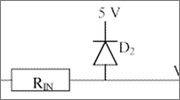
Circuit schematic showing a 5 V supply feeding a diode labelled D2 in series with a resistor labelled R_IN, with an output node labelled V on the right.


I don't have any idea I am just guessing but there's not enough details I think is 0 V but I am not sure.. how am I suppose to answer this??
 
Physics news on Phys.org
They want the maximum output voltage, which applies to all possible input values.
 
luigihs said:
I don't understand is that 5V?

Grab Vo, what if you try to force a voltage on it. (The actual forcing could be done by a source connected to Vin)
 
luigihs said:
The output voltage is limited to a minimum of 5V. ?

You mean a maximum of 5V. If you go higher the diode turns on and there is a short to a voltage source that pins the voltage. Is there a diode drop involved?
 
You can try different voltage values at the output and see how the circuit behaves.

If the diode is not ideal, then there is no theoretical limit on the output voltage due to limited positive-biased diode impedance. However, I assume that the diode is ideal and thus is positively-biased and turns once the output voltage exceeds the cathode voltage.
 
Does this make it any easier to understand. It's the same circuit. If Vin >> 5V the diode conducts and stops Vout going any higher.
 
Attachments
  • Circuit schematic: input V_IN feeds series resistor R_IN, then the output node V_OUT, which connects down to diode D2 with its cathode to a 5 V supply.
    voltages.jpg
    5 KB · Views: 525
No, it means it can't be more than 5.7V (=5V+Vf).

If Vin >> 5V current flows from Vin, through the resistor, through the diode to the +5V rail.