Meaning of small triangle in chemical potential

Click For Summary
SUMMARY

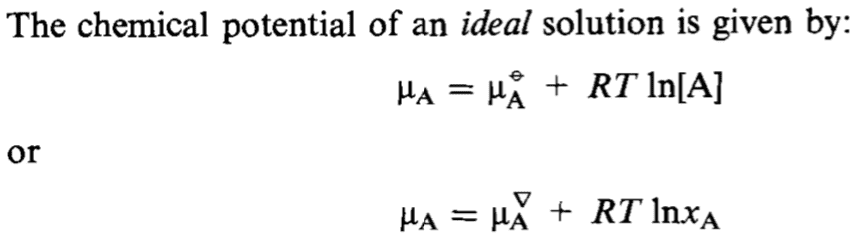
The small triangle symbol (▽) in the context of chemical potential likely represents an outdated notation for the chemical potential of a pure solvent A (μA*). The discussion clarifies that in ideal solutions, where the activity coefficient (γA) equals 1, the chemical potential can be expressed as μA = μA* + RTlnxA. This formulation aligns with the principles of Raoult's Law, indicating that the reference state for the second equation is pure A, while the first equation uses a 1M concentration reference state.

PREREQUISITES
  • Understanding of chemical potential and Gibbs energy
  • Familiarity with Raoult's Law and ideal solutions
  • Knowledge of mole fraction and activity coefficients
  • Basic concepts of vapor pressure in chemistry
NEXT STEPS
  • Study the IUPAC recommendations for chemical notation in thermodynamics
  • Learn about the derivation of chemical potential in ideal solutions
  • Explore the implications of Raoult's Law on vapor pressure and solutions
  • Investigate the role of activity coefficients in non-ideal solutions
USEFUL FOR

Chemistry students, researchers in physical chemistry, and professionals working with thermodynamic properties of solutions will benefit from this discussion.
etotheipi
It is given that the solution is ideal, i.e. that we can take ##\gamma_A = 1##.

1600201533759.png


I wondered what that small triangle signifies in the second definition? Thanks!
 
Chemistry news on Phys.org
Good question. I've never seen that before. But it looks like in the first equation the reference state is a solution with [A] = 1M, while in the second, the reference state is xA = 1, i.e. pure A. But I've never seen the little triangle symbol.
 
  • Like
Likes   Reactions: etotheipi
Thanks, that's probably what's intended. It's likely just outdated notation :wink:. If I stumble across the small-print sometime in the future, then I'll post an update :smile:
 
etotheipi said:
It's likely just outdated notation

I am outdated and I have never seen it as well, so more like an obscure notation :wink:
 
  • Like
Likes   Reactions: berkeman and etotheipi
etotheipi said:
I wondered what that small triangle signifies in the second definition?
Where is that screenshot from?
 
  • Like
Likes   Reactions: etotheipi
It's from the Oxford Chemistry Primers series, there are some really nice undergrad-level overviews of different subjects in Chemistry; if you like you can have a look at some of the titles here :smile:.
 
  • Like
Likes   Reactions: berkeman
I got my PhD in chemistry in 2018 so I believe my knowledge on recent textbooks is rather updated, but me too have never seen that kind of symbol.

That being said, considering that xA is a notation used for Mole fraction, I believe μA equals to μA* (chemical potential of a pure A solvent), and the only difference is that the former notation is not what the IUPAC recommends. This is the chemical potential of the solution based on vapor pressure.

Chemical potential (Gibbs energy) for mixed gas is:
\mu=\mu^{\ominus}+RTln\frac{p}{p^{\ominus}}
where p^{\ominus} is the standard pressure (1 bar) and IUPAC recommends using this symbol. Now turning to solution case, the chemical potential of the vapor pressure of fully pure liquid A (which in equilibrium, this is identical to the chemical potential of the liquid) is:
\mu _{A}^{*}=\mu _{A}^{\ominus}+RTln \frac{p _{A}^{*}}{p^{\ominus}}
If the liquid is not pure A, then:
\mu _{A}=\mu _{A}^{\ominus}+RTln \frac{p _{A}}{p^{\ominus}}
So combining these two equation gives:
\mu _{A}=\mu _{A}^{*}+RTln\frac{p _{A}}{p _{A}^{*}}
We can write this in terms of chemical activity a_{A}=\frac{p _{A}}{p _{A}^{*}}, which gives:
\mu _{A}=\mu _{A}^{*}+RTlna _{A}
And using activity coefficient and mole fraction,
\mu _{A}=\mu _{A}^{*}+RTln\gamma _{A}x_{A}
Ideal solution with sufficiently low solute B and pure solvent A (Roult's Law) means that \gamma _{A}=1 so,
\mu _{A}=\mu _{A}^{*}+RTlnx_{A}
This is now identical to the second equation of the OP's question.
 
Last edited:
  • Informative
Likes   Reactions: etotheipi

Similar threads

  • · Replies 1 ·
Replies
1
Views
2K
  • · Replies 2 ·
Replies
2
Views
3K
  • · Replies 2 ·
Replies
2
Views
2K
  • · Replies 2 ·
Replies
2
Views
2K
Replies
2
Views
3K
  • · Replies 14 ·
Replies
14
Views
3K
  • · Replies 8 ·
Replies
8
Views
3K
Replies
8
Views
4K
  • · Replies 3 ·
Replies
3
Views
2K
Replies
5
Views
2K