Measuring Deer Antler Volume

  • Thread starter Thread starter erobz
  • Start date Start date
Click For Summary
The discussion revolves around a proposed method to measure deer antler volume using water displacement in a fish tank, comparing it to the Boone and Crockett scoring system. Participants explore the feasibility of using a sight glass for precision measurement and suggest adding detergent to prevent air bubbles. Concerns are raised about the density and buoyancy of antlers, with suggestions for underwater weighing and varnishing to prevent water ingress. The conversation highlights the challenges of accurately measuring volume due to the irregular shape of antlers and the need for appropriate weighing equipment. Overall, the method aims to provide a direct volume measurement while minimizing errors associated with traditional scoring systems.
  • #31
Oh. A suspended spring scale. I am such a stupidhead. :sorry:
 
Engineering news on Phys.org
  • #32
Thanks, Jack.

Some expensive balances are designed with the ability to do this. I've used a small digital scale. I built a jig that allowed me to suspend an object below the scale on thin fishing line. It wasn't difficult to do. It looked sort of like this (you'll have to imagine how the scale is supported):

jig.webp


If the object isn't dense enough to sink well on its own then you'd need to add a dense weight.

This idea is used to estimate body fat percentage. You are weighed in air and then submerged in a tank, sitting on a seat attached to a scale. I did this once as part of a class. It was kind of fun.

But for antlers it's probably not worth the trouble. The guys in that paper I linked above used the overflow method.
 
Last edited:
  • #33
All that is necessary to obtain the volume is to put the tank on a balance. No need for an overflow of any sort. Push the antlers down into the water until covered, not touching the bottom, and note the change of reading on the balance, in grams. That is the volume of the antlers in cubic centimetres.
 
  • #34
tech99 said:
All that is necessary to obtain the volume is to put the tank on a balance. No need for an overflow of any sort. Push the antlers down into the water until covered, not touching the bottom, and note the change of reading on the balance, in grams. That is the volume of the antlers in cubic centimetres.
Except that you're trying to read off grams from a scale that is designed to measure tonnes (that's how big it would have to be to hold the largest set of antlers).

(see post 25)
 
  • #35
tech99 said:
All that is necessary to obtain the volume is to put the tank on a balance.
The balance would need to be counterweighted against about 300 kg of water, then the difference measured. That would require a very sensitive balance, where a difference of 1 gram will move 2 x 300 kg = 600 kg to settle in a new position.

Weighing the force difference in the balance, measured without the balanced masses moving, would give the fastest and most accurate result.
 
  • #36
tech99 said:
All that is necessary to obtain the volume is to put the tank on a balance. No need for an overflow of any sort. Push the antlers down into the water until covered, not touching the bottom, and note the change of reading on the balance, in grams. That is the volume of the antlers in cubic centimetres.
But wouldn't that change of reading NOT include the volume of the antlers already submerged without pushing them down? For example, what if the antlers sink completely below the surface (on the bottom or not), on their own? Then the reading is just the combined weight of the tank and the antlers.
 
  • #37
Baluncore said:
...300 kg of water...
Pending erobz's responses to some of my questions, I think 300kg is conservative, depending on scope-of-use.
If this were to hope to challenge the current system, it would need to support the maximum possible dimensions of any antler set.

Moose antlers can spread 2m wide and 1m long. You would need a 2m x 1m x 1m tank - that's 2,000kg.

But we'll see.
 
  • #38
jack action said:
But wouldn't that change of reading NOT include the volume of the antlers already submerged without pushing them down? For example, what if the antlers sink completely below the surface (on the bottom or not), on their own? Then the reading is just the combined weight of the tank and the antlers.
When you dip anything into the tank, it has upthrust due to its displacement volume. If you hold the object rigid, then there is an equal downward reaction force on the balance. The weight of the object is not relevant if the object is held rigidly.
 
  • Like
Likes jack action
  • #39
DaveC426913 said:
Moose antlers can spread 2m wide and 1m long. You would need a 2m x 1m x 1m tank - that's 2,000kg.
I was being conservative in the opposite direction to you. For 1 gram = 1 ml = 1 cc resolution, neither 1 in 3x10⁵, nor 1 in 2x10⁶ is good.

So dispense with the tank of water and the balance, submerge the antlers in a lake, holding them fully submerged with a wire from the scales. The change in weight, in air, then in water, will give the volume of water displaced by the volume of the antlers. If needed, correct that value for density variation due to temperature, or salinity for seawater.
 
  • #40
Baluncore said:
I was being conservative in the opposite direction to you. For 1 gram = 1 ml = 1 cc resolution, neither 1 in 3x10⁵, nor 1 in 2x10⁶ is good.

So dispense with the tank of water and the balance, submerge the antlers in a lake, holding them fully submerged with a wire from the scales. The change in weight, in air, then in water, will give the volume of water displaced by the volume of the antlers. If needed, correct that value for density variation due to temperature, or salinity for seawater.
If antlers float. What if they don't?
 
  • #41
DaveC426913 said:
If antlers float. What if they don't?
They will be held down by the solid wire that connects them to the scales.
 
  • #42
Baluncore said:
They will be held down by the solid wire that connects them to the scales.
If they sink, they don't need to be held down, but it also means you have a to use a different technique to weigh the antlers.
 
  • #43
DaveC426913 said:
If they sink, they don't need to be held down, but it also means you have a to use a different technique to weigh the antlers.
Since the wire is rigid, it can push down or pull up, and the scales using a load-cell, can read and display ±weight, as required by antler density.
 
  • Informative
Likes DaveC426913
  • #44
I wasn't really thinking about weight(although it could be argued to be just as genetically of interest)
). The reason for all this is that the most genetically gifted trophy white tail are usually the largest volume of antler on the head...its naturally most impressive. They assert their dominance among other competing males by growing large alters and then fighting ( age/maturation has much to much to do with it). It may be about torque (I don't know)! There is an extra criterion of symmetry, (right vs left antler) that acts as a deduction in the Boone and Crocket scoring system that is pleasing aesthetically. I however think its mostly about either volume (or mass). Deer age and maturity greatly impacts horn growth. The older bucks (to a point) grow larger antlers in a season. The Boone and Crocket uses as "characteristic length", I just though I would like to shift the tides to an actually scientific measurement (and something repeatable ). There is a lot of subjectivity in the Boone and Crocket scoring system I would like to eliminate.
 
  • #45
Boone and Crocket measure subjective volume which is what any buck on seeing the size of the antlers on the opponent may either back away from a fight or not be impressed. Actual volume may represent something else.
Does that make sense.

Another option without all the trouble,
One might put the antlers in front of a grided screen, take a frontal photograph ( or some other specified direction ), designate the tip points of the antlers on the grid, and calculate the projected area encompassed within these exterior points of an area as if they had been joined by a string. Similar to a method of collision detection of two objects that meet in a video game.
 
  • #46
erobz said:
I wasn't really thinking about weight(although it could be argued to be just as genetically of interest)
The difference between the weight in air, and weight submerged in water, is the buoyancy, which is due only to the volume of the antlers. For freshwater, that is; 1 cc volume per 1g weight difference, or 1 litre per kg.

Procedure.
Attach the antler to the digital scales with a rigid wire, suspended from the scales. Weigh the antlers in air.
Then lower them into a lake, or your bath, not touching the bottom or sides, weighing them submerged, up to a fixed mark on the wire.
Subtract the weight submerged from the weight in air.
You then have both the weight and the volume of the antlers, in two weighings, without a need to weigh or to transport a tank.
 
  • #47
256bits said:
Actual volume may represent something else.
Does that make sense.
It does!

I implicitly accepted the OP's assumption that actual displacement volume was the gold standard. But why? A given set of antlers might have unusually thick trunks yet a diminutive spread, giving it a large actual displacement volume, even while being aesthetically underwhelming. Should this be the Gold Prize winner?
 
  • #48
Each year, antler development is dependent on nutrition and constitution. In general, healthier males grow bigger antlers, in mass, volume and spread.

Antlers that are too thin bend and break, those that are too thick get broken off the head or do not reach sufficiently to win the fight. The dominant male, that reproduces this year, must survive all the selection fights.
 
  • #49
Baluncore said:
Each year, antler development is dependent on nutrition and constitution. In general, healthier males grow bigger antlers, in mass, volume and spread.

Antlers that are too thin bend and break, those that are too thick get broken off the head or do not reach sufficiently to win the fight. The dominant male, that reproduces this year, must survive all the selection fights.
Perhaps. But what matters is what the judges and community think matters.

Before the OP can argue for his new measung device, he will first have to convince them that girth of antler "beams" is as important to the quality of a prize rack as their overall spread is. And I'm just not sure that's going to happen.

I'm having a tough time imagining a billionaire hanging his prize rack on the wall of his chalet, saying "Sure, it's only four feet across the points, but look at the girth of those beams!"

1764775481059.webp
 
  • #50
DaveC426913 said:
Before the OP can argue for his new measung device, he will first have to convince them that girth of antler "beams" is as important to the quality of a prize rack as their overall spread is. And I'm just not sure that's going to happen.
Mass, volume and spread will correlate to a large extent. There will be optimum ratios, discovered by recording and analyzing the scatter plots of the data.

Ideally, the dominant male, each year, will indicate values that should score the highest quality. But most of the good antlers recovered will be from "runners-up" to the dominant male. Will collectors value the same qualities that are needed for success by the dominant male?
 
  • #51
Baluncore said:
Will collectors value the same qualities that are needed for success by the dominant male?
This.

I personally do not think so. Originally, I assumed volume was the primary criterion by which racks were judged, with some allowance for aesthetics, and the OP was just looking for a more accurate, more reliable way to assess volume.

But I no longer think that. I thInk that the primary criteria is more like "size", which is obviously complex and arbitrary, but based more on extent than on anything to do with actual displacement volume.

So, I think I will back off guessing what I think the judges will or should prefer.
 
  • #52
DaveC426913 said:
So, I think I will back off guessing what I think the judges will or should prefer.
I agree. Our task is to come up with a reliable and accurate way of gathering the volume data.

If that technique measures weight, then that is a bonus. Density can also be computed, giving volume, weight and density from two measurements with one instrument. The buoyancy technique can be applied in many other research situations.
 
  • #53
Baluncore said:
I agree. Our task is to come up with a reliable and accurate way of gathering the volume data.
Even if we're no longer convinced the OP is right about what kind of volume is desired, and wonder if perhaps his idea should be reevaluated...
 
  • #54
256bits said:
Boone and Crocket measure subjective volume which is what any buck on seeing the size of the antlers on the opponent may either back away from a fight or not be impressed.

I found a Boone and Crockett scoring sheet and there is no volume measurement. It's a collection of length and circumference measures that are added together to produce a score. If that score correlates with how deer perceive antler volume I'd love see how that was deduced.

People are pretty bad at estimating volume. It wouldn't surprise me if deer weren't very good at it either and instead focus first on linear measures.
 
  • Like
Likes sophiecentaur
  • #55
erobz said:
TL;DR: Trying to figure out simple low-tech solution

the Boone and Crockett system is the current record measurement standard . . . . .
I thought you just had to kidding with that name but it really is an actual thing. I reckon the B&C formula was devised as being the least difficult practical system to use and anyone could do their own measurement. I can't believe there would be an alternative method that would be accepted by the Whitetail shooting fraternity.

If you used density then there could be cheating by inserting lead weights etc. If you use density (a standard, mean density of to produce a volume value then how would it actually be any more meaningful than just quoting the weight?

This thread has clearly been fun but it's shown the usual PF Brownian motion through the topic before doing what all good Engineers would do and consider what's actually needed and what's the end product.
 
  • #56
DaveC426913 said:
Pending erobz's responses to some of my questions, I think 300kg is conservative, depending on scope-of-use.
If this were to hope to challenge the current system, it would need to support the maximum possible dimensions of any antler set.

Moose antlers can spread 2m wide and 1m long. You would need a 2m x 1m x 1m tank - that's 2,000kg.

But we'll see.

I'm just looking at White Tail sized antlers.
 
  • #57
erobz said:
I'm just looking at White Tail sized antlers.
OK, would you care to address any of the other questions in post 29?
 
  • #58
In the B&C system, asymmetry is punished, as the "Total of Lengths of Abnormal Points" is subtracted from the score. A volume measurement would not distinguish between good and evil without additional complexity.
 
  • Like
Likes sophiecentaur
  • #59
DaveC426913 said:
OK, a few questions for @erobz:
  1. How do you see this utilized? For your own personal use, or is this open to all - say, at a public contest? This helps us understand practical constraints, such as: will need it to be
    - robust,
    - foolproof,
    - operable by a third party,
    - portable,
    as opposed to, say, you in your basement.
Portable, just to see if it gains any traction as "objective measurement"
DaveC426913 said:
  1. Is the idea to (someday) replace - or at least offer an alternative to - the existing system?
Maybe supplement.
DaveC426913 said:
  1. What are the maximum plausible dimensions of the best rack? All three dims, if you please. Moose antlers can span 2m in two dimensions. This will inform questions 1 and 2. I suspect a portable setup will require a pickup truck.
Whitetail ( sp[ecifically midwest )could still require a pretty large tank ( maybe 1m by 1 m), but not "moose large"
DaveC426913 said:
  1. Do all antlers float? Do all antlers sink? It sounds like, for this to be a practical alternative, the measurement proceure will have to accommodate both scenarios. Ideally, for fairness, it should use the exact same setup for both floaters and sinkers*.
* I imagine that might not be too hard. You can attach a standard weight to them, until they sink, then simply subtract that away.
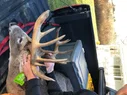
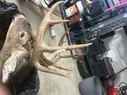
If we just measure volume and assume a common density, I don't think it would be an issue. See pictures. The first buck scores a Net 131-5/8, while the second buck scores 132 inches. The gross scores (before symmetry deductions) are 163 inch and 139 - 5/8" respectively. Which do you think would be dominant? Which is the more impressive set of antlers for a buck to boast for breeding competition?
 

Attachments

  • IMG_1768.webp
    IMG_1768.webp
    65.5 KB · Views: 3
  • IMG_3277.webp
    IMG_3277.webp
    55.3 KB · Views: 2
  • Like
Likes DaveC426913
  • #60
erobz said:
The gross scores before deductions are 163 inch and 139 - 5/8" respectively. Which do you think would be dominant?
I doubt that dominance is decided by symmetry, or minor imperfections.
Nutrition decides antler mass or volume, and so in a head-to-head conflict, the best fed buck, with the best healthy genetics will dominate.
 
  • Like
Likes sophiecentaur and erobz

Similar threads

  • · Replies 1 ·
Replies
1
Views
4K
  • · Replies 6 ·
Replies
6
Views
5K
  • · Replies 5 ·
Replies
5
Views
4K
  • · Replies 1 ·
Replies
1
Views
3K