Measuring distance between two stars in a binary system

Click For Summary

Discussion Overview

The discussion revolves around calculating the distance between two stars in a binary system, focusing on the concept of angular separation and its relation to physical distance using trigonometry. Participants explore the definitions and implications of angular separation, the center of mass (CoM), and the challenges in visualizing and applying trigonometric principles to this scenario.

Discussion Character

  • Exploratory
  • Technical explanation
  • Conceptual clarification
  • Debate/contested
  • Mathematical reasoning

Main Points Raised

  • One participant expresses confusion about angular separation and its translation to physical distance, questioning how to visualize the setup for trigonometric calculations.
  • Another participant explains that the CoM is between the two stars but not necessarily at the midpoint, and that angular separation can change over time due to orbital motion.
  • There is a discussion about the use of tangent versus sine in calculations, with one participant suggesting that sine may be more appropriate depending on the diagram drawn.
  • Participants debate the nature of angular separation, with some suggesting it is constant while others argue it may only represent maximum separation in certain orbital configurations.
  • One participant highlights the complexity of orbits, noting that the angular separation and physical distance can vary significantly based on the stars' positions in their orbits.
  • Clarifications are made regarding the right angles in diagrams, with some participants indicating that the placement of these angles is crucial for accurate trigonometric calculations.
  • There is a mention of specific stars orbiting Sgr-A and how their orbital characteristics affect the interpretation of angular separation and distance measurements.
  • A participant seeks clarification on the acronym "CoM," which is confirmed to stand for Center of Mass.

Areas of Agreement / Disagreement

Participants exhibit a mix of agreement and disagreement regarding the definitions and implications of angular separation, the role of the CoM, and the appropriate trigonometric functions to use. The discussion remains unresolved, with multiple competing views on how to approach the calculations and visualizations.

Contextual Notes

Participants note limitations in their understanding of the diagrams and trigonometric relationships, indicating that the complexity of orbital motion and the definitions of angles may not be fully addressed in the source material.

TheCelt
Messages
24
Reaction score
5
Hello

I am trying to teach myself some basic maths for astronomy from a book, namely trying to calculate the distance between two stars in a binary system.

One thing i am confused with is what angular separation means and how it can be translated to true physical distance between them using trigonometry. I am trying to visualise it but its a bit confusing at the moment. The book did not explain it as it seems to have presumed i already understood this.

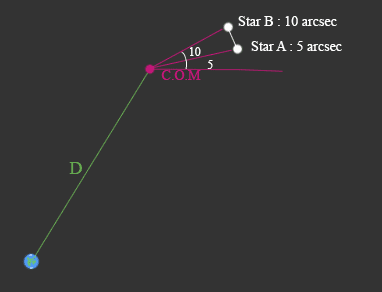
Firstly what does it mean for each star to have an angular separation from centre of mass, eg if star A has 5 arcsec and star B has 10 arcsec what are these angles relative to? And if you know the distance D of the system from Earth, i presume trigonometry can be done to solve it but i am struggling to visualise how to draw it out to do the trigonometry for it at the moment.

I made a drawing to show the setup of what i think it might mean:
1600740363958.png


When they say angular separation from COM is this correct thinking? If so how are they defining the angle? What constitutes the 0 arcsec line, what counts as the positive x-axis in space i guess is what I am asking.

Secondly from that i do not understand how you might calculate the physical separation distance between the two stars (white line magnitude). Mainly because i am confused by the angle situation.
 
Astronomy news on Phys.org
CoM has to be between the two stars of a binary pair, but probably not half way.
So the angle for each is going to be the deviation from that point. The line from you to the CoM is the arcsec line. A star with half the mass of the other will have twice the angular separation at any given moment, but the angular separation between the stars will change over the course of their orbit, possibly dropping to zero if you're on their orbital plane. The physical distance between them will also be changing as orbits are rarely perfectly circular.

Distance from you to the binary pair isn't trivial to figure out. Usually for something nearby, parallax is used to measure distances, but it only works so far.
 
  • Like
Likes   Reactions: PeroK
Halc said:
CoM has to be between the two stars of a binary pair, but probably not half way.
So the angle for each is going to be the deviation from that point. The line from you to the CoM is the arcsec line. A star with half the mass of the other will have twice the angular separation at any given moment, but the angular separation between the stars will change over the course of their orbit, possibly dropping to zero if you're on their orbital plane. The physical distance between them will also be changing as orbits are rarely perfectly circular.

Distance from you to the binary pair isn't trivial to figure out. Usually for something nearby, parallax is used to measure distances, but it only works so far.

Thanks for the reply, the bit i am struggling with is how to draw the triangle as a diagram so i can understand the trig used to calculate it.

I refer to this question in my book which during the calculations it finds the separation of two stars (which is what i am trying to solve) and it uses tangent and multiplies it by the distance from Earth. But i can't visualise the triangle to understand why they use tangent or why multiply by the distance from Earth.

1600741657704.png


I also don't understand how that gives the distance from the center of mass.
 
The text there spells out the triangle pretty clearly: Earth, CoM, star1 is one triangle, Earth, CoM, star2 is the other. You know the length of one side (1.31 pc) so the tangent(measured angle) gives you the other (distance to star from CoM). The mass ratio here is about 6 to 5 respectively between the stars.

The text seems to indicate that the angular separation is constant, which is really rare. Maybe they mean the max angular separation, which gives a distance between the stars when they're equidistant from Earth.

Given their separation distance and orbital period, their respective masses can be computed.
 
  • Like
Likes   Reactions: PeroK
Well the book simplifies things since its only introducing the subject and hasn't added the complexity of things moving.

I think i understand how to visualise it now but i think my trig is wrong because i seem to find using the sin function is required not the tan function, so i don't quite see why they use tan, unless i am still drawing it wrong?

1600743677883.png
 
You've still not got the COM on a straight line between the stars. Your right angles are in the wrong place, hence the confusion between sine and tangent.
 
TheCelt said:
Well the book simplifies things since its only introducing the subject and hasn't added the complexity of things moving.

If the stars are orbiting each other then they are moving!
 
PeroK said:
You've still not got the COM on a straight line between the stars. Your right angles are in the wrong place, hence the confusion between sine and tangent.

Well I couldn't visually work out how to draw it properly as I have said, i was not sure where the right angle would be, and its not clear to my why there would be one (see picture 2). I don't see why we draw them at right angle to the COM relative to the vector from Earth. Because after some time won't be they will be shifted slightly since as you mention - they are moving...

You seem to be saying the right angles go here like this:

1600760625027.png


But what if it's another moment in time since they are moving why wouldn't it be like this image below having no right angles at all?

1600760863255.png


Doesn't really make much sense to me why we include a right angle by default because i don't see a right angle in the second diagram.
 
That's why @Halc pointed out that we must be talking about the maximum angular separation.

Halc said:
The text seems to indicate that the angular separation is constant, which is really rare. Maybe they mean the max angular separation, which gives a distance between the stars when they're equidistant from Earth.

The maximum occurs when you have the right-angles at the COM in your diagram.
 
  • Like
Likes   Reactions: Halc
  • #10
PeroK said:
The maximum occurs when you have the right-angles at the COM in your diagram.
Not necessarily I think. It is true for a reasonably circular orbit. There are clues to computing actual orientations of orbits and thus maximum distances when the orbit is highly elliptical.
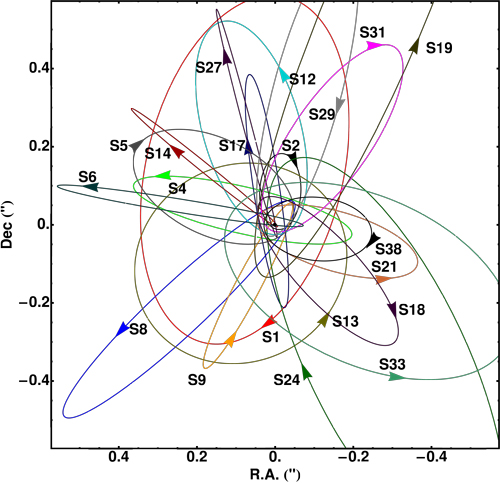
Take some of the stars orbiting Sgr-A:
stars1.jpg

I see S1 as a fairly circular orbit, despite S13 appearing to be more circular.
S8 has its minor axis (and possibly its major axis, hard to tell) nearly perpendicular to our field of view, so its maximum angular separation is actually a good measure of its actual distance.
S6, S14 and S27 are good examples where this is not the case. We're looking at their orbits fairly edge-on and the angle with our line of sight when these stars are at maximum angular separation is anything but a right angle.
S17 I think is the most circular of all of these, despite it appearing highly eccentric from our PoV. The angles here would be closer to right angles at points of maximum angular separation.
 
  • Like
Likes   Reactions: PeroK
  • #11
What does the acronym "CoM" stand for?

ADDED
Now I got it: Center of Mass.
 

Similar threads

  • · Replies 5 ·
Replies
5
Views
3K
  • · Replies 14 ·
Replies
14
Views
3K
  • · Replies 4 ·
Replies
4
Views
2K
  • · Replies 11 ·
Replies
11
Views
2K
  • · Replies 4 ·
Replies
4
Views
2K
  • · Replies 1 ·
Replies
1
Views
2K
  • · Replies 4 ·
Replies
4
Views
2K
  • · Replies 3 ·
Replies
3
Views
4K
  • · Replies 12 ·
Replies
12
Views
3K
  • · Replies 6 ·
Replies
6
Views
2K