Meet Olinguito the new mammalian carnivore

  • Thread starter Thread starter Greg Bernhardt
  • Start date Start date
Click For Summary

Discussion Overview

The discussion centers around the discovery of the olinguito, a newly identified mammalian carnivore found in the cloud forests of Colombia and Ecuador. Participants explore the implications of this discovery, the classification of the olinguito within the carnivore family, and the accuracy of media reports regarding its discovery.

Discussion Character

  • Exploratory
  • Debate/contested
  • Technical explanation

Main Points Raised

  • Some participants highlight that the olinguito is the first new species of carnivore identified in the Western hemisphere in 35 years, emphasizing the rarity of such discoveries in the 21st Century.
  • There is a discussion about the dietary classification of the olinguito, with some noting it primarily eats fruit but also consumes insects and nectar.
  • One participant points out the distinction between the popular and technical meanings of "carnivore," referencing the classification of the giant panda within the Carnivora order.
  • Several participants express skepticism about the accuracy of media statements regarding the discovery, suggesting that the wording implies a living specimen was found when it may not be the case.
  • Another participant shares personal experiences with related species, noting similarities between the olinguito and the olingo, and questions whether the olinguito is cuter than other mammals.
  • There are conflicting interpretations of the news reports, with some asserting that a living specimen was indeed discovered, while others believe the reports may mislead readers regarding the nature of the discovery.

Areas of Agreement / Disagreement

Participants express differing views on the accuracy of the media's portrayal of the discovery and the classification of the olinguito. There is no consensus on whether the olinguito was definitively discovered alive or if the reports were misleading.

Contextual Notes

Some participants note that the discussion relies on interpretations of media reports and the definitions of terms like "carnivore," which may vary in strictness. There are also unresolved questions about the specifics of the discovery process and the implications of the findings.

Messages
19,911
Reaction score
10,924
Olinguito: 'Overlooked' mammal carnivore is major discovery
http://www.bbc.co.uk/news/science-environment-23701151
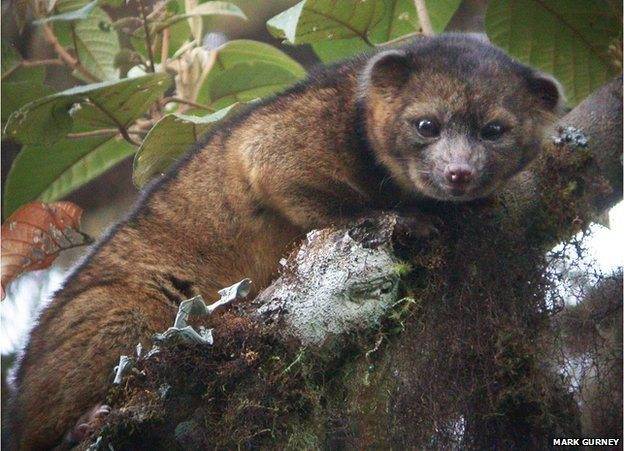
Scientists in the US have discovered a new animal living in the cloud forests of Colombia and Ecuador.

It has been named olinguito and is the first new species of carnivore to be identified in the Western hemisphere in 35 years.

It has taken more than a decade to identify the mammal, a discovery that scientists say is incredibly rare in the 21st Century.


_69301446_1photoofolinguito.jpg
 
Last edited:
Biology news on Phys.org
"Olinguito: 'Overlooked' mammal carnivore is major discovery"
"mammal carnivore is major discovery"
"mammal carnivore"
"carnivore"

"Eats fruit mainly, but also consumes insects and nectar"
"Eats fruit mainly"
"fruit mainly"

Carnivore: "A carnivore is an animal that derives its energy and nutrient requirements from a diet consisting mainly or exclusively of animal tissue"
"mainly animal tissue"

...?
 
parkerjm said:
"Olinguito: 'Overlooked' mammal carnivore is major discovery"
"mammal carnivore is major discovery"
"mammal carnivore"
"carnivore"

"Eats fruit mainly, but also consumes insects and nectar"
"Eats fruit mainly"
"fruit mainly"

Carnivore: "A carnivore is an animal that derives its energy and nutrient requirements from a diet consisting mainly or exclusively of animal tissue"
"mainly animal tissue"

...?

I think it is Anglicization of a technical term. http://tolweb.org/Carnivora/15971 says the giant panda is in "Carnivora". It also says the vernacular name for "Carnivora" is "carnivores".

The BBC article qoutes Kristofer Helgen, "The olinguito is a carnivore - that group of mammals that includes cats, dogs and bears and their relatives. Many of us believed that list was complete, but this is a new carnivore - the first to be found on the American continent for more than three decades."
 
Last edited:
  • Like
Likes   Reactions: 1 person
I figured the BBC would be using the popular meaning of the word instead of the stricter meaning, but that makes a lot more sense!
 
It *is* cute, but many mammals are cuter.
 
Evo said:
It *is* cute, but many mammals are cuter.

I agree. I'm a mammal. You do the math :smile:
 
"Scientists in the US have discovered a new animal living in the cloud forests of Colombia and Ecuador" is hardly accurate.

They hope one will be found living, I'm sure we all do. The have discovered one that did live there.
 
epenguin said:
"Scientists in the US have discovered a new animal living in the cloud forests of Colombia and Ecuador" is hardly accurate.

They hope one will be found living, I'm sure we all do. The have discovered one that did live there.

I think they did find one, at least that's how I read the news report. At the end they did make a trip to look for it.
 
  • #10
http://en.wikipedia.org/wiki/Bassaricyon

I've seen olingos and kinkajous when doing field research long ago. The olinguito looks really very much like the olingo.

Anyway the article above says that Helgen did in fact discover the species in the wild, in 2006, just published this week.
 
  • #11
jim mcnamara said:
http://en.wikipedia.org/wiki/Bassaricyon

I've seen olingos and kinkajous when doing field research long ago. The olinguito looks really very much like the olingo.

Anyway the article above says that Helgen did in fact discover the species in the wild, in 2006, just published this week.

But is the olinguito cuter than the others? From Helgen's range data, is it possible you might have seen it on your field work long ago?
 
  • #12
atyy said:
I think they did find one, at least that's how I read the news report. At the end they did make a trip to look for it.

OK right, I was mistaken, just if you read the article without seeing the video which I did you could think they have only seen the museum specimen, and even the video is mostly about that.
 

Similar threads

  • · Replies 1 ·
Replies
1
Views
2K
  • · Replies 6 ·
Replies
6
Views
4K
  • · Replies 25 ·
Replies
25
Views
6K
  • · Replies 2 ·
Replies
2
Views
605
Replies
12
Views
3K
  • · Replies 3 ·
Replies
3
Views
5K