cupid.callin
- 1,130
- 1
Hi all
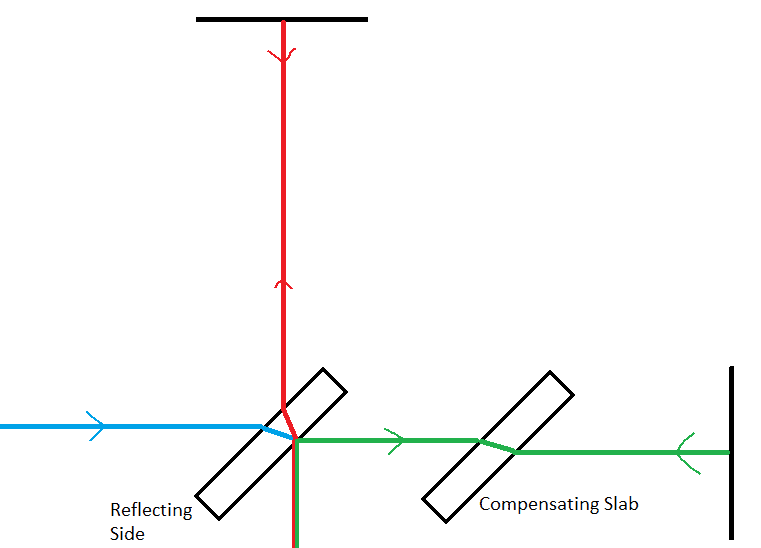
Edit: The reflecting side is the right side of left slab
Please look at the pic above ... The light from source splits at left slab and goes in 2 directions and come back to interfere.
From figure, it is obvious that path diff. in slabs for both rays is 0
and only path diff. would be because of the difference in distance of 2 mirrors from left slab, which is d
so, i found the path diff, as \Delta = 2\mu d cos \theta \pm \frac{\lambda}{2}
\frac{\lambda}{2} as green ray is reflected by denser medium ...
But i need to know how the circular or straight fringes are formed and how it depends on alignment of M1 and M'2
Some help please ... :)
EDIT: μ would be the refractive index of stuff filled in whole system ... like air for example
and θ is incidence angle angle at slabs ... :}
Edit: The reflecting side is the right side of left slab
Please look at the pic above ... The light from source splits at left slab and goes in 2 directions and come back to interfere.
From figure, it is obvious that path diff. in slabs for both rays is 0
and only path diff. would be because of the difference in distance of 2 mirrors from left slab, which is d
so, i found the path diff, as \Delta = 2\mu d cos \theta \pm \frac{\lambda}{2}
\frac{\lambda}{2} as green ray is reflected by denser medium ...
But i need to know how the circular or straight fringes are formed and how it depends on alignment of M1 and M'2
Some help please ... :)
EDIT: μ would be the refractive index of stuff filled in whole system ... like air for example
and θ is incidence angle angle at slabs ... :}
Attachments

Last edited: