Mixing air how much water leaving?

  • Thread starter Thread starter peet_dk
  • Start date Start date
  • Tags Tags
    Air Mixing Water
Click For Summary

Discussion Overview

The discussion revolves around calculating the amount of water leaving an air stream, particularly in the context of fog formation and condensation processes. Participants explore the application of psychrometric principles and specific equations related to humidity and condensation.

Discussion Character

  • Exploratory, Technical explanation, Conceptual clarification

Main Points Raised

  • One participant presents an equation for calculating water leaving the air based on the difference in humidity ratios at two points, questioning the choice of points for measurement.
  • Another participant suggests using a psychrometric chart to model the processes involved in the air stream.
  • A follow-up inquiry is made regarding whether two different cooling processes (A-B and A-C) will yield the same amount of condensation.
  • A participant shares a PDF with a detailed diagram to aid in understanding the cooling processes discussed.

Areas of Agreement / Disagreement

The discussion includes questions and suggestions but does not present a consensus on the best approach or the outcomes of the processes described.

Contextual Notes

Participants express uncertainty about the selection of measurement points for humidity and the relationship between different cooling processes and their effects on condensation.

peet_dk
Messages
9
Reaction score
0
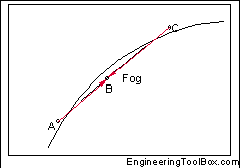
I have a situation like this:

Airpsychrometricschangingconditionsfog.gif


Where C is a air stream from a pipe, and A is the sky. Droplet will be made, and there will be fog.

Now I have to calculate the amount of water leaving the air.

In my book I found this equation:

Qwater = Qdry.air.C * (xA - xC)

But do it have to be point C and A? Why not the two points where RH=100% ?

And how do I know how much water that there will be in the air as fog, and how much will raining down?
 
Engineering news on Phys.org
Thanks for the reply.

Here is the cooling processes into the diagram, A-B and A-C. If you look at the two processes, will they produce the same amount of condense?
 

Attachments

  • Unavngiven.png
    Unavngiven.png
    52.4 KB · Views: 677
I made a pdf of the diagram, with more details on it.
 

Attachments

Similar threads

Replies
25
Views
5K
  • · Replies 16 ·
Replies
16
Views
6K
  • · Replies 14 ·
Replies
14
Views
3K
  • · Replies 3 ·
Replies
3
Views
1K
  • · Replies 9 ·
Replies
9
Views
2K
  • · Replies 14 ·
Replies
14
Views
2K
Replies
5
Views
2K
  • · Replies 3 ·
Replies
3
Views
3K
  • · Replies 1 ·
Replies
1
Views
3K
Replies
24
Views
3K