Modelling eddy currents in a pendulum

Click For Summary
SUMMARY

This discussion focuses on modeling eddy currents in a copper pendulum entering a uniform magnetic flux density region. The key equation referenced is Faraday's law, specifically the curl of the electric field, which relates the induced electric field to the changing magnetic field. The user seeks clarity on managing multiple variables in the equations and determining the retarding force due to induced currents. A suggested approach is to simplify the problem by starting with a circular loop before integrating to model the disk.

PREREQUISITES
  • Understanding of Faraday's law of electromagnetic induction
  • Familiarity with vector calculus, particularly curl and partial derivatives
  • Knowledge of electromagnetic theory, specifically magnetic flux density
  • Basic principles of electric current and induced electromotive force (EMF)
NEXT STEPS
  • Research numerical simulation techniques for electromagnetic fields
  • Learn about the mathematical modeling of eddy currents in conductive materials
  • Explore the integration of circular loops in magnetic fields for complex shapes
  • Study the relationship between induced currents and retarding forces in moving conductors
USEFUL FOR

Physicists, electrical engineers, and students studying electromagnetism who are interested in the practical applications of eddy currents and magnetic fields in dynamic systems.

FabusMarco
Messages
2
Reaction score
0
Hello,
I was solving a problem related to Eddie currents recently and I need some help with simulating it numerically. Basically, we have a disc-like copper pendulum entering a region of uniform magnetic flux density B (see diagram). I understand that I need to use Faraday's law:
\nabla \times \vec{E} = - \frac {\partial{\vec B}} {\partial t},
but even if I assume B is in the z-direction and E is in the x-y plane, I am left with
\frac {\partial{E_y}} {\partial x} - \frac {\partial{E_x}} {\partial y} = - \frac {\partial{B}} {\partial t}.
Once I have E, I can find J and subsequently the current induced. However, do I not have too many variables? And how could I then find the retarding force, given that it depends on things like the velocity of moving charges?

Many thanks for your help in advance.

Diagram:
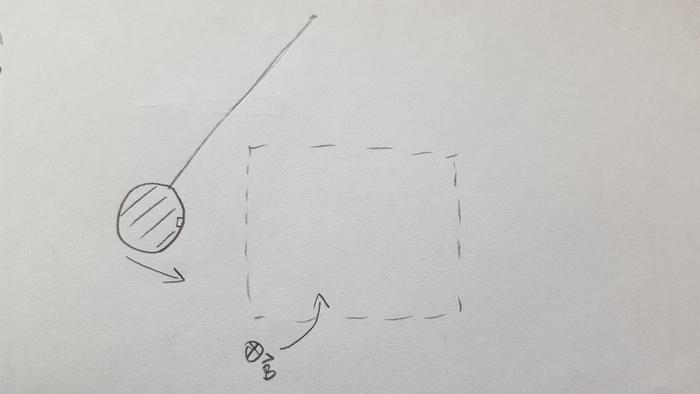
17887639_1382459645174041_1954335255_o.jpg
 
Physics news on Phys.org
If I were attacking this problem, I would not use a top-down approach. Instead of a disk, I would start with a circular loop; once I understand the loop, I can integrate loops to get the disk. Also, I would first consider the loop going into the field region in a straight line; once I understand that, I can extend to the arc of a pendulum.
 
kuruman said:
If I were attacking this problem, I would not use a top-down approach. Instead of a disk, I would start with a circular loop; once I understand the loop, I can integrate loops to get the disk. Also, I would first consider the loop going into the field region in a straight line; once I understand that, I can extend to the arc of a pendulum.
Thanks for the idea, I'll try it out!
 

Similar threads

  • · Replies 10 ·
Replies
10
Views
623
  • · Replies 3 ·
Replies
3
Views
3K
  • · Replies 5 ·
Replies
5
Views
2K
  • · Replies 2 ·
Replies
2
Views
2K
  • · Replies 1 ·
Replies
1
Views
2K
  • · Replies 4 ·
Replies
4
Views
2K
  • · Replies 3 ·
Replies
3
Views
2K
Replies
3
Views
1K
  • · Replies 3 ·
Replies
3
Views
2K
  • · Replies 2 ·
Replies
2
Views
2K