- 2,739
- 11,966
- TL;DR
- A molecular mechanism by which a bacteria can slide along a substrate has been described.
This article from Science Advances (probably not open access, an AAAS publication) has described a complex and interesting molecular mechanism (a nano-bio-molecular machine).
A rotary motor in the cell membrane (driving mechanisms unknown) spins a gear that pushes a "tread" along a track imbeded between the cell's inner and outer membranes in a peptidoglycan layer. The tread poke through the outer membrane topped off with an adhesin molecule which binds things in the substrate. Adhesin molecules are proteins that bind particular extracellular molecules, underlying cell to cell adhesion. This gives the mechanism resistance to move forward with. Since the track spirls around the cell, the cell rotates on its long axis as it moves forward along its access.
Picture of their hypothesized mechanism:
https://www.physicsforums.com/attachments/258274
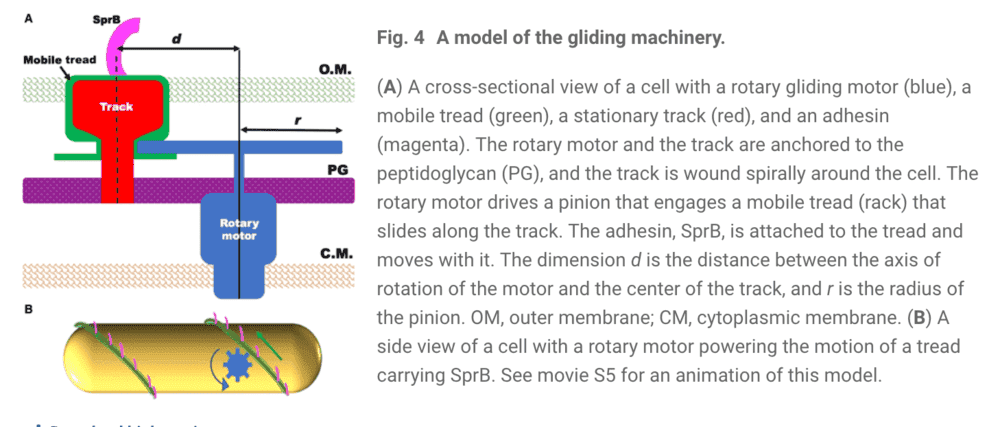
Here is their cartoon movie (click on movie S5) of how it works can be found here (may not be behind paywall since it is supplemental material).
I find these evolved complex molecular machines that cells make use of to be fascinating.
A rotary motor in the cell membrane (driving mechanisms unknown) spins a gear that pushes a "tread" along a track imbeded between the cell's inner and outer membranes in a peptidoglycan layer. The tread poke through the outer membrane topped off with an adhesin molecule which binds things in the substrate. Adhesin molecules are proteins that bind particular extracellular molecules, underlying cell to cell adhesion. This gives the mechanism resistance to move forward with. Since the track spirls around the cell, the cell rotates on its long axis as it moves forward along its access.
Picture of their hypothesized mechanism:
https://www.physicsforums.com/attachments/258274
Here is their cartoon movie (click on movie S5) of how it works can be found here (may not be behind paywall since it is supplemental material).
I find these evolved complex molecular machines that cells make use of to be fascinating.
Last edited:
