Moment of inertia (formula problem)

Click For Summary

Homework Help Overview

The discussion revolves around the concept of moment of inertia, specifically regarding the different formulas used for a slender rod when calculating rotational inertia about different axes. Participants explore the implications of using different values of inertia and the context in which each formula applies.

Discussion Character

  • Conceptual clarification, Assumption checking

Approaches and Questions Raised

  • Participants attempt to understand why two different values of inertia are used for the same slender rod, questioning the interchangeability of these values in calculations. They discuss the context of using the formulas for different points of rotation and express confusion regarding specific examples from the material.

Discussion Status

Some participants express a growing understanding of the topic, noting the importance of the point about which the moment of inertia is calculated. There is acknowledgment of the need to clarify the application of the formulas, and while some questions remain, productive dialogue is occurring regarding the concepts involved.

Contextual Notes

Participants mention specific examples from the material, indicating that the discussion is framed within the constraints of a textbook or instructional context. There is a recognition of potential gaps in foundational understanding that may affect the interpretation of the formulas.

sseebbeekkk
Messages
10
Reaction score
0
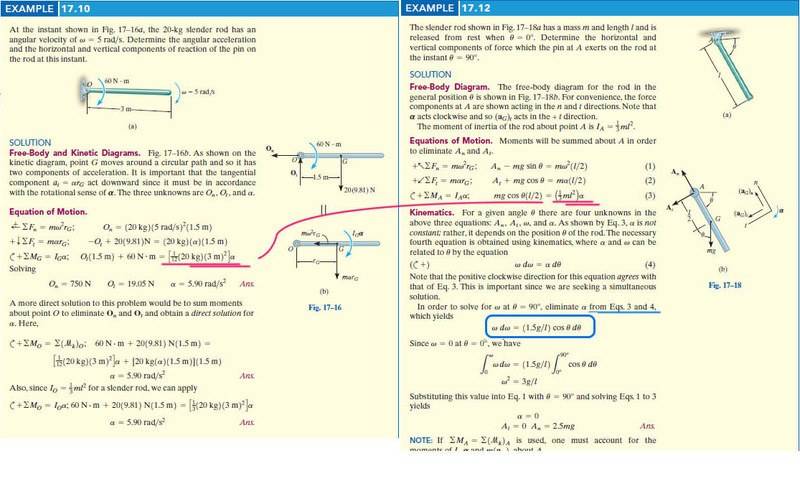
1. Material
DMkRCvV.jpg

2. Questions:

a) (pink) Why does the author use two different values of inertia for the same slender rod ?

The Attempt at a Solution


[/B]
a) I could assume that 1/3 is holding it at the end and 1/12 is holding it in the center.
But it's not interchangeable because if I chose 1/3 instead of 1/12 in the example (17.10) I would get totally different final result.
 
Physics news on Phys.org
sseebbeekkk said:
a) I could assume that 1/3 is holding it at the end and 1/12 is holding it in the center.
They are the rotational inertias about the end and about the center, respectively. It is up to you to figure out which is the most useful point for calculating moments in any particular problem. (Sometimes it doesn't matter.)

sseebbeekkk said:
But it's not interchangeable because if I chose 1/3 instead of 1/12 in the example (17.10) I would get totally different final result.
Realize that 17.10 uses both values of rotational inertia. :)
 
Ok, thank you :)
 
Ok I have realized that I don't understand it fully (I miss something basic probably)
GwP1NjA.png


According to this example we should calculate the moment of inertia using formula I=1/12ml2+md2

So why did the author in 17.10 use simply [1/12ml2]*α

Instead of [1/12ml2+md2]*α
 
sseebbeekkk said:
According to this example we should calculate the moment of inertia using formula I=1/12ml2+md2
Only because you want the moment of inertia about point O.

sseebbeekkk said:
So why did the author in 17.10 use simply [1/12ml2]*α

Instead of [1/12ml2+md2]*α
Because the author was calculating the moment of inertia about the center of mass, not the end of the rod.
 
Ok, finally I understand it (hope so)

I can choose I=1/12ml2 = in that case (17.10) 1/12*20*32=15
or I=1/3ml2 = (center at 1.5) 1/3*20*1,52=15

It works :biggrin:EDIT: but if that what I have just written is true, I have got the following question:

Why did the author write in 17.12 (1/3ml2) instead of 1/3m * (l/2)2 ?
 
Last edited:
sseebbeekkk said:
Ok, finally I understand it (hope so)

I can choose I=1/12ml2 = in that case (17.10) 1/12*20*32=15
or I=1/3ml2 = (center at 1.5) 1/3*20*1,52=15
Don't do that!

In both formulas, the "l" stands for the length of the rod. It's the same value in both formulas. The moment of inertia about one end (the 1/3 formula) is different from the moment of inertia about the center (the 1/12 formula).
 
That was very concise and clear.
Thank you :-)
 

Similar threads

Replies
2
Views
2K
  • · Replies 13 ·
Replies
13
Views
3K
Replies
11
Views
4K
  • · Replies 3 ·
Replies
3
Views
1K
  • · Replies 12 ·
Replies
12
Views
2K
Replies
25
Views
2K
Replies
8
Views
2K
  • · Replies 4 ·
Replies
4
Views
2K
  • · Replies 9 ·
Replies
9
Views
2K
  • · Replies 9 ·
Replies
9
Views
2K