Moon's eccentricity, apogee and perigee

  • Context: Undergrad 
  • Thread starter Thread starter darkdave3000
  • Start date Start date
  • Tags Tags
    Eccentricity
Click For Summary
SUMMARY

The discussion centers on the variability of the Moon's orbital properties, specifically eccentricity, apogee, and perigee, which are influenced by the Sun's tidal forces. The Moon's orbit experiences changes due to the gravitational pull of the Sun, causing its shape to distort and leading to variations in these properties over time. The JPL Horizons website is identified as a key resource for obtaining current and historical data on the Moon's orbital elements. The participants conclude that the precession of the Moon's orbit does not directly explain the changes in apogee and perigee; rather, it is the changes in eccentricity that drive these variations.

PREREQUISITES
  • Understanding of lunar orbital mechanics
  • Familiarity with tidal forces and their effects on celestial bodies
  • Knowledge of orbital elements, including eccentricity, apogee, and perigee
  • Experience with astronomical data retrieval, particularly from JPL Horizons
NEXT STEPS
  • Research how to calculate the Moon's eccentricity over time using historical data
  • Explore the JPL Horizons website for real-time lunar orbital data
  • Study the effects of solar perturbations on the Moon's orbit
  • Investigate the relationship between the Moon's apogee and perigee in relation to its position relative to the Sun
USEFUL FOR

Astronomers, astrophysicists, software developers creating lunar simulations, and educators seeking to understand the dynamics of the Moon's orbit and its variations.

darkdave3000
Messages
242
Reaction score
5
Why do these properties each have a range each instead of a fixed value? Is it because of the 8 year precession?

I'm writing a graphical software that will illustrate the lunar orbit. I planned to show the precession too but am unsure what values of apogee and perigee and even eccentricity because of the ranges given in Wikipedia.

Note the fixed values that are given are given as averages of the given ranges. Once again, why are there ranges?
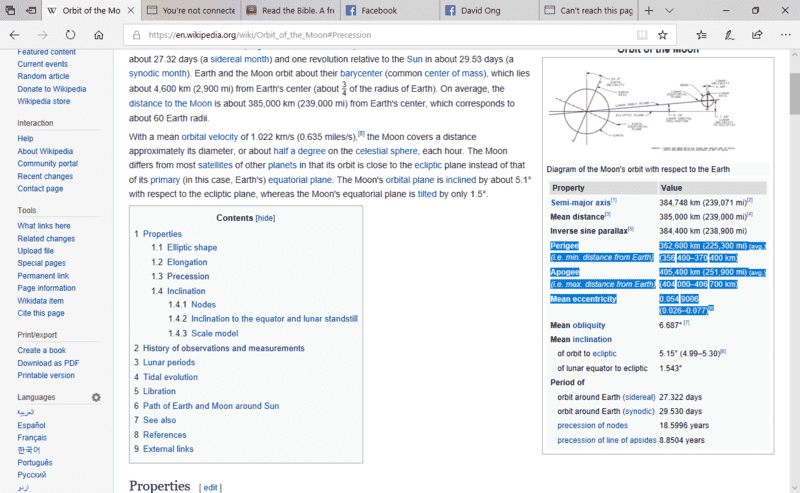
upload_2019-1-9_1-1-21.png
 

Attachments

  • upload_2019-1-9_1-1-21.png
    upload_2019-1-9_1-1-21.png
    71 KB · Views: 1,132
Astronomy news on Phys.org
The Sun exerts a tidal influence across the orbit of the Moon distorting its shape. As the Earth-Moon system orbits the Sun, the orientation of the line of apsides changes with respect to the radial line joining with the Sun, Thus the distortion of the Moon's orbital shape changes over the course of a year, altering the perigee and apogee.
 
I get that there is precession caused by the sun so the moon-earth orbit rotates as Wikipedia shows, but how does this change the eccentricity and the resulting perigee and apogee? Is this change a cycle that repeats and is predictable? If so how do I calculate when the apogee will be at it's min and max end of it's range?
 
Figures 4-6 and 4-7 at this site show how the eccentricity, apogee, and perigee change with time. You would need to dig deeper to know exactly how those graphs are calculated.
 
  • Like
Likes   Reactions: darkdave3000
darkdave3000 said:
I get that there is precession caused by the sun so the moon-earth orbit rotates as Wikipedia shows, but how does this change the eccentricity and the resulting perigee and apogee? Is this change a cycle that repeats and is predictable? If so how do I calculate when the apogee will be at it's min and max end of it's range?
While precession will change the direction of the line of apsides with respect to the the fixed stars over time, What I was talking about was how tidal forces of the Sun actually pull on and change the shape of the Moon's orbit. IOW, the Moon's orbit exhibits its own version of "tidal bulges". When these bulges align with the line of apsides, its eccentricity is increased and both perigee and apogee are pulled further from the Earth.
 
Where can I find:

1) The location of the current apogee and perigee using the Earth Moon barycentre as a position reference?

2) Or their current distances from said reference frame?

3) Also where can I also find out the length of the current Semi Major Axis of the moon's orbit?

I'm asking since all of these numbers change with time after each new moon... surely there is a way to get their current values and perhaps also their past and future numbers? Since I'm building a simulator I need to know where to position these nodes according to the user specified calendar date.

If I cannot find these values, would it be fair to say that when the apogee is minimum the perigee will be maximum and vice versa? Can I use the min and max values of both nodes this way?
 
Last edited:
Early solar system sim:
 
darkdave3000 said:
Where can I find:

1) The location of the current apogee and perigee using the Earth Moon barycentre as a position reference?

2) Or their current distances from said reference frame?

3) Also where can I also find out the length of the current Semi Major Axis of the moon's orbit?

I'm asking since all of these numbers change with time after each new moon... surely there is a way to get their current values and perhaps also their past and future numbers? Since I'm building a simulator I need to know where to position these nodes according to the user specified calendar date.

If I cannot find these values, would it be fair to say that when the apogee is minimum the perigee will be maximum and vice versa? Can I use the min and max values of both nodes this way?

The best place to get this kind of information is the JPL Horizons web site. It can tell you the position of any solar system body at any time. There is a page here that lists the orbital elements of the moon at a single time, but I don't see how to get these as a function of time. It has a reference that might be useful. Finding the data you are asking for will probably be a significant amount of work.
 
  • Like
Likes   Reactions: darkdave3000
Thanks for this, I was going to ask if I could do this:

"So if I was to use 0.7 X apogee's min-max range and add it to the apogee's minimum distance then the Perigee should be 0.3 X perigee's rage added to perigee's minimum right?"
or similarly:
"So if I was to use 0.5 X apogee's min-max range and add it to the apogee's minimum distance then the Perigee should be 0.5 X perigee's rage added to perigee's minimum right?"
"So if I was to use 1 X apogee's min-max range and add it to the apogee's minimum distance then the Perigee should be 0 X perigee's rage added to perigee's minimum right?"
"So if I was to use 0 X apogee's min-max range and add it to the apogee's minimum distance then the Perigee should be 1 X perigee's rage added to perigee's minimum right?"

Tell me what you think, in the mean time I will check out your references.

David

phyzguy said:
The best place to get this kind of information is the JPL Horizons web site. It can tell you the position of any solar system body at any time. There is a page here that lists the orbital elements of the moon at a single time, but I don't see how to get these as a function of time. It has a reference that might be useful. Finding the data you are asking for will probably be a significant amount of work.
 
  • #10
After reading the materials, the precession of the Moon's orbit does not explain the varying distances to the apogee and perigee. Can anyone else explain how the orbit changes shape? The precession of the orbit does not explain why or how it changes shape nor does it explain it. Are you sure that the precession of the orbit is directly influencing the changing shape of the orbit and the varying apogee?

Would it be more logical to reason that the apogee is at maximum when it faces the sun and minimum when the perigee faces the sun according to season?
 
  • #11
No one said that it was just the precession that affects the shape of the orbit. I think the best answer is, "it's complicated." In the link I posted in post #4, it says:

"This dynamic behavior is due to the gravitational pull of the Sun on the Moon as it orbits Earth. Consequently, a continuous torque is applied to the lunar orbit in an unsuccessful effort to permanently align the major axis towards the Sun. The annual orbit of the Earth-Moon system around the Sun coupled with the Moon's synodic orbit around Earth mean that the conditions for such a permanent alignment are always changing. The overall effect is to twist and distort the shape and orientation of the Moon's elliptical orbit.

It was stated earlier that the Moon's mean orbital eccentricity is 0.0549, but this too is subject to large changes because of solar perturbations. Figure 4-6 plots the variation in the Moon's orbital eccentricity from 2008 through 2010. The instantaneous eccentricity (light gray curve) oscillates with a period tied to the synodic month and ranges from 0.0266 to 0.0762 over this 3-year interval. "

It is the changes in eccentricity that cause the changes in apogee and perigee, not the precession. As I said earlier, getting all of the details right will probably be a lot of work. I suspect you could spend years modeling the moon's orbit in detail, and I'll bet people have.
 
  • Like
Likes   Reactions: darkdave3000
  • #12
Right right right! So what happens if the sun finally manages to get that semi major axis to turn toward the sun? 2012 disaster film? :)

Or will the alignment stay fixed toward the sun permanently?
 
  • #13
darkdave3000 said:
After reading the materials, the precession of the Moon's orbit does not explain the varying distances to the apogee and perigee. Can anyone else explain how the orbit changes shape? The precession of the orbit does not explain why or how it changes shape nor does it explain it. Are you sure that the precession of the orbit is directly influencing the changing shape of the orbit and the varying apogee?

Would it be more logical to reason that the apogee is at maximum when it faces the sun and minimum when the perigee faces the sun according to season?
Here is the Moon's orbit at 4 different times of Earth's orbit. In the upper corner is its "normal" shape without tidal influence by the Sun. We will ignore any apsidal precession.
orbit shape.png

The red arrows show the tidal force "stretching" the Orbit. At the top and bottom this stretches the Moon's orbit along the major axis(pulling both perigee and apogee away from the Earth), and on either side , it stretches it along the minor axis.( The shapes here are exaggerated for visual effect.)
The tidal Influence from the Sun also produces an apsidal precession causing the line of apsides joining perigee and apogee to rotate with respect to the fixed stars. One complete rotation takes ~8.45 yrs. This simply means the the line of apsides won't align with the Sun at the same point of the orbit every time, and the times of the year when the perigee is at its furthest changes.
 

Attachments

  • orbit shape.png
    orbit shape.png
    6.6 KB · Views: 1,052
Last edited:
  • #14
darkdave3000 said:
Right right right! So what happens if the sun finally manages to get that semi major axis to turn toward the sun? 2012 disaster film? :)

Or will the alignment stay fixed toward the sun permanently?
That can never happen. The tidal influence from the Sun has an effect that produces a torque that causes the line of apsides to rotate. It's like when you try to change the direction of the axis of a gyroscope; it twists in your hands and the "twist" is at right angles to the direction you were trying to turn it.
 

Similar threads

  • · Replies 2 ·
Replies
2
Views
2K
  • · Replies 2 ·
Replies
2
Views
6K
  • · Replies 1 ·
Replies
1
Views
3K
  • · Replies 2 ·
Replies
2
Views
3K
  • · Replies 13 ·
Replies
13
Views
2K
  • · Replies 1 ·
Replies
1
Views
4K
  • · Replies 6 ·
Replies
6
Views
4K
  • · Replies 4 ·
Replies
4
Views
5K
  • · Replies 4 ·
Replies
4
Views
3K
  • · Replies 43 ·
2
Replies
43
Views
12K