Multi-event probability puzzle - is my answer correct?

  • Thread starter Thread starter musicgold
  • Start date Start date
  • Tags Tags
    Probability Puzzle
Click For Summary
SUMMARY

The forum discussion centers on calculating the probabilities of achieving exactly three different colors in two bags through a series of exchanges. The initial configuration includes Bag A with red, green, violet, and yellow balls, and Bag B with black and orange balls. The participants detail four possible exchanges, each with specific probabilities calculated as fractions, ultimately leading to a combined probability of 6/25 for achieving the desired outcome. The discussion also highlights the potential oversight of additional cases in the calculations, prompting further exploration of the problem.

PREREQUISITES
  • Understanding of basic probability concepts
  • Familiarity with combinatorial analysis
  • Knowledge of color theory in probability contexts
  • Experience with mathematical notation and fraction calculations
NEXT STEPS
  • Explore advanced combinatorial probability techniques
  • Research the concept of conditional probability in multi-event scenarios
  • Learn about the application of probability trees for complex exchanges
  • Investigate similar probability puzzles involving colored objects and exchanges
USEFUL FOR

Mathematicians, educators, students studying probability theory, and puzzle enthusiasts seeking to enhance their problem-solving skills in combinatorial contexts.

musicgold
Messages
303
Reaction score
19
Homework Statement
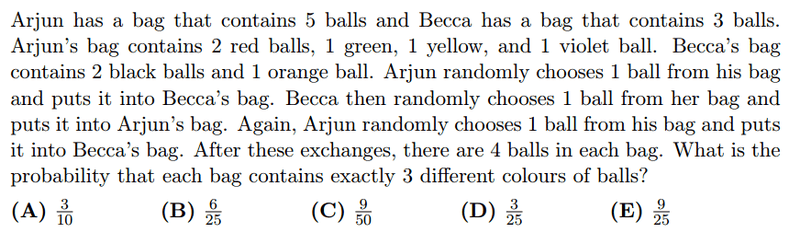
Is there a more elegant / efficient way to solve this puzzle? See the attached puzzle.
Relevant Equations
At the end of all three 3 moves, the bags should contain:
Bag B: B, B, O, + G/V/Y
Bag A: remaining balls
Here is my attempt.
Beginning state:
Bag B : B, B, O
Bag A : R, R, G, V, Y

Final state:
Bag B: B, B, O, + G/V/Y
Bag A: remaining balls

First possible exchange that would have exactly 3 different colors in each bag is:
Move 1: P ( Arjun moves either the green, violet, or yellow ball to bag B) = 3/5
Move 2. P ( Becca moves one black ball to bag A ) = 2/4
Move 3. P ( Arjun moves the black ball to bag B ) = 1/5
P (exchange 1)= 3/5 x 2/4 x 1/5 = 3/50

Second possible move that would have exactly 3 different colors in each bag is:
Move 1: P ( Arjun moves one red ball to bag B) = 2/5
Move 2. P ( Becca moves the red ball to bag A ) = 1/4
Move 3. P ( Arjun moves either the green, violet, or yellow ball to bag B ) = 3/5
P(exchange 2) = 3/5 x 2/4 x 1/5 = 3/50

P ( exchange 1 OR exchange 2) = 3/50+ 3/50 = 3/25
2023-12-26 07 57 10.png
 
Physics news on Phys.org
Are you sure those are the only possibilities?
 
  • Like
Likes   Reactions: musicgold
PeroK said:
Are you sure those are the only possibilities?
Ah...

Third possible exchange that would have exactly 3 different colors in each bag is:
Move 1: P ( Arjun moves either the green, violet, or yellow ball to bag B) = 3/5
Move 2. P ( Becca moves the orange ball to bag A ) = 1/4
Move 3. P ( Arjun moves the orange ball to bag B ) = 1/5
P (exchange 3)= 3/5 x 1/4 x 1/5 = 3/100

Fourth possible exchange that would have exactly 3 different colors in each bag is:
Move 1: P ( Arjun moves either G/V/Y ball to bag B) = 3/5
Move 2. P ( Becca moves the G/V/Y ball to bag A ) = 1/4
Move 3. P ( Arjun moves either G/V/Y ball to bag B ) = 3/5
P (exchange 4)= 3/5 x 1/4 x 3/5 = 9/100

P ( exchange 1 OR exchange 2 OR exchange 3 OR exchange 4 ) = 6/100+ 6/100+ 3/100 + 9/100 = 6/25 ?

Any better way of solving this without missing any possible exchanges in the first place?


Thanks
 
The only idea I have is to note that we have six different colours, with two duplicates. If we have three different colours in a bag, then we must have a d pair of duplicates plus two others. The final configuration must have two B's in one bag and two R's in the other.

As only one ball is taken from bag B, then we must leave the two black balls alone.

Likewise, we either leave the two red balls alone, or move one back and forward.

And, if we leave the red balls alone, it doesn't matter which of the others we choose.
 
  • Like
Likes   Reactions: musicgold
A black ball can move out of bag 2, then back in, if a "non red" ball was moved in first.
 
  • Like
Likes   Reactions: SammyS and PeroK
There is some symmetry here. You can waste a pair of moves at the start, RR, or a pair at the end, BB. There are three options for the third move.
The only other sequences consist of leaving the reds and blacks alone, 3x2x3.
 
  • Like
Likes   Reactions: bob012345
musicgold said:
Ah...

Third possible exchange that would have exactly 3 different colors in each bag is:
Move 1: P ( Arjun moves either the green, violet, or yellow ball to bag B) = 3/5
Move 2. P ( Becca moves the orange ball to bag A ) = 1/4
Move 3. P ( Arjun moves the orange ball to bag B ) = 1/5
P (exchange 3)= 3/5 x 1/4 x 1/5 = 3/100

Fourth possible exchange that would have exactly 3 different colors in each bag is:
Move 1: P ( Arjun moves either G/V/Y ball to bag B) = 3/5
Move 2. P ( Becca moves the G/V/Y ball to bag A ) = 1/4
Move 3. P ( Arjun moves either G/V/Y ball to bag B ) = 3/5
P (exchange 4)= 3/5 x 1/4 x 3/5 = 9/100

P ( exchange 1 OR exchange 2 OR exchange 3 OR exchange 4 ) = 6/100+ 6/100+ 3/100 + 9/100 = 6/25 ?

Any better way of solving this without missing any possible exchanges in the first place?


Thanks
If you are still interested, I think you missed some cases in the third possible exchange.
 
bob012345 said:
If you are still interested, I think you missed some cases in the third possible exchange.
Yes, I'm not sure whether @musicgold realised that post #6 leads to a higher number than 6/25.
 
  • Like
Likes   Reactions: bob012345

Similar threads

  • · Replies 2 ·
Replies
2
Views
3K
  • · Replies 2 ·
Replies
2
Views
1K
  • · Replies 8 ·
Replies
8
Views
2K
  • · Replies 8 ·
Replies
8
Views
3K
  • · Replies 10 ·
Replies
10
Views
3K
Replies
7
Views
2K
  • · Replies 6 ·
Replies
6
Views
2K
  • · Replies 10 ·
Replies
10
Views
3K
  • · Replies 2 ·
Replies
2
Views
3K
  • · Replies 2 ·
Replies
2
Views
3K