Multiple reflections in A-mode ultrasound imaging

35 replies · 5K views · last reply
nao113
Messages
68
Reaction score
13
Homework Statement
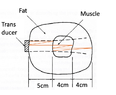
(a) For the anatomical configuration shown right, sketch the arrival times of all echoes as they would be seen on an A-mode display. Do not calculate echo strengths, merely calculate times of arrival referenced to the initial transmit time, out to a maximum of 200 us. Include multiple reflections and use the precise phase velocity of the materials shown.
(b) What percentage error is introduced in the calculated arrival time of the first echo if the velocity is assumed to be the average calibration value (c = 1540 m/s) rather than fat?
Relevant Equations
t1 = (2/c1) l1
t2 =t1+(2/c2) l2
Diagram of a tissue cross-section with a transducer on the left edge, showing a fat layer around an inner muscle region, with dashed beam lines and distance markers of 5cm, 4cm and 4cm along the horizontal axis.

Here is my answer:
PART A:
Handwritten-style calculation of ultrasound travel times: velocities fat = 1479 m/s and muscle = 1566 m/s, then t1 = 67.6 us, t2 = 118.7 us, t3 = 172.8 us from layer thicknesses of 5 cm and 4 cm.

Those three didn't surpass 200 us.
But, I am still wondering whether I did it right or not since I don t really understand the meaning of `multiple reflections `. I don't know whether I have answered for multiple reflections in my answer above. or should I double the value t1, or t2 to include multiple reflections.
Slide showing an A-mode ultrasound echo diagram: a tissue outline with a transducer on the left, speed c1 in the outer region and c2 in an inner region, layer thicknesses l1 and l2, and an amplitude-versus-time trace with echoes a, b, c and d at times t1, t2 and t3, with the last echo circled and labelled multiple reflections.

The picture above is the sample in the material, but I still don't understand.

PART B:
Handwritten-style typeset solution: b) Answer. Velocity: average calibration value = 1540 m/s; t1' = (2/c1') l1' = 2/1540 m/s (5 x 10^-2 m) = 10^-1/1540 s = 64.9 x 10^-6 s = 64.9 us; t1 = (2/c1) l1 = 2/1479 m/s (5 x 10^-2 m) = 10^-1/1479 s = 67.6 x 10^-6 s = 67.6 us; percentage error equation with (67.6 - 64.9) us / 67.6 us x 100% = 4%.

Please help me to point out my mistake in the answers. Thank you
 
Last edited:

Your calculations look good so far.

Multiple reflections occur when there is more than one reflection before the sound is detected. Here are some examples:

Three diagrams of an ultrasound transducer on the left, with blue ray paths bouncing between a blunt-shaped object and the transducer, numbered red points 1 to 6, with distances of 5cm and 4cm marked below each.

The two pictures on the left have three reflections. The picture on the right has five reflections. Clearly, there are many possibilities. Fortunately, you only need to be concerned with cases for which the total travel time is less than 200 μs.

So far, you have found 3 cases with travel times less than 200 μs. These are single reflection cases. Can you find any cases of multiple reflections where the total travel time is less than 200 μs?
 
  • Like
Likes   Reactions: Steve4Physics, PhDeezNutz, Delta2 and 1 other person
TSny said:
Your calculations look good so far.

Multiple reflections occur when there is more than one reflection before the sound is detected. Here are some examples:

View attachment 301422
The two pictures on the left have three reflections. The picture on the right has five reflections. Clearly, there are many possibilities. Fortunately, you only need to be concerned with cases for which the total travel time is less than 200 μs.

So far, you have found 3 cases with travel times less than 200 μs. These are single reflection cases. Can you find any cases of multiple reflections where the total travel time is less than 200 μs?
Thank you very much for the explanation, okay, I ll try to do it. Btw, for part b about the error, did you think I get it right?
 
nao113 said:
Btw, for part b about the error, did you think I get it right?
Yes, it looks right.
 
TSny said:
Your calculations look good so far.

Multiple reflections occur when there is more than one reflection before the sound is detected. Here are some examples:

View attachment 301422
The two pictures on the left have three reflections. The picture on the right has five reflections. Clearly, there are many possibilities. Fortunately, you only need to be concerned with cases for which the total travel time is less than 200 μs.

So far, you have found 3 cases with travel times less than 200 μs. These are single reflection cases. Can you find any cases of multiple reflections where the total travel time is less than 200 μs?
Hello, related to the statement `Do not calculate echo strengths, merely calculate times of arrival referenced to the initial transmit time, out to a maximum of 200 us.“ What does it actually mean?

honestly, I am confused about what “t“ means? is it the variable for each echo?

I tried to calculate based on the picture I sent. I think this one is multiple reflection with less than 200 us.
My answer is on the next post
 
Last edited:
Let's take your nice example:
Diagram of an ultrasound beam path through a cross-section of tissue, with a transducer on the left, fat regions, a central muscle region, and numbered reflection points 1 to 5 joined by orange arrows; labelled widths 5 cm, 4 cm and 4 cm along the bottom.


We want to find the total time that it takes the sound to travel this complicated path. This will be the time at which the echo is detected for this multiple-reflection example.

Note that the sound travels four times through the 5 cm of fat on the left side, as shown below in blue:
Diagram of an ultrasound transducer on the left side of a cross-section of tissue, with a layer of fat around a central muscle region. Orange and blue arrows trace multiple reflection paths numbered 1 to 5. Labels read 5cm, 4cm and 4cm along the bottom.


The sound also travels twice through the 4 cm of fat on the right:
Diagram of a cross-section with fat on the outer region and a central muscle region, a transducer on the left edge, numbered orange arrows showing a multiple-reflection sound path, a blue path on the right, and distance labels 5cm, 4cm and 4cm along the bottom.


That makes a total distance of 28 cm of travel through fat.

The sound also travels six times through the 4 cm of muscle, as shown in green:

Diagram of an ultrasound transducer on the left edge of a body cross-section with fat and a central muscle region, showing orange and green multiple-reflection paths; labelled 5cm, 4cm and 4cm along the bottom.

So that's 24 cm of travel through muscle.

How much time does it take the sound to travel through 28 cm of fat?
How much time does it take the sound to travel through 24 cm of muscle?
What's the time at which the echo for this example is detected?
 
  • Like
Likes   Reactions: hutchphd
TSny said:
Let's take your nice example:
View attachment 301596

We want to find the total time that it takes the sound to travel this complicated path. This will be the time at which the echo is detected for this multiple-reflection example.

Note that the sound travels four times through the 5 cm of fat on the left side, as shown below in blue:
View attachment 301597

The sound also travels twice through the 4 cm of fat on the right:
View attachment 301598

That makes a total distance of 28 cm of travel through fat.

The sound also travels six times through the 4 cm of muscle, as shown in green:

View attachment 301599
So that's 24 cm of travel through muscle.

How much time does it take the sound to travel through 28 cm of fat?
How much time does it take the sound to travel through 24 cm of muscle?
What's the time at which the echo for this example is detected?
Thank you very much for the guidance, I calculated the question you asked. btw, I didn't know how to calculate “What's the time at which the echo for this example is detected?“ Do I just need to do addition as 378.6 us + 306.5 us = 658.1 us for ur third ? Which one that I need to get less than 200 us? Is it your 1 and 2 questions or the third one? Thank youuu
 
Attachments
  • Two worked equations: t_fat = (2/c_fat) l_fat = 2/1479 m/s x 28 x 10^-2 m = 378.6 x 10^-6 s, and t_muscle = (2/c_muscle) l_muscle = 2/1566 m/s x 24 x 10^-2 m = 306.5 x 10^-6 s.
    Screen Shot 2022-05-19 at 12.25.30.png
    8.1 KB · Views: 175
  • Like
Likes   Reactions: Delta2
nao113 said:
Thank you very much for the guidance, I calculated the question you asked. btw, I didn't know how to calculate “What's the time at which the echo for this example is detected?“ Do I just need to do addition as 378.6 us + 306.5 us = 658.1 us for ur third ?
Yes, you would add the total time traveled in the fat to the total time traveled in the muscle to get the time of arrival of the echo. But, I don't agree with your numbers 378.6 μs and 306.5 μs. These are twice what I get. Can you explain how you obtained these results?

nao113 said:
Which one that I need to get less than 200 us? Is it your 1 and 2 questions or the third one? Thank youuu
It's the time of arrival of the echo (my third question) that needs to be less than 200 μs.
 
TSny said:
Yes, you would add the total time traveled in the fat to the total time traveled in the muscle to get the time of arrival of the echo. But, I don't agree with your numbers 378.6 μs and 306.5 μs. These are twice what I get. Can you explain how you obtained these results?It's the time of arrival of the echo (my third question) that needs to be less than 200 μs.
I explained how I got them in the picture I attached, is it visible on your side? May I know how you got ur answer?
 
Here it is
 
Attachments
  • Two typeset equations giving round-trip travel times: t_fat = (2/c_fat) l_fat = 2/(1479 m/s) × 28×10^-2 m = 378.6 × 10^-6 s, and t_muscle = (2/c_muscle) l_muscle = 2/(1566 m/s) × 24×10^-2 m = 306.5 × 10^-6 s.
    Screen Shot 2022-05-19 at 12.25.30.png
    8.1 KB · Views: 175
Hi @nao113. Some thoughts which might help.

You can save work by converting speeds to cm/μ s at the start. Then to get a time, you simply divide distance (in cm) by the speed (in cm/μs).

E.g. ##c_{muscle}## = 1566m/s = 0.1566cm/μs.

The fastest speed is in muscle. The furthest distance which can be covered in 200 μs is therefore 200μs x 0.1566 cm/μ s = 31.32cm (less if there is some fat).

Paths longer than 31.23cm will take more than 200μs and can be ignored.

We can represent the layers like this:

A←5cm fat→B←4cm muscle→C←4cm fat→D​

The simplest possible paths (one reflection each) are:
A→B→A (path-length= 5cm+5cm=10cm)
A→B→C→B→A(path-length= 5cm+4cm+ 4cm+5cm =18cm)
A→B→C→D→C→B-A(path-length=5cm+4cm+ 4cm+4cm + 4cm+5cm = =26cm)
So these explain three of the signals of the display

Many other paths are possible, e.g.
A→B→A→B→A (path-length= 5cm+5cm+5cm+5cm+ = 20cm

Think about the possible paths. You can ignore paths of length greater than 32.32cm. (Note that a path through a lot of fat, can be less than 32.32cm but still take more than 200μs; so these need separate checking.)

A few other points...

In the formula ##t = (\frac 2 c)l## note that ##l## is the depth and the factor 2 doubles it to give path-length. Don’t accidentally use ##l## as the path-length.

Be careful with your choice of symbols. In a post #1 attachment you used ##c_1## and ##c_3## for the speed in fat. You should use the same symbol for the same quantity..

And (even worse!) you wrote:
##\epsilon = \frac {t_1 – t_1}{t_1} \times 100%##
which (I hope you realize) gives zero!
You need different symbols for different times.

Make sure your understand what is going on – don’t just be plug numbers into formulae.
 
  • Like
Likes   Reactions: TSny
The total time of travel through the fat is just $$t_{fat} = \frac{\rm distance \,traveled \, through \, fat}{\rm speed \, through \, fat}$$
We found that the distance through the fat is 28cm. So, the time of travel through the fat is $$t_{fat} = \frac{0.28 \rm m}{1479 \; \rm m/s}$$
You calculated this as ##t_{fat} = 2 \frac{0.28 m}{1479 m/s}##. The factor of 2 should not be there.

I think you are maybe getting confused because of the way the textbook or class notes wrote ##t_1 = \frac{2}{c_1} l_1## for the case shown below
Diagram of a body cross-section with an irregular outline containing an inner cavity, a hatched transducer on the left edge, and a blue arrow path going into the body and back. Three segments are labelled l1, l2 and l3 along the bottom.


You can see that the distance traveled is ##2 l_1##. So, the arrival time for the echo is ##t_1 = \frac{2 l_1}{c_1}##. And this can be written as ##t_1 = \frac{2}{c_1} l_1##.

[Edited to correct a typo]
 
Last edited:
Steve4Physics said:
And (even worse!) you wrote:
##\epsilon = \frac {t_1 – t_1}{t_1} \times 100%##
which (I hope you realize) gives zero!
You need different symbols for different times.
It's hard to see 🔬, but I think the OP has a prime on the second ##t_1## in the numerator:
Equation: epsilon = (t1 - t1') / t1 x 100 %, with a prime on the second t1 in the numerator.
 
  • Like
Likes   Reactions: Steve4Physics
TSny said:
It's hard to see 🔬, but I think the OP has a prime on the second ##t_1## in the numerator:
View attachment 301639
Thanks @TSny. You are correct. I should have looked more carefully (and should clean my screen more often). Apologies to @nao113 .
 
Steve4Physics said:
Thanks @TSny. You are correct. I should have looked more carefully (and should clean my screen more often). Apologies to @nao113 .
No worries, btw, thank you for your attention, you helped me a lot
 
Last edited:
TSny said:
The total time of travel through the fat is just $$t_{fat} = \frac{\rm distance \,traveled \, through \, fat}{\rm speed \, through \, fat}$$
We found that the distance through the fat is 28cm. So, the time of travel through the fat is $$t_{fat} = \frac{0.28 \rm m}{1479 \; \rm m/s}$$
You calculated this as ##t_{fat} = 2 \frac{0.28 m}{1479 m/s}##. The factor of 2 should not be there.

I think you are maybe getting confused because of the way the textbook or class notes wrote ##t_1 = \frac{2}{c_1} l_1## for the case shown below
View attachment 301635

You can see that the distance traveled is ##2 l_1##. So, the arrival time for the echo is ##t_1 = \frac{2 l_1}{c_1}##. And this can be written as ##t_1 = \frac{2}{c_1} l_1##.

[Edited to correct a typo]
I see I got it, I will try to implement your solution, that s a very complete explanation Thank you very much. Btw, may I have another question? These are the question and my answer. The question asked me to draw, did I draw it right?
 
Attachments
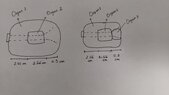
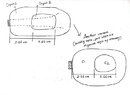
  • Handwritten sketch of two side-by-side cross-sections of a body with Organ 1, Organ 2 and Organ 3 labelled by arrows, dashed beam lines passing through, and distance markings of 2.66 cm, 2.66 cm and 0.3 cm along the bottom.
    WhatsApp Image 2022-05-20 at 3.45.43 AM.jpeg
    20.9 KB · Views: 144
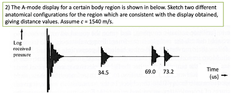
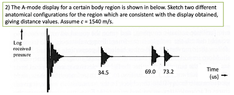
  • Handwritten-style problem statement and an A-mode ultrasound trace: log received pressure against time in microseconds, with a large initial spike and echoes at 34.5, 69.0 and 73.2 us.
    Screen Shot 2022-05-20 at 3.36.53.png
    36.4 KB · Views: 175
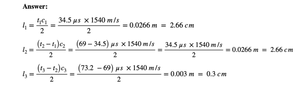
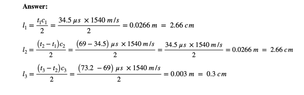
  • Handwritten-style typeset solution with three equations for layer thicknesses l1, l2 and l3 using round-trip echo times and speed 1540 m/s, giving 0.0266 m (2.66 cm), 0.0266 m (2.66 cm) and 0.003 m (0.3 cm).
    Screen Shot 2022-05-20 at 3.38.19.png
    8.2 KB · Views: 157
Steve4Physics said:
Hi @nao113. Some thoughts which might help.

You can save work by converting speeds to cm/μ s at the start. Then to get a time, you simply divide distance (in cm) by the speed (in cm/μs).

E.g. ##c_{muscle}## = 1566m/s = 0.1566cm/μs.

The fastest speed is in muscle. The furthest distance which can be covered in 200 μs is therefore 200μs x 0.1566 cm/μ s = 31.32cm (less if there is some fat).

Paths longer than 31.23cm will take more than 200μs and can be ignored.

We can represent the layers like this:

A←5cm fat→B←4cm muscle→C←4cm fat→D​

The simplest possible paths (one reflection each) are:
A→B→A (path-length= 5cm+5cm=10cm)
A→B→C→B→A(path-length= 5cm+4cm+ 4cm+5cm =18cm)
A→B→C→D→C→B-A(path-length=5cm+4cm+ 4cm+4cm + 4cm+5cm = =26cm)
So these explain three of the signals of the display

Many other paths are possible, e.g.
A→B→A→B→A (path-length= 5cm+5cm+5cm+5cm+ = 20cm

Think about the possible paths. You can ignore paths of length greater than 32.32cm. (Note that a path through a lot of fat, can be less than 32.32cm but still take more than 200μs; so these need separate checking.)

A few other points...

In the formula ##t = (\frac 2 c)l## note that ##l## is the depth and the factor 2 doubles it to give path-length. Don’t accidentally use ##l## as the path-length.

Be careful with your choice of symbols. In a post #1 attachment you used ##c_1## and ##c_3## for the speed in fat. You should use the same symbol for the same quantity..

And (even worse!) you wrote:
##\epsilon = \frac {t_1 – t_1}{t_1} \times 100%##
which (I hope you realize) gives zero!
You need different symbols for different times.

Make sure your understand what is going on – don’t just be plug numbers into formulae.
Thank you very much for the explanation, this is so detail ... I ll try to use this understanding on my answer
 
  • Like
Likes   Reactions: Steve4Physics
Steve4Physics said:
Hi @nao113. Some thoughts which might help.

You can save work by converting speeds to cm/μ s at the start. Then to get a time, you simply divide distance (in cm) by the speed (in cm/μs).

E.g. ##c_{muscle}## = 1566m/s = 0.1566cm/μs.

The fastest speed is in muscle. The furthest distance which can be covered in 200 μs is therefore 200μs x 0.1566 cm/μ s = 31.32cm (less if there is some fat).

Paths longer than 31.23cm will take more than 200μs and can be ignored.

We can represent the layers like this:

A←5cm fat→B←4cm muscle→C←4cm fat→D​

The simplest possible paths (one reflection each) are:
A→B→A (path-length= 5cm+5cm=10cm)
A→B→C→B→A(path-length= 5cm+4cm+ 4cm+5cm =18cm)
A→B→C→D→C→B-A(path-length=5cm+4cm+ 4cm+4cm + 4cm+5cm = =26cm)
So these explain three of the signals of the display

Many other paths are possible, e.g.
A→B→A→B→A (path-length= 5cm+5cm+5cm+5cm+ = 20cm

Think about the possible paths. You can ignore paths of length greater than 32.32cm. (Note that a path through a lot of fat, can be less than 32.32cm but still take more than 200μs; so these need separate checking.)

A few other points...

In the formula ##t = (\frac 2 c)l## note that ##l## is the depth and the factor 2 doubles it to give path-length. Don’t accidentally use ##l## as the path-length.

Be careful with your choice of symbols. In a post #1 attachment you used ##c_1## and ##c_3## for the speed in fat. You should use the same symbol for the same quantity..

And (even worse!) you wrote:
##\epsilon = \frac {t_1 – t_1}{t_1} \times 100%##
which (I hope you realize) gives zero!
You need different symbols for different times.

Make sure your understand what is going on – don’t just be plug numbers into formulae.
the question asked me to include multiple reflections, so it doesn't mean I need to make three different path for the anatomical configuration, right? There are single reflection you mentioned:
A→B→A (path-length= 5cm+5cm=10cm)
A→B→C→B→A(path-length= 5cm+4cm+ 4cm+5cm =18cm)
A→B→C→D→C→B-A(path-length=5cm+4cm+ 4cm+4cm + 4cm+5cm = =26cm)

So, to create multiple reflection, I need to make a new path like A -> B -> A -> C -> A ( 5 + 5 + 5 + 4 + 4 + 5 = 28 cm) -> based on my calculation, it will produce less than 200 us. Am I correct?
 
TSny said:
Your calculations look good so far.

Multiple reflections occur when there is more than one reflection before the sound is detected. Here are some examples:

View attachment 301422
The two pictures on the left have three reflections. The picture on the right has five reflections. Clearly, there are many possibilities. Fortunately, you only need to be concerned with cases for which the total travel time is less than 200 μs.

So far, you have found 3 cases with travel times less than 200 μs. These are single reflection cases. Can you find any cases of multiple reflections where the total travel time is less than 200 μs?
Btw, for multiple reflection, can I stop on the muscle, let say there are A - B = 5 cm, B-C = 4 cm, and C-D= 4 cm. Can I stop on B? so it will be like A-B-A-C-B-D-C, can I do that?
 
Attachments
  • Diagram of an ultrasound transducer on the left edge of a body cross-section, with fat labelled around a muscle region; orange lines show multiple reflection paths, and distances of 5cm, 4cm and 4cm are marked along the beam.
    Screen Shot 2022-05-13 at 16.51.46-4.png
    56.3 KB · Views: 167
nao113 said:
the question asked me to include multiple reflections, so it doesn't mean I need to make three different path for the anatomical configuration, right?
I'm not quite sure what you are asking here.

nao113 said:
There are single reflection you mentioned:
A→B→A (path-length= 5cm+5cm=10cm)
A→B→C→B→A(path-length= 5cm+4cm+ 4cm+5cm =18cm)
A→B→C→D→C→B-A(path-length=5cm+4cm+ 4cm+4cm + 4cm+5cm = =26cm)
Yes. Of course, for A→B→C→B→A you need to take into account that 10 cm of length takes place in fat and 8 cm takes place in muscle. It looks like you correctly calculated the time for this path in your first post.
A simple way to calculate this is ##t_{\rm echo} = \frac{.10 \, \rm m}{1479 \, \rm m/s} +\frac{.08 \, \rm m}{1566 \, \rm m/s} = 118.7 \, \mu \rm s##

Likewise, for the path A→B→C→D→C→B-A you can see that 18 cm takes place in fat and 8 cm takes place In muscle. So,
##t_{\rm echo} = \frac{.18 \, \rm m}{1479 \, \rm m/s} +\frac{.08 \, \rm m}{1566 \, \rm m/s} = 172.8 \, \mu \rm s##. This agrees with what you got for this path in your first post.

nao113 said:
So, to create multiple reflection, I need to make a new path like A -> B -> A -> C -> A ( 5 + 5 + 5 + 4 + 4 + 5 = 28 cm) -> based on my calculation, it will produce less than 200 us. Am I correct?
Yes, I also get less than 200 μs for this case. If you want to tell me the specific answer that you got for this case, I can tell you if I agree.
 
nao113 said:
Btw, for multiple reflection, can I stop on the muscle, let say there are A - B = 5 cm, B-C = 4 cm, and C-D= 4 cm. Can I stop on B? so it will be like A-B-A-C-B-D-C, can I do that?
No. The sound must return to the transducer in order to be registered as an echo. So, all paths must start and end at A.
 
TSny said:
I'm not quite sure what you are asking here.Yes. Of course, for A→B→C→B→A you need to take into account that 10 cm of length takes place in fat and 8 cm takes place in muscle. It looks like you correctly calculated the time for this path in your first post.
A simple way to calculate this is ##t_{\rm echo} = \frac{.10 \, \rm m}{1479 \, \rm m/s} +\frac{.08 \, \rm m}{1566 \, \rm m/s} = 118.7 \, \mu \rm s##

Likewise, for the path A→B→C→D→C→B-A you can see that 18 cm takes place in fat and 8 cm takes place In muscle. So,
##t_{\rm echo} = \frac{.18 \, \rm m}{1479 \, \rm m/s} +\frac{.08 \, \rm m}{1566 \, \rm m/s} = 172.8 \, \mu \rm s##. This agrees with what you got for this path in your first post.Yes, I also get less than 200 μs for this case. If you want to tell me the specific answer that you got for this case, I can tell you if I agree.
Thank you so much for the detail information. Okay, I ll share my full answer, btw, can I ask another question? I already answered it, here they are. Did I do it correctly?
 
Attachments
  • A-mode ultrasound display plotting log received pressure against time in microseconds, with a large initial spike near zero and echo peaks labelled at 34.5, 69.0 and 73.2 us.
    Screen Shot 2022-05-20 at 3.36.53.png
    36.4 KB · Views: 157
  • Worked solution with three equations for layer thicknesses l1, l2 and l3 using t times c divided by 2, with values in microseconds and metres per second, giving 0.0266 m, 0.0266 m and 0.003 m.
    Screen Shot 2022-05-20 at 3.38.19.png
    8.2 KB · Views: 171
  • Hand-drawn sketch of two cross-sections showing organs with dashed ultrasound beam lines; left diagram labels Organ 1 and Organ 2 with distances 2.66 cm, 2.66 cm and 0.3 cm; right diagram labels Organ 1, Organ 2 and Organ 3 with distances 2.66 cm, 2.66 cm and 0.3 cm.
    WhatsApp Image 2022-05-20 at 3.45.43 AM.jpeg
    20.9 KB · Views: 162
TSny said:
I'm not quite sure what you are asking here.Yes. Of course, for A→B→C→B→A you need to take into account that 10 cm of length takes place in fat and 8 cm takes place in muscle. It looks like you correctly calculated the time for this path in your first post.
A simple way to calculate this is ##t_{\rm echo} = \frac{.10 \, \rm m}{1479 \, \rm m/s} +\frac{.08 \, \rm m}{1566 \, \rm m/s} = 118.7 \, \mu \rm s##

Likewise, for the path A→B→C→D→C→B-A you can see that 18 cm takes place in fat and 8 cm takes place In muscle. So,
##t_{\rm echo} = \frac{.18 \, \rm m}{1479 \, \rm m/s} +\frac{.08 \, \rm m}{1566 \, \rm m/s} = 172.8 \, \mu \rm s##. This agrees with what you got for this path in your first post.Yes, I also get less than 200 μs for this case. If you want to tell me the specific answer that you got for this case, I can tell you if I agree.
Here is my full answer.. do you agree with me? Thank you
 
Attachments
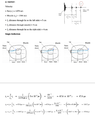
  • Worked solution with A-mode ultrasound A-scan trace at top right showing echoes a to d over time, three diagrams of a transducer beam through fat and muscle layers, and equations for t1, t2 and t3 in microseconds.
    Screen Shot 2022-05-20 at 6.47.51.png
    25.9 KB · Views: 165
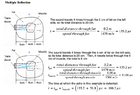
  • Two diagrams labelled A and B of an ultrasound transducer on the left sending beams through a body cross-section with fat, muscle and a labelled 5cm, 4cm, 4cm depth scale, with worked calculations for echo time: t = 135.2 µs for fat and t_muscle = 51.08 µs, total 186.3 µs.
    Screen Shot 2022-05-20 at 6.48.08.png
    48.8 KB · Views: 182
nao113 said:
Thank you so much for the detail information. Okay, I ll share my full answer, btw, can I ask another question? I already answered it, here they are. Did I do it correctly?
Two hand-drawn sketches of a rounded shape with a transducer on the left, dashed beam lines, and labelled regions 2.66 cm, 2.66 cm and 0.3 cm; the left sketch has Organ 1 and Organ 2, the right has Organ 1, Organ 2 and Organ 3.


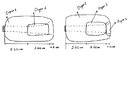
Both of these configurations would produce the A-mode display of echos. But, the two configurations are esssentially the same since they both consist of two 2.66 cm regions and one 0.3 cm region and all three regions are assumed to have the same sound speed c. Can you come up with a different configuration that is fundamentally different and would produce the same display of echos?
 
TSny said:
View attachment 301664

Both of these configurations would produce the A-mode display of echos. But, the two configurations are esssentially the same since they both consist of two 2.66 cm regions and one 0.3 cm region and all three regions are assumed to have the same sound speed c. Can you come up with a different configuration that is fundamentally different and would produce the same display of echos?
How about I replaced the first picture with this one? so only 2 organs here with one 2.66 cm region and one 0.3 cm region. Then, should I name these two organs as organ 4 and organ 5? since organ 1, 2, and 3 are used in the second picture?, by doing that, it seems that they will have different speed of c
 
Attachments
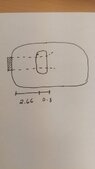
  • Hand-drawn sketch of a rounded oval outline with a hatched probe block on the left, dashed lines running to a small rounded inner shape, and labels 2.66 and 0.3 with a dimension line beneath.
    WhatsApp Image 2022-05-20 at 7.10.33 AM.jpeg
    10.6 KB · Views: 160
nao113 said:
How about I replaced the first picture with this one?
Hand-drawn sketch of a rounded shape with a hatched rectangle on its left edge and a small rounded bar inside, with dashed lines extending from the bar; labels 2.66 and 0.3 mark distances along a horizontal dimension line below.

This won't work since it would produce an echo at 38.4 μs which does not appear in the echo display diagram. Can you see how this echo would be produced?
 
By the way, in your figure shown below you might want to calculate the 0.3 cm distance more accurately so that it is accurate to the nearest 0.01 cm.
Handwritten sketch of two cross-sections of a rounded body with a probe on the left, dashed beam lines, Organ 1, Organ 2 and Organ 3 labelled, and segment lengths 2.66 cm, 2.66 cm and 0.3 cm marked below.
 
TSny said:
View attachment 301667
This won't work since it would produce an echo at 38.4 μs which does not appear in the echo display diagram. Can you see how this echo would be produced?
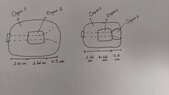
Yes, I just realized it will produced 38.4. is there any formula to recreate another anatomical configurations? Can you explain more about what should I have to do? Here, I tried another one, is it correct?
 
Attachments
  • Two hand-drawn sketches of an ultrasound probe on an oval body outline: top shows Organ 1 and Organ 2 with dashed beam lines and distances 2.66 cm and 2.66 cm; bottom labels the regions C1 and C2 with the same 2.66 cm distances.
    WhatsApp Image 2022-05-20 at 7.52.01 AM.jpeg
    31.2 KB · Views: 145
Last edited:
TSny said:
By the way, in your figure shown below you might want to calculate the 0.3 cm distance more accurately so that it is accurate to the nearest 0.01 cm.
View attachment 301666
Yes, I changed the way I draw it so the distance will look more realistic
 
Attachments
  • Two hand-drawn side-by-side diagrams of a rounded rectangular body with a hatched probe at the left edge and dashed beam lines running right. Left: Organ 1 is the outer region, Organ 2 a rectangle inside; distances 2.66 cm, 2.66 cm, 0.3 cm. Right: Organ 1, Organ 2, and a thin Organ 3 at the far right; distances 2.66 cm, 2.66 cm, 0.3 cm.
    WhatsApp Image 2022-05-20 at 7.07.55 AM.jpeg
    22.5 KB · Views: 161