My confusion about ##u## and ##\mu##

  • Context: High School 
  • Thread starter Thread starter docnet
  • Start date Start date
  • Tags Tags
    Confusion
Click For Summary
SUMMARY

The discussion clarifies the confusion surrounding the symbols ##u## and ##\mu## in the context of partial differential equations. The function ##u(x, y)## is often used, while ##\mu(x, y)## represents a measure or index, with the Greek letter ##\mu## being pronounced "MYOO." The distinction between these symbols is emphasized, noting that ##u## is typically a function and ##\mu## is used in integrals, such as ##\int u\,d\mu##. The conversation also highlights the potential for sloppy handwriting to cause misinterpretation of these symbols.

PREREQUISITES
  • Understanding of partial differential equations
  • Familiarity with mathematical notation and symbols
  • Knowledge of measure theory concepts
  • Basic grasp of Greek alphabet in mathematical contexts
NEXT STEPS
  • Research the role of measures in integration, specifically in the context of Lebesgue integration
  • Study the conventions of mathematical notation in differential equations
  • Explore the differences between Latin and Greek symbols in mathematical literature
  • Learn about common handwriting issues in mathematical writing and their impact on interpretation
USEFUL FOR

Students and educators in mathematics, particularly those studying partial differential equations, as well as anyone interested in mathematical notation and its conventions.

docnet
Messages
796
Reaction score
486
TL;DR
Are ##u## and ##\mu## used interchangeably in partial differential equations?
Hi all, I am confused about symbols.

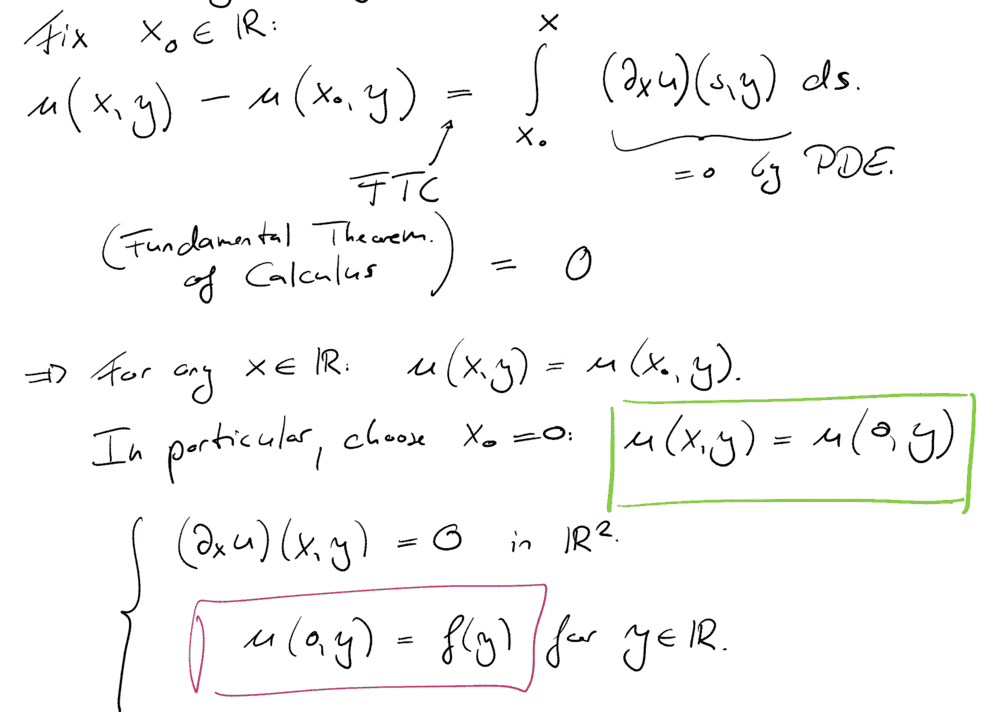
I cannot figure out why my partial differential equations professor writes ##u## and ##\mu## in his lectures. A function ##u(x, y)## turns into ##\mu(x, y)##. His homework sets are always typed with ##u##. I also think he says MYOO during the lectures so it is not just a strange way to write ##u##. He is a Frenchman.
Screen Shot 2021-01-31 at 2.43.15 AM.png
 
Mathematics news on Phys.org
##u## and ##\mu## are two very different letters, not only because one is Latin and the other one is Greek, but also because ##\mu ## is the Greek ##m##. I cannot find any ##\mu## in your photo above, and I think it is more a case of sloppy handwriting than it is a case of interchanging the two. However, there are some conventions: ##u## is normally a function, ##\mu## is either an index or a measure. This means that ##\int u\,d\mu## makes sense. But as with all conventions, this is no rule and everybody can use it in a different way.
 
  • Like
Likes   Reactions: docnet and sysprog
@fresh_42 is right - this is sloppy handwriting. The same error can be seen in the 'y' characters, particularly in the last line (the second one in ## f(y) ## is almost unrecognisable).

Note that outside a mathematical context the prefix 'micro-' which is properly abbreviated ## \mu ## is sometimes represented by a 'u' when limited to characters of the Latin alphabet: 1 min = 60 s = 60,000 ms = 60,000,000 us.
 
Last edited:
  • Like
Likes   Reactions: docnet and sysprog

Similar threads

  • · Replies 19 ·
Replies
19
Views
3K
  • · Replies 7 ·
Replies
7
Views
3K
  • · Replies 50 ·
2
Replies
50
Views
4K
  • · Replies 3 ·
Replies
3
Views
1K
  • · Replies 1 ·
Replies
1
Views
2K
  • · Replies 7 ·
Replies
7
Views
2K
Replies
1
Views
2K
  • · Replies 11 ·
Replies
11
Views
2K
  • · Replies 0 ·
Replies
0
Views
2K
  • · Replies 10 ·
Replies
10
Views
2K