Need help solving 1st order pde numerically

  • Context: Graduate 
  • Thread starter Thread starter re444
  • Start date Start date
  • Tags Tags
    Pde
Click For Summary

Discussion Overview

The discussion revolves around solving a first-order partial differential equation (PDE) numerically, specifically using the method of characteristics. The problem is situated in the context of a thesis, with a focus on a nonlinear equation that requires a system of five ordinary differential equations (ODEs) to be solved as part of a boundary value problem.

Discussion Character

  • Exploratory
  • Technical explanation
  • Debate/contested
  • Mathematical reasoning

Main Points Raised

  • Reza expresses confusion about treating the parameter 'r' in the ODEs, noting that the equations involve derivatives with respect to 'r' but not 's'.
  • One participant suggests that without equations involving 's', a solution may not be attainable.
  • Reza inquires about alternative methods, specifically mentioning the "Vanishing Viscosity method".
  • Another participant asks for clarification on the definition of 'r' and whether the equations were derived using the method of characteristics, requesting the original PDEs and boundary conditions.
  • Reza provides the original PDE and mentions medium-related parameters, indicating the formulation of the characteristic method used.
  • A later reply explains that 'r' and 's' are independent variables, and that the solution involves integrating along lines of constant 'r' in the 's' direction, emphasizing the need to solve the ODEs repeatedly for different values of 'r'.

Areas of Agreement / Disagreement

Participants express varying levels of understanding and propose different approaches to the problem. There is no consensus on how to proceed with the numerical solution, and multiple viewpoints regarding the treatment of parameters and methods remain present.

Contextual Notes

The discussion highlights potential limitations in the formulation of the problem, particularly regarding the dependence on the definitions of 'r' and 's', and the need for clarity on the boundary conditions and original PDEs.

re444
Messages
14
Reaction score
0
Hi everybody,

I need to solve a 1st order PDE for my thesis and I'm not a specialist in this field.
I've read some texts about this and know one method of solving a 1st order PDE is the method of characteristics. since my equation is nonlinear and a bit complicated, I'm going to solve it numerically.

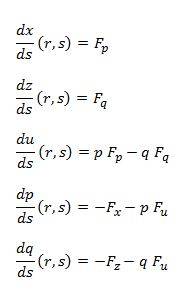
Equation should be solved in x-z domain so I have to solve a system of five ODEs and is a boundary problem (Cauchy problem). According to the text found in internet the five are of the form:

main formula:
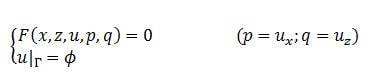
10pcdps.jpg


ODEs to be solved:

33c6wcn.jpg


I omit the 5 boundary equations which are of the form for example for q, q(r,0)=g(r).

In the case of analytical solution at the end, u, the answer, will become: u=u(x,z). But when trying to solve numerically I'm a bit confused. How I should treat the parameter 'r' in ODEs? Software s like Matlab solves system of ODEs but this kind of ODEs with two parameters, 'r' and 's', seems strange to me!

Any suggestion and hint is really appreciated,
Reza,
 
Physics news on Phys.org
These are all functions of r and s but you only have equations involving the derivative with respect to r? You will not be able to get a solution because you have no way to find the functions dependence on s.
 
  • Like
Likes   Reactions: 1 person
Then How should I treat with my problem? Should I test some other methods? How about "Vanishing Viscosity method" ?
 
re444 said:
Hi everybody,

I need to solve a 1st order PDE for my thesis and I'm not a specialist in this field.
I've read some texts about this and know one method of solving a 1st order PDE is the method of characteristics. since my equation is nonlinear and a bit complicated, I'm going to solve it numerically.

Equation should be solved in x-z domain so I have to solve a system of five ODEs and is a boundary problem (Cauchy problem). According to the text found in internet the five are of the form:

main formula:

10pcdps.jpg


ODEs to be solved:

33c6wcn.jpg


I omit the 5 boundary equations which are of the form for example for q, q(r,0)=g(r).

In the case of analytical solution at the end, u, the answer, will become: u=u(x,z). But when trying to solve numerically I'm a bit confused. How I should treat the parameter 'r' in ODEs? Software s like Matlab solves system of ODEs but this kind of ODEs with two parameters, 'r' and 's', seems strange to me!

Any suggestion and hint is really appreciated,
Reza,
What is the definition of r in this development? I assume that the equations you have listed were derived using the method of characteristics. Correct? Would it be possible to list the original PDEs and boundary conditions?
 
Chestermiller said:
What is the definition of r in this development? I assume that the equations you have listed were derived using the method of characteristics. Correct? Would it be possible to list the original PDEs and boundary conditions?

Yes sure, the original PDE is:

288nhgo.jpg


in which \alpha_{i}s are medium related parameters.

The formulation of the characteristic method I'm using is from here.

thanks,
Reza
 
Thanks for sending me the write-up on the method of characteristics. It was a little complicated, and I didn't have the determination or time to go through the details. But I do understand the questions you are asking as well as the equations you are working with. The parameters r and s are independent variables, and x and y are parameterized in terms of r and s. You are integrating along lines of constant r in the s direction. You will be solving the set of differential equations over and over again, starting at location s = 0, but for different values of r. This is how you fill in the function space of all the dependent variables as a function of r and s. But, for this to work, you need to know the dependent variable values at the appropriate x and z values that correspond to the curve s = 0 at the different values of r along that contour. I hope this makes sense. The key is that you have to solve the ordinary differential equations over and over again for various values of r.

Chet
 

Similar threads

  • · Replies 36 ·
2
Replies
36
Views
5K
  • · Replies 5 ·
Replies
5
Views
3K
  • · Replies 2 ·
Replies
2
Views
4K
  • · Replies 3 ·
Replies
3
Views
1K
  • · Replies 1 ·
Replies
1
Views
2K
  • · Replies 5 ·
Replies
5
Views
4K
  • · Replies 12 ·
Replies
12
Views
2K
  • · Replies 1 ·
Replies
1
Views
2K
  • · Replies 6 ·
Replies
6
Views
3K
  • · Replies 1 ·
Replies
1
Views
2K