No Infinite speed on information yet?

Click For Summary
SUMMARY

The discussion centers on the impossibility of using entangled photon pairs for instantaneous communication. It highlights that while detecting photons at D1 results in particle behavior at D0, the randomness of measurement outcomes prevents the transmission of information. The concept of entanglement does not allow for controlled state collapse, making it impossible to send binary information (1s and 0s) without prior communication of measurement results. This catch-22 scenario confirms that no mechanism for communication can be established using this method.

PREREQUISITES
  • Understanding of quantum entanglement
  • Familiarity with photon detection methods (D0 and D1)
  • Knowledge of wavefunction collapse in quantum mechanics
  • Basic principles of interference patterns in quantum experiments
NEXT STEPS
  • Research the implications of quantum entanglement on information theory
  • Learn about the measurement problem in quantum mechanics
  • Explore the concept of wavefunction collapse and its interpretations
  • Investigate alternative quantum communication methods, such as quantum key distribution
USEFUL FOR

Quantum physicists, researchers in quantum communication, and students studying advanced quantum mechanics concepts.

seb7
Messages
66
Reaction score
0
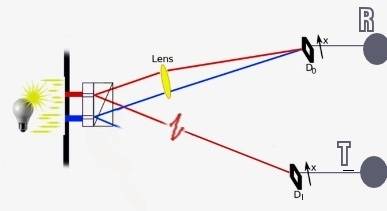
Could someone explain why we can not use the double split experiment with entangled photon pairs as to communicate information at infinite speed? Switching off and on readers effects whether the other photons displays as interference or as particles; so why can't we use this to send 1 and 0s. (Its probably been asked before, but my searches are not turning up any answers for me.)

1 - photons being deliberately detections by D1 and recorded, thus show particles at D0
0 - photons not being recorded via D1, thus photons show interference at D0.

By firing a constant stream of photos to both D0, D1, surely we can use time to instantly send information from D1 to D0 ?

Here's a sketch, (manipulated from a similar experiment.. )
info-ftl.jpg
 
Physics news on Phys.org
You misunderstand entanglement. The results are random so no information is transmitted. That is, if you KNOW what the state is of a particle that's going to hit D1 before it hits, then it is not entangled with anything.
 
It doesn't work because, as soon as the entangled partner is out there, you never see an interference pattern.

dcqe-photon-graph.png


Using the measurement results from the other party, you can filter the result-not-showing-an-interference-pattern into two complementary interference patterns. But they need to tell you the measurement results, which is kind of a catch-22 if you're trying to make a mechanism for communication. You need the mechanism to communicate, but you need to communicate for the mechanism to work. Clearly not going to work very well.
 
There's no way of controlling the information you send (making the use of the word a bit of a misnomer), we know (or pretty sure) that the collapse of the wavefunction is 'instantaneous' now (youtube.com/watch?v=6Dp27XYjHuk) but this doesn't mean one can control what state it collapses in!

If you think carefully about what is described there you see why it's impossible by these means.
 

Similar threads

  • · Replies 2 ·
Replies
2
Views
2K
  • · Replies 2 ·
Replies
2
Views
2K
  • · Replies 3 ·
Replies
3
Views
4K
  • · Replies 12 ·
Replies
12
Views
3K
  • · Replies 8 ·
Replies
8
Views
3K
  • · Replies 3 ·
Replies
3
Views
2K
  • · Replies 11 ·
Replies
11
Views
2K
  • · Replies 20 ·
Replies
20
Views
2K
  • · Replies 7 ·
Replies
7
Views
2K
  • · Replies 15 ·
Replies
15
Views
2K