Other No motivation, considering taking time off -- what are some....

  • Thread starter Thread starter ozil
  • Start date Start date
  • Tags Tags
    Motivation Time
Click For Summary
The discussion revolves around the challenges faced by a college graduate with a low GPA who aspires to attend medical school after initially failing science courses. The individual is considering taking time off to work and improve their academic skills, particularly in math and science, while also contemplating a master's degree to bolster their qualifications. Participants emphasize the importance of developing effective study habits, maintaining discipline, and the need for practical experience in the field, such as working in a lab. Suggestions include focusing on foundational knowledge in chemistry and math, potentially taking community college courses, and engaging in projects to enhance motivation and accountability. Overall, the conversation highlights the significant effort required to overcome past academic failures and the importance of a strategic approach to future studies.
  • #31
russ_watters said:
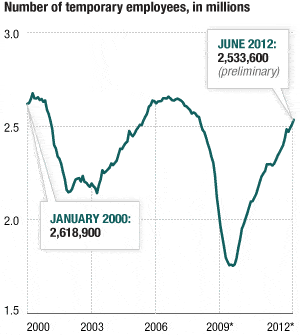
OT, but though I realize many people are thinking pessimistically, there really aren't any typical statistical indicators that say the economy isn't good overall: unemployment, corporate earnings, personal incomes, stock market, GDP, etc. are all doing well or very well. Most relevant to the question I was answering though is unemployment: since we are effectively at full employment, it means that jobs are out there for the asking/taking right now, so it is as good a time to upgrade as it ever gets to be. And [google] my speculation was correct too: temporary employment is cyclical, matching permanent employment (or even leading it a bit). IE, when the economy is down people get rid of their temporary employees first and when the economy is up, they hire temporary employees first. This is out of date, but the trend has continued the past 3 years:
gr-tempemployees-300.gif


Today it is near or at an all-time high of 3.2 million:
https://americanstaffing.net/posts/2016/12/07/staffing-employment-growth-eased-third-quarter/
http://www.marketplace.org/2016/05/31/world/profits-temps

russ, as a counter-example to your claim above, see the following article from CNN:

http://money.cnn.com/2016/02/06/news/economy/obama-us-jobs/

Granted, this dates back to February 2016 so may be outdated, but according to the article:

1. Only 62.7% of adult Americans are working, based on the Labor Force Participation Rate (presumably collected from the BLS), which, again according to the article "hasn't been this low since the 1970's". Now a part of the reason is that a huge part of the population are retiring, and more young people are in college/university and graduate school. But there is also a significant percentage of the population who may have given up searching for work. I don't know if the statistics on this have changed.

2. Long term unemployment (at least as of Feb 2016) was still high, with 2.1 million Americans unable to find work for over a year. Again, I'm curious to see what the long term unemployment numbers are at this time.

3. Wage growth is anemic. Now russ, you state that personal incomes are doing well or very well, but according to the article, the median income is about the same as 20 years ago, adjusting for inflation. Do we have any evidence that the situation has noticeably improved since February?
 
Physics news on Phys.org
  • #32
StatGuy2000 said:
russ, as a counter-example to your claim above, see the following article from CNN:

http://money.cnn.com/2016/02/06/news/economy/obama-us-jobs/

Granted, this dates back to February 2016 so may be outdated, but according to the article:

1. Only 62.7% of adult Americans are working, based on the Labor Force Participation Rate (presumably collected from the BLS), which, again according to the article "hasn't been this low since the 1970's". Now a part of the reason is that a huge part of the population are retiring, and more young people are in college/university and graduate school. But there is also a significant percentage of the population who may have given up searching for work. I don't know if the statistics on this have changed.
There's never such a thing as a perfect economy with no negative indicators, but you have to admit that it takes a pretty deep dive into secondary indicators to find those negatives. That's what that article is about. In this example, not only is it a secondary indicator, but one has to dig into it to find a negative part of it, since the first two explanations for the stat are both positives or at worst neutral! So I'd have to see the stat that they/you are referring to to know how significant it is. But I can say this: after a recession, that number will lag because obviously unemployment has to go down first before people come back into the labor market. So even if that number is higher than what one would call "good" (I don't know because the stat isn't offered), it is still almost certainly trending rapidly in the right direction. And more to the point, with us being essentially at full employment, there is no good excuse for those people to stay out of the labor market.
2. Long term unemployment (at least as of Feb 2016) was still high, with 2.1 million Americans unable to find work for over a year. Again, I'm curious to see what the long term unemployment numbers are at this time.
That is a clear negative, but again, when you have to dig into a positive stat to find a negative component, you're working reeealy hard to spin an overall positive as a negative.
3. Wage growth is anemic. Now russ, you state that personal incomes are doing well or very well, but according to the article, the median income is about the same as 20 years ago, adjusting for inflation. Do we have any evidence that the situation has noticeably improved since February?
That one is now well out of date. It had been of significant concern/surprise during the recovery, but the census bureau updates those numbers annually, in September. So despite being only a 10 month old story, that's 2013-14 numbers. The 2014-15 jump in median income was huge:
http://money.cnn.com/2016/09/13/news/economy/median-income-census/
 
Last edited:
  • #33
russ_watters said:
And more to the point, with us being essentially at full employment

I don't think that's what the data show. Of all the metrics, the one that seems closest to "how easy is it to find a job" is the difference between the U6 and U3 rates. Google was kind enough to find someone who has already plotted it.

U6-minus-U3-Nov2016.jpg


It shows that things are better than they have been since 2008, but not as good as the 1994-2008 period.
 
  • #34
Vanadium 50 said:
I don't think that's what the data show. Of all the metrics, the one that seems closest to "how easy is it to find a job" is the difference between the U6 and U3 rates.
That's mainly a measure of the fraction of people who have part time jobs but would prefer full time jobs (underemployment). While I'll acknowledge that underemployment is still a problem, I'm going to be a bit pedantic here and point out that those people do have jobs. And that's probably why I don't see people using that when defining/discussing "full employment": https://en.wikipedia.org/wiki/Full_employment#.22Ideal.22_unemployment

What isn't clear to me is if those who state they are underemployed are actively looking for full time jobs? If they aren't, then there isn't all that much that can be done for such people, is there?

The reason I like the U3 rate is that it is looking at the bottom line from the point of view of the employer: it tells us how easy it is to fill full time job openings and thus how easy it should be for people looking for such jobs to get them. I don't have a ton of sympathy for people who say they want full time jobs, but aren't looking for them (such as "discouraged" workers and "marginally attached", whatever that means). To me, the low U3 rate says the economy is ready for those people to get back in the game, but it is up to them to actually do it.
 
  • #35
russ_watters said:
That's mainly a measure of the fraction of people who have part time jobs but would prefer full time jobs (underemployment). While I'll acknowledge that underemployment is still a problem, I'm going to be a bit pedantic here and point out that those people do have jobs. And that's probably why I don't see people using that when defining/discussing "full employment": https://en.wikipedia.org/wiki/Full_employment#.22Ideal.22_unemployment

What isn't clear to me is if those who state they are underemployed are actively looking for full time jobs? If they aren't, then there isn't all that much that can be done for such people, is there?

The reason I like the U3 rate is that it is looking at the bottom line from the point of view of the employer: it tells us how easy it is to fill full time job openings and thus how easy it should be for people looking for such jobs to get them. I don't have a ton of sympathy for people who say they want full time jobs, but aren't looking for them (such as "discouraged" workers and "marginally attached", whatever that means). To me, the low U3 rate says the economy is ready for those people to get back in the game, but it is up to them to actually do it.

You have to factor in what the jobs are exactly that being created or in demand. If its minimum wage food service or call center jobs then I would say there hasn't been much of an improvement in addressing the core problem. In addition temporary employees are often preferred to full time because they don't require benefits - thus the spike in temporary employees is a result of companies becoming cheaper, not evidence that they couldn't hire a full time worker if they wanted to pay for one.
 
  • #36
Why whine about jobs, as if someone owes you one? Find an unmet need and start a business!
 
  • #37
I am sure Ozil, if you work hard, get decent grades, and do well at interviews + tailor your cv and get those certs...you will land a job. Keep it up : - ) and as Dr said you can even do your own business if you can find such unmet needs. :)
 
  • #38
russ_watters said:
There's never such a thing as a perfect economy with no negative indicators, but you have to admit that it takes a pretty deep dive into secondary indicators to find those negatives. That's what that article is about. In this example, not only is it a secondary indicator, but one has to dig into it to find a negative part of it, since the first two explanations for the stat are both positives or at worst neutral! So I'd have to see the stat that they/you are referring to to know how significant it is. But I can say this: after a recession, that number will lag because obviously unemployment has to go down first before people come back into the labor market. So even if that number is higher than what one would call "good" (I don't know because the stat isn't offered), it is still almost certainly trending rapidly in the right direction. And more to the point, with us being essentially at full employment, there is no good excuse for those people to stay out of the labor market.
That is a clear negative, but again, when you have to dig into a positive stat to find a negative component, you're working reeealy hard to spin an overall positive as a negative.

russ, I didn't really delve that deeply into the statistics on this, so I fully acknowledge that more investigation is required to determine how significant the "discouraged worker" phenomenon is at the time the report was published (which was presumably based on 2013-2014 numbers). More to the point, I would be very interested to see if the percentage of Americans in the work force has shifted significant based on 2014-2015 and 2015-2016 data.

That one is now well out of date. It had been of significant concern/surprise during the recovery, but the census bureau updates those numbers annually, in September. So despite being only a 10 month old story, that's 2013-14 numbers. The 2014-15 jump in median income was huge:
http://money.cnn.com/2016/09/13/news/economy/median-income-census/

In my post, I was precisely looking for evidence of a change in the wage growth, which you have provided (based on the same CNN money section from which I have previously referred to). It is interesting to note the jump in median income between 2014-2015. I would be curious to see what the median income would be for the 2015-2016 period.

[As an aside, it may be worth noting that these jumps in median income occurred under the watch of the Obama administration, and so one could argue that the Obama administration, and Democrats in general, should get credit for this, to the extent that the US federal government has control or influence over the US economy. But I digress.]
 

Similar threads

  • · Replies 9 ·
Replies
9
Views
2K
  • · Replies 16 ·
Replies
16
Views
2K
  • · Replies 33 ·
2
Replies
33
Views
5K
  • · Replies 8 ·
Replies
8
Views
2K
  • · Replies 21 ·
Replies
21
Views
4K
  • · Replies 2 ·
Replies
2
Views
2K
  • · Replies 8 ·
Replies
8
Views
2K
  • · Replies 3 ·
Replies
3
Views
2K
  • · Replies 2 ·
Replies
2
Views
1K
  • · Replies 4 ·
Replies
4
Views
1K