Nonlinear Pendulum: Calculating Angular Displacement

  • Context: Undergrad 
  • Thread starter Thread starter Saim
  • Start date Start date
  • Tags Tags
    Non-linear Pendulum
Click For Summary

Discussion Overview

The discussion revolves around calculating angular displacement for a nonlinear pendulum using elliptical integral equations. Participants explore the relationship between the time period of the pendulum and its angular displacement, considering both theoretical and practical aspects of the problem.

Discussion Character

  • Exploratory
  • Technical explanation
  • Mathematical reasoning

Main Points Raised

  • One participant inquires about calculating angular displacement after determining the time period using elliptical integral equations.
  • Another participant provides links to resources on pendulum clocks and suggests that the equations may yield transcendental solutions.
  • A participant mentions that there is no simple analytic formulation for angular displacement, referencing the use of Fourier series for expressing θ(t).
  • Some participants discuss the differential equation governing the motion of a simple pendulum and the implications of the small angle approximation.
  • There are references to simulations that model displacement against time, indicating potential methods for visualizing the relationship.

Areas of Agreement / Disagreement

Participants express uncertainty regarding the existence of a straightforward analytic solution for angular displacement, with multiple viewpoints on how to approach the problem. No consensus is reached on a definitive method for calculating θ(t).

Contextual Notes

The discussion highlights limitations in deriving angular displacement from the time period, particularly in the context of nonlinear dynamics and the challenges posed by transcendental equations.

Saim
Messages
2
Reaction score
0
If I calculate the time period of a non linear pendulum using elliptical integral equation, then how can I find out the angular displacement.
 
Physics news on Phys.org
Saim said:
If I calculate the time period of a non linear pendulum using elliptical integral equation, then how can I find out the angular displacement.
Welcome to the PF. :smile:

What reading have you been doing on this question so far? I did a Google search on the phrase from your post and got a lot of useful hits: nonlinear pendulum using elliptical integral equation

https://www.google.com/search?clien...HHrYTgAhX1HzQIHbKWD9EQBQgpKAA&biw=807&bih=572
 
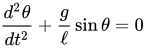
The differential equation which represents the motion of a simple pendulum is
36e0d601a33a7562dfb162abd7e58859a40ccff1

If it is assumed that the angle is much less than 1 radian
e631c25b3635b429ab40642a8c2e2c23ff28fa87

and
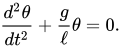
above equation becomes
a4a67eb92d55d29ed4df138689010456418a3b15


Given the initial conditions θ(0) = θ0 and /dt(0) = 0, the solution becomes

c87ee425bd0a91e0e2b11316a3fa755c474e6e77

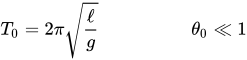
The period of the motion, the time for a complete oscillation is
93d0e7e6fb1df1c2541d6fabbfba15924e35cde4

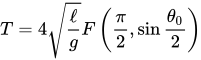
For amplitudes beyond the small angle approximation,time period can be calculated using formula:
9b33d77af48c6b672509da8394e0e7387675db8e

K is the complete elliptic integral of the first kind defined by
7b79d77a3118e9cd02c82ee78498c50d71405646


So, If somehow I am able to calculate the Time period for non linear Pendulum, then how can I plot the angular displacement θ(t) against time.
 
I'm not certain exactly what you want but there are some interesting articles here on the period of extreme precision pendulum clocks. The articles include useful references.
http://www.leapsecond.com/hsn2006/
This is a discussion of the circular error correction of period using AGM.
http://www.leapsecond.com/hsn2006/pendulum-period-agm.pdf
You may be able to invert the equation in his conclusion.
Unfortunately they appear to be transcendental solutions.

Following that are pendulum simulations that model displacement against time.
http://www.leapsecond.com/hsn2006/pendulum-simulation-1.pdf
Perhaps there is a solution using the model, conversion between PE and KE.
 
There is no simple analytic formulation of ##\theta(t)## for the non-linear pendulum.

Check out https://en.wikipedia.org/wiki/Pendulum_(mathematics). You will find there how the period is found to be an elliptical integral, without having to know ##\theta(t)##. There is also an expression for ##\theta(t)## in terms of a Fourier series.
 
There is no simple analytic formulation of ##\theta(t)## for the non-linear pendulum.

Check out https://en.wikipedia.org/wiki/Pendulum_(mathematics). You will find there how the period is found to be an elliptical integral, without having to know ##\theta(t)##. There is also an expression for ##\theta(t)## in terms of a Fourier series.
 

Similar threads

  • · Replies 3 ·
Replies
3
Views
869
  • · Replies 2 ·
Replies
2
Views
2K
  • · Replies 11 ·
Replies
11
Views
2K
  • · Replies 14 ·
Replies
14
Views
2K
  • · Replies 9 ·
Replies
9
Views
3K
  • · Replies 1 ·
Replies
1
Views
2K
  • · Replies 27 ·
Replies
27
Views
2K
  • · Replies 15 ·
Replies
15
Views
2K
  • · Replies 1 ·
Replies
1
Views
2K