Numerically simulating stellar pulsation using a "one zone" model

Click For Summary
SUMMARY

The discussion focuses on numerically simulating stellar pulsation using a "one zone" model, specifically referencing the ideal gas law and hydrostatic equilibrium. The user seeks to determine the appropriate pressure value to input for simulating the Sun's pulsation characteristics, including amplitude and period. The equation of state used is P = Kρ^γ, where γ is a constant. Key expressions derived include the density as a function of radius and the frequency of radial pulsations, which is shown to be independent of amplitude for small oscillations.

PREREQUISITES
  • Understanding of hydrostatic equilibrium in astrophysics
  • Familiarity with the ideal gas law and its application in stellar models
  • Knowledge of pulsation frequency calculations in gaseous spheres
  • Proficiency in numerical simulation techniques for astrophysical phenomena
NEXT STEPS
  • Research the ideal gas law in the context of stellar structures
  • Learn about the derivation of pulsation frequencies in astrophysical contexts
  • Investigate numerical methods for simulating stellar dynamics
  • Explore the impact of varying pressure values on stellar pulsation graphs
USEFUL FOR

Astronomers, astrophysicists, and students studying stellar dynamics and pulsation phenomena will benefit from this discussion.

patrykh18
Messages
32
Reaction score
2
Homework Statement
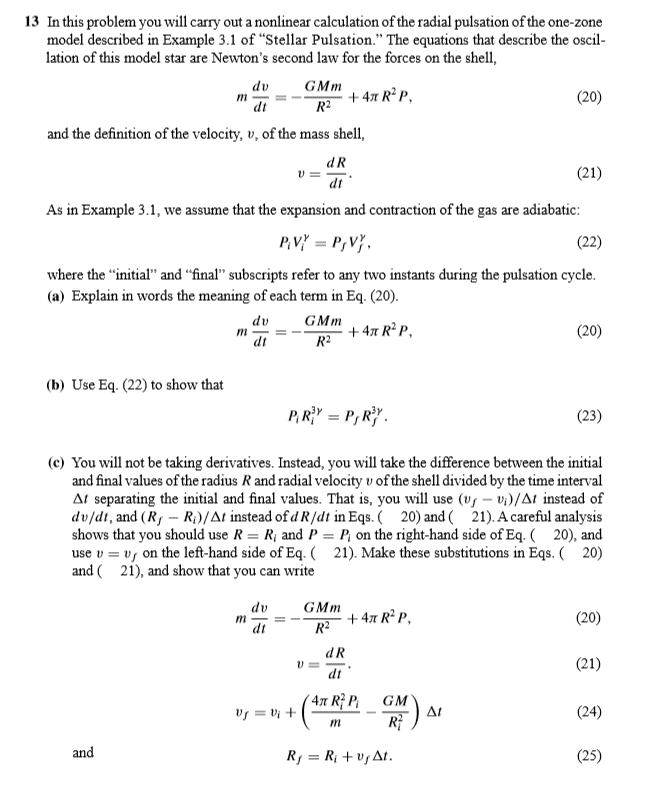
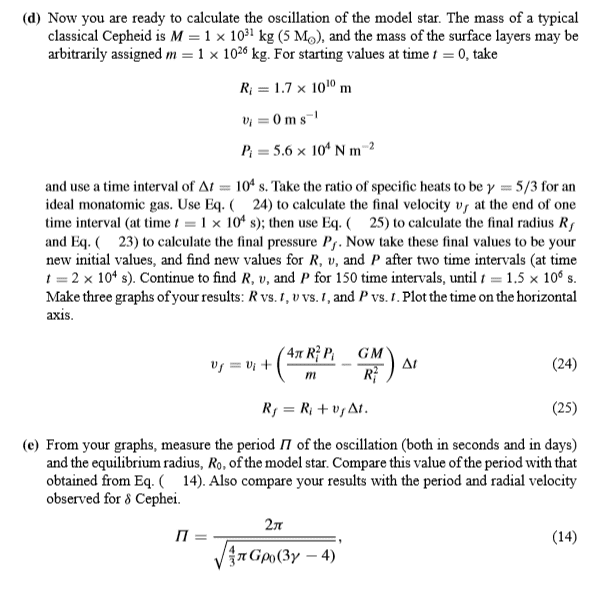
Write a code that will simulate stellar pulsation using a "one zone" model, and plot various graphs
Relevant Equations
The relevant equations are given in the image attached
The question is taken from An Introduction to Modern Astrophysics by Carroll and Ostlie. I did manage to do the entire question and plot the relevant graphs but I just want to to investigate a bit more. For example I want to look at how the graph would like in the case of the Sun. I don't know what the right value for pressure I would need to input in order to get the right graph, with the right amplitude and period. The value for P in part d of the question seems arbitrary to me.
1581789114981.png


1581789160000.png
 
  • Like
Likes   Reactions: PhDeezNutz
Physics news on Phys.org
Any help would be appreciated. Question: Consider a gaseous sphere in hydrostatic equilibrium. Assume that the gas is ideal, with no magnetic field and that the equation of state is given by P = Kρ^γ, where γ is a constant.(a) Derive an expression for the density as a function of radius.(b) Assume that the density at the center of the sphere is ρ_c and that the sound speed is given by c_s = (γP/ρ)^1/2. Obtain an expression for the frequency of radial pulsations of the sphere.(c) Show that for small amplitudes, the frequency is independent of the amplitude.(d) Assuming that P = P_0 cos (ωt), plot the behavior of the density as a function of r for two different values of ω.
 

Similar threads

  • · Replies 1 ·
Replies
1
Views
2K
  • · Replies 9 ·
Replies
9
Views
4K
  • · Replies 8 ·
Replies
8
Views
3K
  • · Replies 20 ·
Replies
20
Views
2K
  • · Replies 3 ·
Replies
3
Views
2K
  • · Replies 29 ·
Replies
29
Views
6K
  • · Replies 19 ·
Replies
19
Views
5K
Replies
1
Views
3K
  • · Replies 5 ·
Replies
5
Views
2K
  • · Replies 1 ·
Replies
1
Views
2K