*oblique asymptotes of radical expressions

  • Topic:
  • Thread starter Thread starter karush
  • Start date Start date
  • Tags Tags
    Expressions Radical
Join the discussion
Registration is free. Start your own thread to ask a follow-up.
3 replies · 7K views
karush
Gold Member
MHB
Messages
3,240
Reaction score
5
it seems most oblique asymptotes are mostly with rational expressions but
$\sqrt{x^2+6x}$ has the asymptote of $y=x+3$ and $y=-x-3$
I don't know how this is derived since it is not a rational expression

thanks ahead:cool:
 
Physics news on Phys.org
karush said:
it seems most oblique asymptotes are mostly with rational expressions but
$\sqrt{x^2+6x}$ has the asymptote of $y=x+3$ and $y=-x-3$
I don't know how this is derived since it is not a rational expression

thanks ahead:cool:

For large \(x\) we have the asymtotic behavior: \[\sqrt{x^2+6x} \sim \sqrt{x^2+6x+9}=\pm (x+3)\]
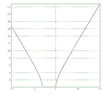
Note deliberate error of use of the \(\pm\) sign, a square root is by definition positive, so as \(x \to +\infty,\ \sqrt{x^2+6x} \sim x+3\), and \(x \to -\infty,\ \sqrt{x^2+6x} \sim -(x+3)\). See plot below.

View attachment 430

CB
 
Attachments
  • plot.PNG
    plot.PNG
    3.6 KB · Views: 135
Last edited:
karush said:
it seems most oblique asymptotes are mostly with rational expressions but
$\sqrt{x^2+6x}$ has the asymptote of $y=x+3$ and $y=-x-3$
I don't know how this is derived since it is not a rational expression

thanks ahead:cool:

As usual, you can proceed by studying the difference $f(x)-(ax+b)$ since you've got that information. For calculus, you would then use the conjuguated expression.

For $x>0$:
$\sqrt{x^2+6x}-x-3=\frac{(\sqrt{x^2+6x}-x-3)(\sqrt{x^2+6x}+x+3)}{\sqrt{x^2+6x}+x+3}=\frac{x^2+6x-(x+3)^2}{\sqrt{x^2+6x}+x+3)}=\frac{-9}{\sqrt{x^2+6x}+x+3)}$
therefore $\lim_{x->+\infty}{f(x)-x-3}=0$
you can even deduce from above that the curve is under the asymptote ($f(x)-(ax+b) < 0 $)
 
Hello, karush!

It seems most oblique asymptotes are mostly with rational expressions,
but $y \:=\:\sqrt{x^2+6x}$ has the asymptotes $y=x+3$ and $y=-x-3$
I don't know how this is derived since it is not a rational expression.
We have: .$y \:=\:\sqrt{x^2+6x} $

Square both sides: .$y^2 \:=\:x^2+6x \quad\Rightarrow\quad x^2 + 6x - y^2 \:=\:0 $

Complete the square: .$x^2 + 6x \color{red}{+ 9} - y^2 \:=\:0 \color{red}{+9} \quad\Rightarrow\quad (x+3)^2 - y^2 \:=\:9 $

Divide by 9: .$\dfrac{(x+3)^2}{9} - \dfrac{y^2}{9} \:=\:1$The graph is the upper half of this hyperbola,

. . whose asymptotes are: $y \:=\:\pm(x+3)$