Oblique impact of smooth spheres?

Click For Summary

Homework Help Overview

The discussion revolves around the oblique impact of two smooth spheres, focusing on the relationship between their masses and the coefficient of restitution. The original poster attempts to show that if the mass of one sphere is equal to the product of the coefficient of restitution and the mass of the other sphere, the resulting directions of motion after impact are perpendicular.

Discussion Character

  • Exploratory, Conceptual clarification, Problem interpretation

Approaches and Questions Raised

  • Participants discuss the application of the coefficient of restitution and momentum conservation. The original poster expresses uncertainty about their approach and seeks guidance on next steps. Others suggest visualizing the problem through vector representation and applying conservation principles.

Discussion Status

Some participants have provided helpful guidance, including references to external resources that may clarify concepts related to elastic collisions. There is an ongoing exploration of different interpretations of the problem setup and the implications of the coefficient of restitution.

Contextual Notes

Participants are navigating the complexities of the problem, including the definitions and implications of the coefficient of restitution and the conditions of the collision. There is a mention of a specific relationship between the masses of the spheres that is central to the discussion.

haddow64
Messages
14
Reaction score
0
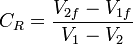
1. A sphere of mass m impinges obliquely on a sphere of mass M, which is at rest. The coefficient of restitution between the spheres is e. Show that if m=eM, the directions of motion after impact are at right angles


2. Coefficient of restitution -
442cb57fc9daffed79a534632d0a5aad.png


3. I really don't think I have a clue with this one, so far I have taken e and substituted it into m=eM to give

m = M x V[tex]_{}2f[/tex]-V[tex]_{}1f[/tex][tex]/[/tex]V[tex]_{}1[/tex]


Can anyone give me any clues as to where to go next or am I going completely wrong with what I have?

Thanks in advance for any help
 
Physics news on Phys.org
Have you tried to draw a vector representation of your problem? Try this and make use of the conservation of momentum.
 
dlgoff said:
Have you tried to draw a vector representation of your problem? Try this and make use of the conservation of momentum.

This is what I have for the problem,

http://img156.imageshack.us/img156/2310/questioncb9.jpg

Do I have the right idea of what the collision looks like?

And how would I use the momentum conservation here, as in U1 (speed of m before) = V2 (speed of M after)?
 
Last edited by a moderator:
Well, that's not exactly what I had in mind.

Could you read over this http://instruct.tri-c.edu/fgram/web/elastic.htm" and let me know if it helps?
 
Last edited by a moderator:
Ah, that article was exactly what I needed, thanks for your help :D
 

Similar threads

  • · Replies 7 ·
Replies
7
Views
1K
  • · Replies 12 ·
Replies
12
Views
2K
  • · Replies 2 ·
Replies
2
Views
4K
  • · Replies 2 ·
Replies
2
Views
3K
  • · Replies 8 ·
Replies
8
Views
4K
  • · Replies 4 ·
Replies
4
Views
2K
Replies
10
Views
3K
  • · Replies 3 ·
Replies
3
Views
2K
Replies
16
Views
2K