Solving ODE Problems: Understanding Tangent Lines and Integrating Functions

  • Context: Graduate 
  • Thread starter Thread starter c.teixeira
  • Start date Start date
  • Tags Tags
    Ode Stupid
Click For Summary
SUMMARY

The discussion centers on solving a problem from "Ordinary Differential Equations" by Pollard, specifically regarding the geometric interpretation of tangent lines and their integration. The problem involves finding a family of curves where the area bounded by the x-axis, the tangent line at a point P(x,y), and its projection on the x-axis is constant. The solution provided states that the tangent line's equation is given by y / (x - a) = y', leading to the conclusion that the area can be derived through integration. However, a participant expresses confusion over the relationship between the tangent line's slope (y') and the curve's derivative, questioning the validity of mixing functions and their derivatives in the integration process.

PREREQUISITES
  • Understanding of Ordinary Differential Equations (ODEs)
  • Familiarity with geometric interpretations of derivatives
  • Knowledge of integration techniques
  • Basic algebraic manipulation of equations
NEXT STEPS
  • Study the geometric interpretation of derivatives in calculus
  • Learn about the properties of tangent lines and their equations
  • Explore integration techniques for area under curves
  • Review the concepts of first-order differential equations
USEFUL FOR

Students of mathematics, particularly those studying calculus and differential equations, as well as educators seeking to clarify the relationship between functions and their derivatives in geometric contexts.

c.teixeira
Messages
39
Reaction score
0
I have been reading Ordinary Differential Equations (Pollard) from Dover.
The chapter I am in, is called Problems Leading to Differential Equations of The First Order - Geometric Problems.

Problem :

Find the family of curves with the property that the area of the region bounded by the x-axis , the tangent line drawn at a point P(x,y) of a curve of the family and the projection of the tangent line on the x-axis has a constante value A.
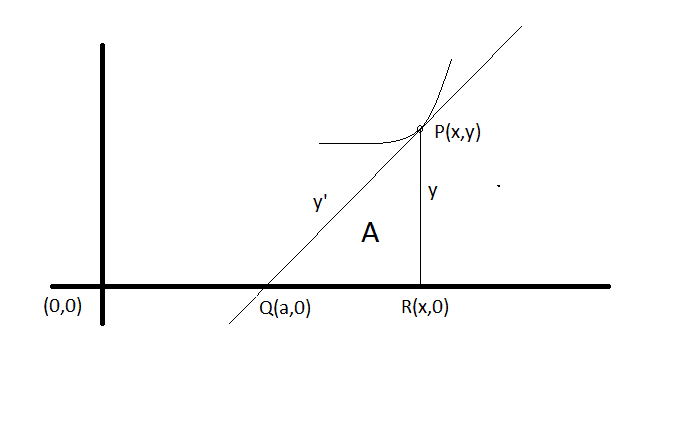
image.png

image hosting png

In the solution, they say the equation of the tangent line is y / (x - a) = y'

They then solve, for a:

a = x - (y/y')

Afterwards, they obtain the distance QR = y/y'

Therefore they have the area of the triangle. They integrate, bla blabla.

Now, when I first looked this, it seemed pretty simple and straighforward. I understood every step. It was an elementary problem.

But, today I gave it a second look, and now I just don't agree with the solution.
---------------
Well, my question is y = mx + b;
but m = y'.

so, y = y' x + b.
I don't agree with this since y defines the equation of the tangent line BUT y' defines the derivative of THE CURVE. therefore in my viewing, when they, in the solution, reach to QR = y/y', and then integrate they are mixing a fuction and a derivative of a diferent fuction.

So, where is my reasoning wrong?
Perhaps I should sleep more. ;D

Thanks for all the explanations!
 
Physics news on Phys.org
c.teixeira said:
Well, my question is y = mx + b;
but m = y'.

so, y = y' x + b.
I don't agree with this since y defines the equation of the tangent line BUT y' defines the derivative of THE CURVE. therefore in my viewing, when they, in the solution, reach to QR = y/y', and then integrate they are mixing a fuction and a derivative of a diferent fuction.

So, where is my reasoning wrong?
Perhaps I should sleep more. ;D

Thanks for all the explanations!

The slope of a line tangent to a function at a point is the same as the value of the derivative of the function at that point, by definition; this also means that the derivative of the tangent line at a point is the same as the derivative of the function at that point, so y'_{line} = y'_{curve}.

Since the line given by y = mx + b is defined to be the tangent line to the curve, that means that m must be equal to the y' of the curve it is tangent to in order to statisfy that condition, which again, happens to also be the y' of the line itself..
 
c.teixeira said:
I have been reading Ordinary Differential Equations (Pollard) from Dover.
The chapter I am in, is called Problems Leading to Differential Equations of The First Order - Geometric Problems.

Problem :

Find the family of curves with the property that the area of the region bounded by the x-axis , the tangent line drawn at a point P(x,y) of a curve of the family and the projection of the tangent line on the x-axis has a constante value A.

In the solution, they say the equation of the tangent line is y / (x - a) = y'

They then solve, for a:

a = x - (y/y')

Afterwards, they obtain the distance QR = y/y'

Therefore they have the area of the triangle. They integrate, bla blabla.

Now, when I first looked this, it seemed pretty simple and straighforward. I understood every step. It was an elementary problem.

But, today I gave it a second look, and now I just don't agree with the solution.
---------------
Well, my question is y = mx + b;
Well, it should be y= m(x- a)+ b.

but m = y'.

so, y = y' x + b.
so y= y'(a)(x- a)+ b

I don't agree with this since y defines the equation of the tangent line BUT y' defines the derivative of THE CURVE. therefore in my viewing, when they, in the solution, reach to QR = y/y', and then integrate they are mixing a fuction and a derivative of a diferent fuction.

So, where is my reasoning wrong?
Perhaps I should sleep more. ;D

Thanks for all the explanations!
One definition of "derivative" (at a given point) is "slope of the tangent line" (at that point).
 

Similar threads

  • · Replies 3 ·
Replies
3
Views
4K
  • · Replies 2 ·
Replies
2
Views
4K
  • · Replies 4 ·
Replies
4
Views
2K
  • · Replies 6 ·
Replies
6
Views
3K
  • · Replies 1 ·
Replies
1
Views
2K
  • · Replies 14 ·
Replies
14
Views
906
  • · Replies 4 ·
Replies
4
Views
2K
  • · Replies 2 ·
Replies
2
Views
2K
  • · Replies 1 ·
Replies
1
Views
2K
  • · Replies 1 ·
Replies
1
Views
2K