psie
- 315
- 40
- TL;DR
- I'm struggling with a remark on page 35 in Folland's text. He makes a connection to a theorem that comes later, theorem 1.19, and I don't see connection.
Folland remarks on page 35 that each increasing and right-continuous function gives rise to not only a Borel measure ##\mu_F##, but also a complete measure ##\bar\mu_F## which includes the Borel ##\sigma##-algebra. He then says that the complete measure is the extension of the measure and that this should follow from the below theorem, theorem 1.19, where ##\mathcal M_\mu## is the domain of the complete (Lebesgue-Stieltjes) measure ##\mu##. How?
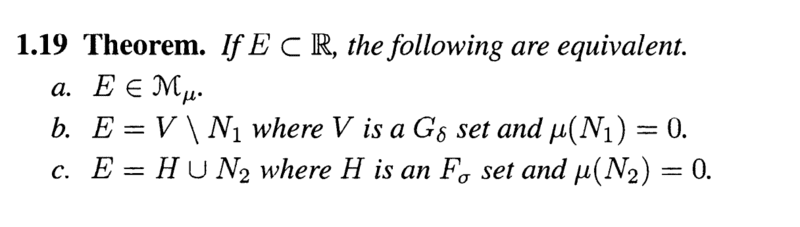
(A ##G_\delta## set is a countable intersection of open sets, and a ##F_\sigma## set is a countable union of closed sets.)
From what I recall, I need to show that if $$N_1\subset E,E\in\mathcal M_\mu\text{ and }\mu(E)=0 \implies N_1\in\mathcal M_\mu.$$ The theorem, on the other hand, says that if ##E\in\mathcal M_\mu##, then there exists a (##G_\delta## set) ##V\in\mathcal B_\mathbb R\subset \mathcal M_\mu## such that ##E=V\setminus N_1## and ##\mu(N_1)=0##.
I struggle with putting the pieces together.
EDIT: Upon closer thought, maybe I need to use (c) and the fact that the completion ##\overline{\mathcal M}## of a ##\sigma##-algebra ##\mathcal M##, where ##\mathcal N=\{N\in\mathcal M:\mu(N)=0\}##, is $$\overline{\mathcal M}=\{E\cup F: E\in\mathcal M\text{ and } F\subset N\text{ for some } N\in\mathcal N\}.\tag1$$ Yet, I still don't see how theorem 1.19c and ##(1)## say the same thing.
(A ##G_\delta## set is a countable intersection of open sets, and a ##F_\sigma## set is a countable union of closed sets.)
From what I recall, I need to show that if $$N_1\subset E,E\in\mathcal M_\mu\text{ and }\mu(E)=0 \implies N_1\in\mathcal M_\mu.$$ The theorem, on the other hand, says that if ##E\in\mathcal M_\mu##, then there exists a (##G_\delta## set) ##V\in\mathcal B_\mathbb R\subset \mathcal M_\mu## such that ##E=V\setminus N_1## and ##\mu(N_1)=0##.
I struggle with putting the pieces together.
EDIT: Upon closer thought, maybe I need to use (c) and the fact that the completion ##\overline{\mathcal M}## of a ##\sigma##-algebra ##\mathcal M##, where ##\mathcal N=\{N\in\mathcal M:\mu(N)=0\}##, is $$\overline{\mathcal M}=\{E\cup F: E\in\mathcal M\text{ and } F\subset N\text{ for some } N\in\mathcal N\}.\tag1$$ Yet, I still don't see how theorem 1.19c and ##(1)## say the same thing.
Last edited: