One particle and two slits

  • Context: Undergrad 
  • Thread starter Thread starter Mentz114
  • Start date Start date
  • Tags Tags
    Particle
Click For Summary

Discussion Overview

The discussion revolves around the interference patterns produced by single particles, specifically photons, in setups involving Mach-Zehnder interferometers and double slits. Participants explore the mathematical relationships between phase shifts and slit geometries, as well as the implications of these setups in quantum mechanics.

Discussion Character

  • Exploratory
  • Technical explanation
  • Debate/contested
  • Mathematical reasoning

Main Points Raised

  • One participant describes how a phase shift in a Mach-Zehnder interferometer leads to interference even with a single photon, proposing a relationship between the phase difference and double slit geometry.
  • Another participant questions the tapering of the interference pattern and suggests that each slit has its own radiation pattern, indicating a need for clarity on the setup being discussed.
  • A participant points out a potential error in the mathematical formulation regarding the distance in the double slit setup, suggesting a correction to the formula used.
  • Some participants express uncertainty about whether the phase calculation is valid within a quantum framework, with one suggesting it requires a proper quantum field theory treatment.
  • There is a discussion about the applicability of the beam splitter equation to the double slit scenario, with concerns raised about the influence of slit size and distance on the observed patterns.
  • One participant references a specific paper on quantum interference with slits, noting discrepancies with the results presented and questioning the validity of the conclusions drawn in that work.
  • Another participant critiques the treatment of the interference patterns, suggesting that the approach taken in the referenced paper lacks depth and fails to engage with the underlying physics adequately.

Areas of Agreement / Disagreement

Participants express differing views on the validity of the mathematical approaches used and the interpretation of the results. There is no consensus on the correct treatment of the interference patterns or the implications of the findings discussed.

Contextual Notes

Participants note limitations in the mathematical formulations and the assumptions made regarding the setups. There are unresolved questions about the applicability of certain models and the influence of experimental parameters on the outcomes.

Mentz114
Messages
5,429
Reaction score
292
The single photon experiment of Grangier showed that if a phase shift ##\theta## is introduced in one arm of a Mach-Zehnder interferometer then there is interference when the two beams are recombined - even if only one photon is introduced.

If a particle encounters a double slit of suitable geometry then one possibility becomes two which are recombined at some point on the screen. I wondered what the result would be if the phase difference in the MZ could be expressed in terms of the two slit geometry. This is easily done and the result is ##\theta_s=2\pi(L_1-L_2)/\lambda## where ##L_1^2=X^2+(y-d)^2,\ L_2^2=X^2+(y-2d)^2##.
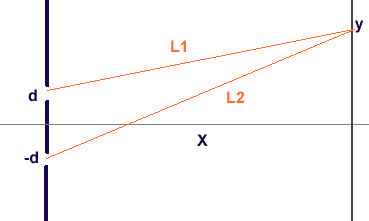
slits-geom.png


One of the detectors in the MZ setup has probability ##(1+\cos(\theta))/2 =\cos(\theta/2)^2##. Putting ##\theta_s## into this looks like this for X=75, λ=1, d=5
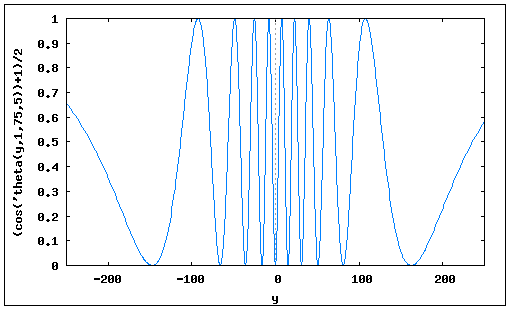
interference-2.png


which at least looks plausible. I'm not sure if this is interesting or valid, but it is all quantum.
 

Attachments

  • slits-geom.png
    slits-geom.png
    1.3 KB · Views: 976
  • interference-2.png
    interference-2.png
    2.5 KB · Views: 979
Physics news on Phys.org
I think it it true that after a period of time, a pattern of dots will build up. I am not sure why your pattern does not taper away from the centre. Each slit has its own radiation pattern.
 
Mentz114 said:
The single photon experiment of Grangier showed that if a phase shift ##\theta## is introduced in one arm of a Mach-Zehnder interferometer then there is interference when the two beams are recombined - even if only one photon is introduced.

If a particle encounters a double slit of suitable geometry then one possibility becomes two which are recombined at some point on the screen. I wondered what the result would be if the phase difference in the MZ could be expressed in terms of the two slit geometry. This is easily done and the result is ##\theta_s=2\pi(L_1-L_2)/\lambda## where ##L_1^2=X^2+(y-d)^2,\ L_2^2=X^2+(y-2d)^2##.
View attachment 222136

One of the detectors in the MZ setup has probability ##(1+\cos(\theta))/2 =\cos(\theta/2)^2##. Putting ##\theta_s## into this looks like this for X=75, λ=1, d=5
View attachment 222137

which at least looks plausible. I'm not sure if this is interesting or valid, but it is all quantum.

I think you'll find the L2 formula should just be ..+d.., not ...-2d... But yes, the Young's slit pattern shows the same stretching off-centre as your plot. We often use a simple formula for calculating the spacing of interference bands but sometimes we forget that it is an approximation.

The introduction of a phase shift of more than 4πd/λ can't be accommodated in the YS setup for geometrical reasons, and this is reflected in the fact that there is no real solution for y. But the M-Z formula handles it without a hitch.

My maths is generally stochastic so I'll echo your comment: I'm not sure if this is interesting or valid.
 
tech99 said:
I think it it true that after a period of time, a pattern of dots will build up. I am not sure why your pattern does not taper away from the centre. Each slit has its own radiation pattern.
Sure, but the plot is for the interferometer not for a double slit. So there's no geometrical factor to worry about.
Certainly you will get a pattern of dots build up in both cases. A DS creates a pattern of dots with a detector array, the MZI builds up a histogram of detections against theta or y. That's the nice thing about quantum systems. They obey quantum mechanics. :biggrin::biggrin::biggrin:
 
tech99 said:
I think it it true that after a period of time, a pattern of dots will build up. I am not sure why your pattern does not taper away from the centre. Each slit has its own radiation pattern.
There was a mistake in the algebra ( I was tired !)
Derek P said:
I think you'll find the L2 formula should just be ..+d.., not ...-2d... But yes, the Young's slit pattern shows the same stretching off-centre as your plot. We often use a simple formula for calculating the spacing of interference bands but sometimes we forget that it is an approximation.

.
Thanks for pointing that out.

Calculating the phase in this way is not quantum, of course so it is not the right pattern. It needs a proper QFT treatment.

Here is a corrected plot.
HOM-int-2.png
 

Attachments

  • HOM-int-2.png
    HOM-int-2.png
    2.3 KB · Views: 444
Mentz114 said:
Calculating the phase in this way is not quantum, of course so it is not the right pattern. It needs a proper QFT treatment.
Are you sure?
 
Last edited:
Derek P said:
Are you sure?
No. I will have a dabble with this later but I don't think the two slits can be handled by the beam splitter equation. The size of the slits is not a parameter and I'm not sure if changes in the distance between them (d) affects the pattern in the way this is observed in experiments.

I made a picture from a plot. The parameters are X=75, d=3, λ=1.
MZ-int-plot-3.png
MZ-int-pic-3.png


The MZ adaptation shown shown above does not agree with the result in
Quantum interference with slits by Thomas V Marcella
which is "the familiar intensity distribution for Fraunhofer diffraction as given in Guenther
[8], among others."

Marcella's result has been deprecated by some responsible https://www.researchgate.net/publication/46584717_Quantum_Interference_with_Slits_Revisitedso its status is not certain.
 

Attachments

  • MZ-int-plot-3.png
    MZ-int-plot-3.png
    2.5 KB · Views: 600
  • MZ-int-pic-3.png
    MZ-int-pic-3.png
    2.2 KB · Views: 608
Last edited:
Mentz114 said:
No. I will have a dabble with this later but I don't think the two slits can be handled by the beam splitter equation. The size of the slits is not a parameter and I'm not sure if changes in the distance between them (d) affects the pattern in the way this is observed in experiments.
Yes, I agree with that. The size of the slits just adds a sinc term to the Fourier transform so you could insert it into the interferometer model as a shaped uncertainty in the "introduced" phase shift. The behaviour with simple coherent light would still be the same in both models because the complex amplitudes have the same form as a classical EM wave. Unfortunately, you haven't actually described the experiments you're talking about, but Grainger's name is associated with highly non-classical states and for all I know, the beam splitter may behave differently. If so then maybe the additional phase uncertainty (reflecting the non-zero width) will make a difference. Good luck with analysing that, I wouldn't know where to begin!
 
Mentz114 said:
The MZ adaptation shown shown above does not agree with the result in
Quantum interference with slits by Thomas V Marcella
which is "the familiar intensity distribution for Fraunhofer diffraction as given in Guenther
[8], among others."
Marcella's result has been deprecated by some responsible https://www.researchgate.net/publication/46584717_Quantum_Interference_with_Slits_Revisitedso its status is not certain.
Well as an irresponsible critic I would agree. Superficially skimming through, it looks like a standard treatment with a few workarounds to avoid explicitly solving wave equations. Lande took the same approach in New Foundations of Quantum Mechanics, 1965, saying something like "the particle interacts with the slits as a whole" implying that the lateral momentum imparted to the particle is a probability distribution whose amplitude is given by the Fourier transform of the slits. Unless there is something deep and mysterious buried in the paper, I cannot agree with their conclusion "It is interesting that for particles scattered from a double slit, the probability amplitude that gives rise to the interference is due to a superposition of delta functions." That is exactly what any integral is and a Fourier transform is no exception. It is true - but not interesting :wink:
 

Similar threads

  • · Replies 1 ·
Replies
1
Views
3K
  • · Replies 1 ·
Replies
1
Views
2K
  • · Replies 2 ·
Replies
2
Views
1K
  • · Replies 7 ·
Replies
7
Views
2K
  • · Replies 36 ·
2
Replies
36
Views
9K
  • · Replies 2 ·
Replies
2
Views
2K
  • · Replies 3 ·
Replies
3
Views
5K
  • · Replies 5 ·
Replies
5
Views
2K
  • · Replies 14 ·
Replies
14
Views
2K
  • · Replies 3 ·
Replies
3
Views
2K