One Way Plug Key: Definition & Uses

  • Thread starter Thread starter gracy
  • Start date Start date
Click For Summary
SUMMARY

The discussion centers on the definition and functionality of a one way plug key, which is primarily used for making or breaking electrical circuits in educational settings. Participants clarify that these devices do not have positive and negative terminals, as they function as switches. The conversation also touches on the proper wiring techniques for battery terminal disconnect switches, emphasizing the importance of connecting them to the "hot" terminal for safety. Additionally, the discussion includes references to related concepts such as Wheatstone bridges and circuit configurations.

PREREQUISITES
  • Basic understanding of electrical circuits
  • Familiarity with switch types and their functions
  • Knowledge of battery terminal configurations
  • Experience with circuit diagrams and schematic symbols
NEXT STEPS
  • Research the functionality of Wheatstone bridges in circuit analysis
  • Learn about different types of electrical switches and their applications
  • Study battery disconnect switches and their wiring best practices
  • Explore safety measures in electrical circuit design
USEFUL FOR

Electronics students, educators in physics and electrical engineering, and hobbyists interested in circuit design and safety practices.
gracy
Messages
2,486
Reaction score
83
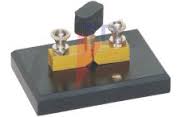
What is one way plug key?I know direct question should not be asked instead we should show some efforts,but seriously i googled it but didn't find anything.In my textbook there is no definition or anything about it ,that's why my teacher also doesn't explain it.But i really want to know.Please forgive me for not showing any effort ,but trust me i have really searched it then only came here.Here is the image of it.
images?q=tbn:ANd9GcR1b9mmXgh6_41HE1YESvO2hVI9ZwhQQqrAnWoWpIYXHKwIsjc_.jpg
 
Physics news on Phys.org
gracy said:
What is one way plug key?I know direct question should not be asked instead we should show some efforts,but seriously i googled it but didn't find anything.In my textbook there is no definition or anything about it ,that's why my teacher also doesn't explain it.But i really want to know.Please forgive me for not showing any effort ,but trust me i have really searched it then only came here.Here is the image of it.
images?q=tbn:ANd9GcR1b9mmXgh6_41HE1YESvO2hVI9ZwhQQqrAnWoWpIYXHKwIsjc_.jpg

I had to google with quotes: "plug key" "one way"
I'm not sure I've ever seen such devices, but it appears to simply be a switch.
Plug keys of the "one way" thru "four way" styles: http://www.tdmodelsindia.com/php/physics/physics27.php
I also can't find a description of how they work, but looking at the devices, and the schematic symbol -( O )- , I think I know how they work.
I'm also guessing that they are used only in classrooms and/or labs, as they don't strike me as practical in the real world.
 
Ok can you pleas tell me positive and negative terminal of this one way plug key.
 
gracy said:
Ok can you pleas tell me positive and negative terminal of this one way plug key.
Switches don't have positive and negative terminals.
http://www.walmart.com/ip/Everstart-936W-Everstart-SWAN-Terminal-Disconnect/16006670 , apparently.
 
Last edited by a moderator:
Ok kindly have a look at this video at time 2:00
 
OmCheeto said:
Switches don't have positive and negative terminals.
http://www.walmart.com/ip/Everstart-936W-Everstart-SWAN-Terminal-Disconnect/16006670 , apparently.
For a battery terminal disconnect switch like the one in the Walmart link, I'm pretty sure the proper way to connect it is to the "hot" (or positive) terminal on the battery (assuming that the negative terminal is grounded). Although the switch would work if attached to either terminal, the recommended way to wire switches of any kind is to insert them in the hot lead to the component.
 
Last edited by a moderator:
gracy said:
Ok kindly have a look at this video at time 2:00


Ha!

As I said, I'm guessing these are only used in classrooms. They may mark them as (+) and (-), for the very newest of students. google google google
I can find no evidence on google images that they do this.With the exception of a 3-D graphics design studio:
pf.2015.01.22.1045.polarized.plug.key.jpg
http://www.it.iitb.ac.in/anides/3d_anim.html

But I wouldn't trust them.

Mark44 said:
For a battery terminal disconnect switch like the one in the Walmart link, I'm pretty sure the proper way to connect it is to the "hot" (or positive) terminal on the battery (assuming that the negative terminal is grounded). Although the switch would work if attached to either terminal, the recommended way to wire switches of any kind is to insert them in the hot lead to the component.

I actually went back and looked at the advertisement, and it said the switch would fit on either terminal. Though I'd not recommend putting the "green" marked disconnect on the positive terminal.

Anecdotal, lesson to be learned side note: My friend toasted $1000 worth of electronic gadgetry in his outboard motor last year by hooking up his battery backwards.
 
Last edited by a moderator:
Stephen Tashi said:
Some more pictures are at: http://naamsedu.com/electronics-apparatus
On the page you have suggested me it is written it is 'Used for making or breaking the electrical circuits'can you please explain how?In the image below as per position of key whether current will flow or not in a circuit?I mean if any circuit having key in the position or condition as in image below will have current or not?
upload_2015-1-23_1-30-1.jpeg
 
  • #10
gracy said:
On the page you have suggested me it is written it is 'Used for making or breaking the electrical circuits'can you please explain how?In the image below as per position of key whether current will flow or not in a circuit?I mean if any circuit having key in the position or condition as in image below will have current or not?
View attachment 78093

The key in this position will have current.
 
  • Like
Likes   Reactions: gracy
  • #11
phy_1258.jpg

In this position the circuit will not have current,right?
Which way should we rotate it to have current,anticlock or clockwise?or both will work?
 
  • #12
gracy said:
phy_1258.jpg

In this position the circuit will not have current,right?
Which way should we rotate it to have current,anticlock or clockwise?or both will work?

In this position of the key in your image, the circuit will have current.
The key is not rotated. The key is removed, in an upward direction, to open the circuit.
 
  • Like
Likes   Reactions: davenn
  • #13
Can you please give me any image (as i have been giving )which will allow no current?
 
  • #14
gracy said:
Can you please give me any image (as i have been giving )which will allow no current?
outfile.jpg
 
  • Like
Likes   Reactions: mp3car, OmCheeto and gracy
  • #15
  • #16
Can you please explain in meter bridge experiment to prove Resistance in series=R1+R2
and Resistance in parallel =1/R1+1/R2
how much resistance should be removed from resistance box?
 
  • #17
What is the meter bridge experiment? I am assuming "meter bridge" refers to a Wheatstone bridge.
 
  • #18
rumborak said:
What is the meter bridge experiment? I am assuming "meter bridge" refers to a Wheatstone bridge.
Yes.
 
  • #19
Stephen Tashi said:

Just wanted to chime in here... Stephen, kudos to you for being so helpful as to take the time to draw the sketch!

Also, gracy, this appears to be homework related... If it's not directly a homework problem and more of a curiosity type of thing, then this forum is fine... However, if it is homework, a better place would be to post it in the homework help sections of the forums... best wishes in whatever the reason is for your inquiry!

https://www.physicsforums.com/forums/homework-and-coursework-questions.152/
 
  • #20
gracy said:
What is one way plug key?I know direct question should not be asked instead we should show some efforts,but seriously i googled it but didn't find anything.In my textbook there is no definition or anything about it ,that's why my teacher also doesn't explain it.But i really want to know.Please forgive me for not showing any effort ,but trust me i have really searched it then only came here.Here is the image of it.
If you are are learning electronics then you need a multimeter; get the best one you can afford. Ensure it has an instruction book. With a multimeter you will be able to find out the positions of the handle which connect the terminals (switch closed) & disconnect them (switch open). I suspect that the terminal colours are irrelevant, but if they are relevant then perhaps the device has a diode inside, in which case the multimeter will show you the diode's polarity.
 
  • #21
Can anyone please answer what's the square part that I have pointed out in the image below indicates

upload_2015-2-10_20-17-47.png
 

Attachments

  • upload_2015-2-10_20-12-13.png
    upload_2015-2-10_20-12-13.png
    23.4 KB · Views: 587
  • #22
It's hard to be 100% sure due to the small image size, but it looks like a bridge circuit (wheatstone).
 
  • #23
gneill said:
It's hard to be 100% sure due to the small image size, but it looks like a bridge circuit (wheatstone).
Can not it be DPDT switch?
 
  • #24
gracy said:
Can not it be DPDT switch?
Yes I suppose that it could be! Well spotted. The presence of the two cells connected to it might indicate that it is meant to reconfigure the voltage source provided to the long-wire resistance, likely by swapping the polarity of top cell's connections in series with the cell to the left of the diamond shape.
 
  • Like
Likes   Reactions: gracy
  • #25
What are gaps in two way plug key ?Can anyone please point out "gaps"in the two way plug key given below?
plug-key.jpg
 
  • #26
So,in your image is this a gap?
 

Attachments

  • upload_2015-2-10_21-39-18.png
    upload_2015-2-10_21-39-18.png
    4.9 KB · Views: 540
  • #27
And in my plug key case
Is this a gap?
upload_2015-2-10_21-42-36.png
 
Last edited:
  • #28
OR
 
  • #29
gracy said:
So,in your image is this a gap?
No, that's a mounting hole for putting a screw through to secure the switch to the table.

The gap is the space between the conductors.

Knife Gap.jpg
 
  • Like
Likes   Reactions: gracy
  • #30
upload_2015-2-10_21-54-24.png

Right?
 

Similar threads

  • · Replies 8 ·
Replies
8
Views
2K
Replies
6
Views
756
  • · Replies 5 ·
Replies
5
Views
2K
Replies
129
Views
9K
  • · Replies 16 ·
Replies
16
Views
2K
  • · Replies 1 ·
Replies
1
Views
1K
Replies
6
Views
2K
  • · Replies 5 ·
Replies
5
Views
2K
  • · Replies 1 ·
Replies
1
Views
2K
  • · Replies 20 ·
Replies
20
Views
2K