Math Amateur
Gold Member
MHB
- 3,920
- 48
I am reader Andrew Browder's book: "Mathematical Analysis: An Introduction" ... ...
I am currently reading Chapter 8: Differentiable Maps and am specifically focused on Section 8.1 Linear Algebra ...
I need some help in fully understanding the differences between Andrew Browder and Michael Field (Essential Real Analysis) concerning the "operator norm" for linear transformations ...
The relevant notes form Browder read as follows:
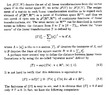
View attachment 9367
In the above text from Browder we read the following:" ... ... A perhaps more natural way to define the distance between linear transformations is by using the so-called "operator norm" defined by
$$\lvert \lvert T \rvert \rvert = \text{ sup} \{ \lvert Tv \rvert \ : \ v \in \mathbb{R}^n , \ \lvert v \rvert \le 1 \}
$$
... ... ... ... ... "
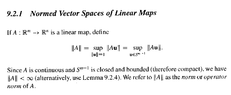
Now the above definition, differs (apparently anyway) from the definition of the operator norm by Michael Field in his book: "Essential Real Analysis" ... Field writes the following:View attachment 9368Thus Field's version of the operator norm (if we write it in Browder's notation is as follows:
$$\lvert \lvert T \rvert \rvert = \text{ sup} \{ \lvert Tv \rvert \ : \ v \in \mathbb{R}^n , \ \lvert v \rvert = 1 \}
$$
My question is as follows:
Are Browder's and Field's definition essentially the same ... if so how are they equivalent ... ... ?
Maybe in Browder's definition the supremum is actually reached when $$\lvert v \rvert = 1$$ ... ...
Help will be appreciated ...
Peter
I am currently reading Chapter 8: Differentiable Maps and am specifically focused on Section 8.1 Linear Algebra ...
I need some help in fully understanding the differences between Andrew Browder and Michael Field (Essential Real Analysis) concerning the "operator norm" for linear transformations ...
The relevant notes form Browder read as follows:
View attachment 9367
In the above text from Browder we read the following:" ... ... A perhaps more natural way to define the distance between linear transformations is by using the so-called "operator norm" defined by
$$\lvert \lvert T \rvert \rvert = \text{ sup} \{ \lvert Tv \rvert \ : \ v \in \mathbb{R}^n , \ \lvert v \rvert \le 1 \}
$$
... ... ... ... ... "
Now the above definition, differs (apparently anyway) from the definition of the operator norm by Michael Field in his book: "Essential Real Analysis" ... Field writes the following:View attachment 9368Thus Field's version of the operator norm (if we write it in Browder's notation is as follows:
$$\lvert \lvert T \rvert \rvert = \text{ sup} \{ \lvert Tv \rvert \ : \ v \in \mathbb{R}^n , \ \lvert v \rvert = 1 \}
$$
My question is as follows:
Are Browder's and Field's definition essentially the same ... if so how are they equivalent ... ... ?
Maybe in Browder's definition the supremum is actually reached when $$\lvert v \rvert = 1$$ ... ...
Help will be appreciated ...
Peter