Orbits in Universe: Milky Way, Sun, Moon & More

Click For Summary
The discussion explores the orbits of celestial bodies, emphasizing that the Earth orbits the Sun, while the Sun orbits the supermassive black hole (SMBH) at the center of the Milky Way galaxy. It clarifies that the Sun's orbit is influenced by various astronomical bodies, not just the SMBH. The Milky Way is noted to have dwarf galaxies, such as the Magellanic Clouds, in orbit around it, but it is not accurately described as orbiting another galaxy. The Milky Way is currently moving towards the Great Attractor, although it may never reach it due to the effects of Hubble's Law. The conversation highlights the complexity of galactic dynamics and the ongoing movement of galaxies in the universe.
Stephanus
Messages
1,316
Reaction score
104
Dear PF Forum,
Lunar Satelite orbits the moon,
The moon orbits the earth,
The Earth orbits the sun,
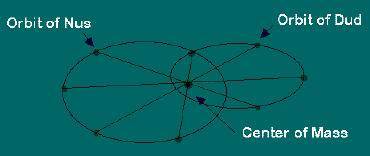
I know that some of you know about this picture
orbit.JPG

You might want to tell me. "No Steven, the Sun also orbits the earth"
But for all practical purpose, we'd say that the earth orbits the sun. So does the moon, the moon satelite, etc

Okay, so I'l continue.
The sun orbits the SMBH in the centre of our galaxy.
And in turn, what Milky Way orbits to?

Considering Hubble Law, that every galaxy is moving away each other.
Does Milky way somehow orbits a bigger galaxy,
And if it's true how many galaxies orbit that thing?
And what thing that that thing orbits?
And in that sense what is the last thing that doesn't orbit anything, if there is such last thing.Thank you very much
 
Space news on Phys.org
Stephanus said:
The sun orbits the SMBH in the centre of our galaxy.
This is not very precise nor correct. The Sun is not on an orbit atound the central black hole. There are many more astronomical bodies which influence the solar orbit in the galaxy. More correct would be to say the sun has an orbit in the galaxy, which it is part of as well. It is not as simple to describe this as having the sun orbit what essentially is a point mass.

This becomes even worse on the galaxy cluster scale and as you increase the distances you are looking at the universe becomes essentially homogeneous.
 
  • Like
Likes Stephanus
Orodruin said:
This is not very precise nor correct. The Sun is not on an orbit atound the central black hole.
To add a little bit of perspective, the black hole at the center of our galaxy (Sagittarius A*) is roughly 0.0006% of the total mass of the Milky Way galaxy, and much less than 1% of the mass that significantly influences the Sun's orbit (only the mass that is closer to the center of the Milky Way than the Sun has a big influence on the Sun's orbit).

There are some dwarf galaxies that are orbiting the Milky Way as well (the large and small Magellanic clouds are the largest of these). I'm not so sure that the Milky Way could really be described as orbiting anything else, however. It is currently falling towards the Great Attractor:
https://en.wikipedia.org/wiki/Great_Attractor
 
  • Like
Likes Stephanus
Chalnoth said:
...There are some dwarf galaxies ... (the large and small Magellanic clouds are the largest of these). ...It is currently falling towards the Great Attractor:
https://en.wikipedia.org/wiki/Great_Attractor
... and Hubble said that every galaxy are moving away from us, aside from Andromeda :smile:
 
Stephanus said:
... and Hubble said that every galaxy are moving away from us, aside from Andromeda :smile:
Not every. That is the overall, average motion on large scales. In the next few billion years, for example, the Milky Way will collide with Andromeda.

I'm not sure that the Milky Way will ever reach the Great Attractor, though: we are moving towards the Great Attractor relative to the Hubble flow, but the Hubble flow is large enough that the Great Attractor is still getting further away at this time. So we're falling in that direction, but will probably never get there.
 
  • Like
Likes Stephanus
Chalnoth said:
I'm not sure that the Milky Way will ever reach the Great Attractor, though: we are moving towards the Great Attractor relative to the Hubble flow, but the Hubble flow is large enough that the Great Attractor is still getting further away at this time. So we're falling in that direction, but will probably never get there.
Thanks for the enlightment
 

Similar threads

  • · Replies 27 ·
Replies
27
Views
2K
  • · Replies 4 ·
Replies
4
Views
3K
  • · Replies 9 ·
Replies
9
Views
8K
  • · Replies 30 ·
2
Replies
30
Views
4K
Replies
9
Views
4K
  • · Replies 19 ·
Replies
19
Views
2K
  • · Replies 3 ·
Replies
3
Views
2K
  • · Replies 3 ·
Replies
3
Views
2K
Replies
1
Views
8K
Replies
17
Views
4K