Original HBT experiment with mercury isotope lamp

Join the discussion
Ask a follow-up here, or get your own question answered by working scientists, mathematicians and engineers — people, not an autocomplete.
Real named experts · corrections over time · the nuance an AI answer skips
2 replies · 1K views
Swamp Thing
Insights Author
Messages
1,062
Reaction score
819
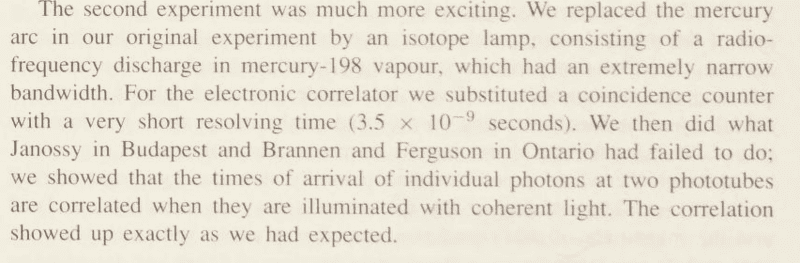
From "Boffin : a personal story of the early days of radar, radio astronomy, and quantum optics", by R Hanbury Brown...
1713618665530.png


If it had been truly coherent (e.g. laser light), wouldn't the detection events have been uncorrelated? That is, two independent Poisson processes?
 
Reply
  • Like
Likes   Reactions: pines-demon
Physics news on Phys.org
Swamp Thing said:
From "Boffin : a personal story of the early days of radar, radio astronomy, and quantum optics", by R Hanbury Brown...


If it had been truly coherent (e.g. laser light), wouldn't the detection events have been uncorrelated? That is, two independent Poisson processes?
I have no idea about experiments and much less on optical experiments. However the text says that photon correlations were measured when the phototubes were illuminated with coherent light, this seems to imply that the photons came from the phototubes and not from the coherent light source. This seems to be key.
 
Unfortunately, there are several different meanings of "coherent light" and one needs to consider the statement by Hanbury Brown in the context of his famous experiment.

There is second-order coherence, which is about correlations in photon detections. Here, coherent light will indeed show no correlations. Thermal light - which is considered incoherent in terms of second order correlations - will show the correlations Hanbury Brown and Twiss observed.

Now, there is also first order coherence. This is what you typically observe in a Michelson interferometer. This is a field correlation. This is not a yes/no quantity, but instead you will get a coherence time. Roughly speaking this is the timescale over which you can predict what the phase of the light field (and sometimes also the amplitude) will look like. Here long coherence times are considered coherent, while short coherence times are considered incoherent. Second-order coherent light (e.g. lasers) will usual show long coherence times. However, the coherence time essentially arises from the Fourier transform of the power speectral density of the light field, so any spectrally narrow light field will have a long coherence time, no matter whether it is a laser (second-order coherent light) or a spectrally strongly filtered light bulb (second-order incoherent light).

If there are HBT-like correlations in thermal light, this bunching signal decays on the timescale of the coherence time of the light. So in order to observe photon bunching with standard equipment you need light that is both coherent and incoherent. It needs to be second-order incoherent (thermal), so that the bunching effect is there, but you also need it to be first-order coherent (spectrally narrow and therefore long coherence time) so that the correlations live long enough for your detector resolution to be able to record it.
 
Reply
  • Informative
  • Like
Likes   Reactions: PeterDonis and Swamp Thing