Oscillation of a particle inside water caused by a sound wave

Click For Summary
SUMMARY

The discussion focuses on the oscillation of a particle in water induced by sound waves, specifically addressing the calculations involved in determining the particle's energy and displacement amplitude. The mass of the particle is calculated using the formula for the volume of a sphere, yielding a mass of approximately 3.14 x 10^-6 m^3 multiplied by 5 kg/m^3. The energy received by the particle is derived from the area exposed to the sound wave, leading to an average kinetic energy calculation using the formula E = 1/2 Mv^2, which ultimately provides an estimate for the displacement amplitude of the particle.

PREREQUISITES
  • Understanding of mechanical waves and sound propagation
  • Familiarity with basic physics equations related to energy and motion
  • Knowledge of fluid dynamics, particularly two-phase flow
  • Proficiency in mathematical calculations involving volume and energy
NEXT STEPS
  • Research the principles of sound wave propagation in fluids
  • Study the effects of sound waves on particle dynamics in two-phase flows
  • Learn about energy transfer mechanisms in mechanical waves
  • Explore advanced topics in fluid dynamics, such as oscillatory motion in liquids
USEFUL FOR

Students and professionals in physics, fluid dynamics researchers, and engineers interested in the interaction between sound waves and particles in fluids.

bubble-flow
Messages
2
Reaction score
1
Homework Statement
Under water, a flat, sinusoidal sound wave with 1 MHz frequency and 1000 kW/m² intensity hits a round particle with a diameter of 10 microns and a density of 5 kg/m³. It is stimulated to oscillate in the longitudinal direction. How big is the amplitude of this movement?
Relevant Equations
No equations given
I don't really know where to start as this is not exactly my homework and I finished school some 15 years ago. I looked into my old high school notes, the last time I ever had anything about mechanical waves and sound. Unfortunately, we never learned anything about sound waves causing oscillation in a 2-phase flow, so I don't even know what to google for an explanation or appropriate equations.
So far this is what I have:
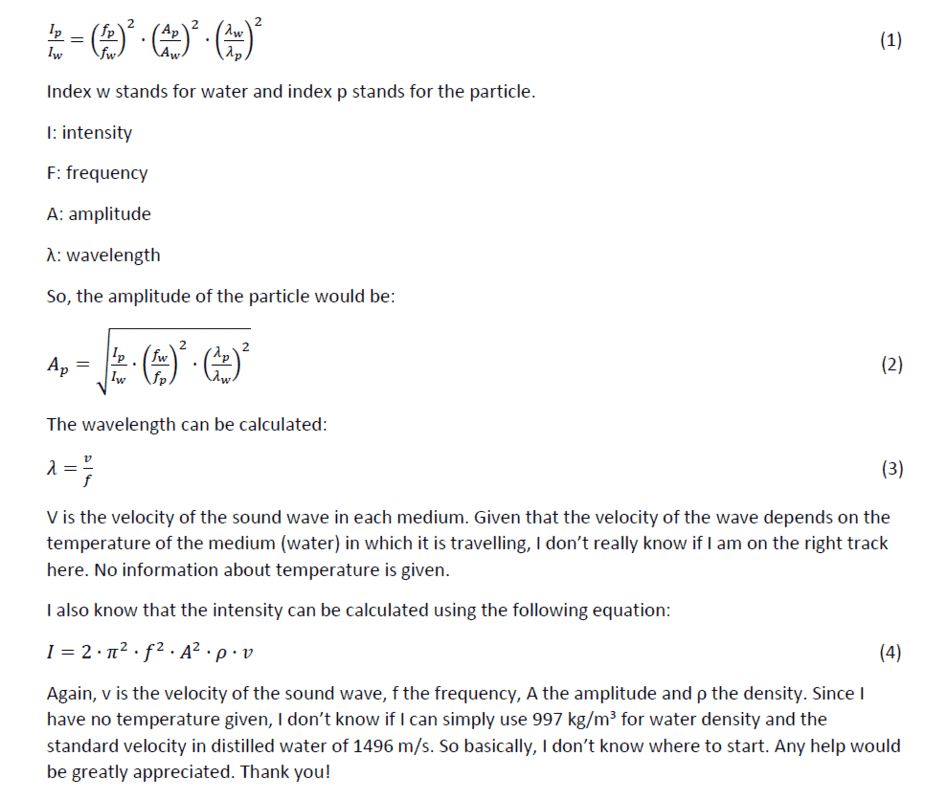
pic.png

 
Physics news on Phys.org
Hi.

I just estimate order of the amplitude.
Mass of the particle is
\frac{3}{4}\pi (10\times10^{-6})^3\ m^3 \times 5\ kg/m^3\ \equiv M
The area that particle receives energy is
\pi(10/2\times 10^{-5})^2\ m^2
So energy the particle get is
\pi(10/2\times 10^{-5})^2\ \times 10^6\ W
During a pair of push pull time of ##10^{-6}## seconds input energy is
\pi(10/2\times 10^{-5})^2\ \times 10^6\times 10^{-6} \ Joule\ \equiv E

In stationary case where input energy dissipates, we may estimate the above energy is average Kinetic Energy whose formula is
E=\frac{1}{2}Mv^2
average absolute value of velocity is
|v|=\sqrt{2E/M}
We get order of displacement amplitude as
|v|\times 10^{-6} \ m
it is calculated order of ##m\ m##.
 
  • Like
Likes   Reactions: Delta2 and bubble-flow

Similar threads

Replies
20
Views
5K
  • · Replies 5 ·
Replies
5
Views
2K
  • · Replies 3 ·
Replies
3
Views
2K
  • · Replies 1 ·
Replies
1
Views
2K
Replies
5
Views
3K
  • · Replies 1 ·
Replies
1
Views
2K
  • · Replies 2 ·
Replies
2
Views
4K
  • · Replies 16 ·
Replies
16
Views
3K
  • · Replies 6 ·
Replies
6
Views
2K
  • · Replies 8 ·
Replies
8
Views
2K