Undergrad Outer measure .... Axler, Result 2.14 .... Another Question ....

  • Thread starter Thread starter Math Amateur
  • Start date Start date
  • Tags Tags
    Measure
Click For Summary
SUMMARY

The discussion centers on Result 2.14 from Sheldon Axler's "Measure, Integration & Real Analysis," specifically the proof that if the closed interval [a, b] is contained in an open interval I1, then the length of I1, denoted as l(I1), is greater than or equal to b - a. Participants seek rigorous demonstrations of related concepts, including the length of closed intervals and the measure of open intervals. Key points include the necessity of defining the length of closed intervals and the implications of the measure properties established in Axler's work.

PREREQUISITES
  • Understanding of measure theory concepts, specifically outer measure.
  • Familiarity with the definitions of length for open intervals as per Axler's framework.
  • Knowledge of the properties of measures, including countable additivity.
  • Proficiency in mathematical induction and rigorous proof techniques.
NEXT STEPS
  • Study the implications of Axler's Result 2.15 and its relationship to Result 2.16.
  • Research the definitions and properties of outer measure in detail.
  • Learn how to construct rigorous proofs for the lengths of closed intervals.
  • Explore the concept of measure on subsets of the reals and its extensions from open intervals.
USEFUL FOR

Mathematicians, students of measure theory, and anyone interested in the rigorous foundations of integration and real analysis, particularly those studying Axler's work.

Math Amateur
Gold Member
MHB
Messages
3,920
Reaction score
48
TL;DR
I need further help in order to fully understand the proof that | [a, b] | = b - a ... ...
I am reading Sheldon Axler's book: Measure, Integration & Real Analysis ... and I am focused on Chapter 2: Measures ...

I need further help with the proof of Result 2.14 ...

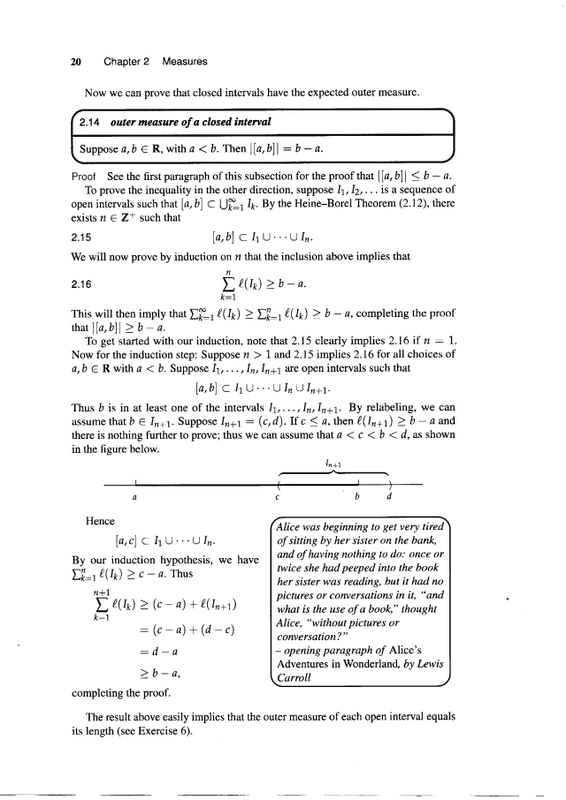
Result 2.14 and its proof read as follows
Axler - Result  2.14- outer measure of a closed interval .png


In the above proof by Axler we read the following:

" ... ... To get started with the induction, note that 2.15 clearly implies 2.16 if ##n = 1## ... "Can someone please demonstrate rigorously that 2.15 clearly implies 2.16 if ##n = 1## ...

... in other words, demonstrate rigorously that ##[a, b] \subset I_1 \Longrightarrow l(I_1) \geq b - a## ...My thoughts ... we should be able to use ##(a, b) \subset [a, b]## and the fact that if ##A \subset B## then ##\mid A \mid \leq \mid B \mid## ... ... but we may have to prove rigorously that ##\mid (a, b) \mid = b - a ## but how do we express this proof ...Help will be much appreciated ... ...

Peter=============================================================================================================

Readers of the above post may be assisted by access to Axler's definition of the length of an open interval and his definition of outer measure ... so I am providing access to the relevant text ... as follows:
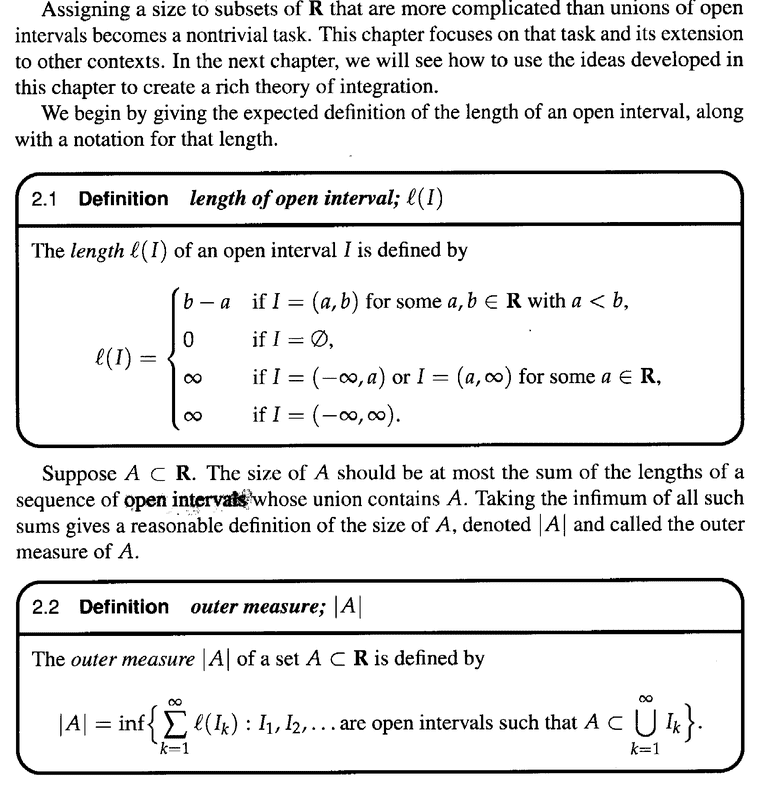
Axler - Defn 2.1 & 2.2 .png
Hope that helps ...

Peter
 
Last edited:
Physics news on Phys.org
You start with ##[a,b]\subseteq I_1##. Write ##I_1=]c,d[##. Then ##l(I_1)= d-c\geq b-a##. Not sure if that solves your problem?
 
  • Like
Likes Math Amateur
Math_QED said:
You start with ##[a,b]\subseteq I_1##. Write ##I_1=]c,d[##. Then ##l(I_1)= d-c\geq b-a##. Not sure if that solves your problem?
I believe that does solve the problem ...

Just a supplementary question ... Axler only defines the length of an open interval ... he has now proven that ##\mid [a, b] \mid = b - a## ...

... however, nothing has been said about the length of ## [a, b] ## ... do we know what ##l( [a, b] )## is ... ?

How would we show rigorously that ##l( [a, b] ) = b - a ...?

I note in passing that other books approach this issue by defining ##l( [a, b] ) = l( (a, b) ) = b - a## ...
... and another supplementary question ...
How would we show rigorously that ## \mid (a, b) \mid = b - a## ...

I know it seems intuitively obvious but how would you express a convincing and rigorous proof of the above result ...Peter
 
Last edited:
Math Amateur said:
I believe that does solve the problem ...

Just a supplementary question ... Axler only defines the length of an open interval ... he has now proven that ##\mid [a, b] \mid = b - a## ...

... however, nothing has been said about the length of ## [a, b] ## ... do we know what ##l( [a, b] )## is ... ?

How would we show rigorously that ##l( [a, b] ) = b - a ...?

I note in passing that other books approach this issue by defining ##l( [a, b] ) = l( (a, b) ) = b - a## ...
... and another supplementary question ...
How would we show rigorously that ## \mid (a, b) \mid = b - a## ...

I know it seems intuitively obvious but how would you express a convincing and rigorous proof of the above result ...Peter

Axler defined the length ##l## only for open intervals, so it does not make sense to ask what ##l([a,b])## is without giving an appropriate definition.

You proved that ##|[a,b]| = b-a##. Similarly, you can prove that ##|(a,b)| = b-a##. So when you will continue reading, you will note that the function ##A \mapsto |A|## restricted to "good" subsets has properties you want a length to have. So actually what you are doing is constructing a measure on some collection of subsets of the reals such that it extends the length of the open interval ##(a,b)## in an intuitive and good way. Hope this helps.
 
  • Like
Likes Math Amateur
Math_QED said:
Axler defined the length ##l## only for open intervals, so it does not make sense to ask what ##l([a,b])## is without giving an appropriate definition.

You proved that ##|[a,b]| = b-a##. Similarly, you can prove that ##|(a,b)| = b-a##. So when you will continue reading, you will note that the function ##A \mapsto |A|## restricted to "good" subsets has properties you want a length to have. So actually what you are doing is constructing a measure on some collection of subsets of the reals such that it extends the length of the open interval ##(a,b)## in an intuitive and good way. Hope this helps.

Thanks ... yes definitely helps a lot ...

Still reflecting on what you have written...

Thanks again...

Peter
 
I'm confused on why Axler doesn't just use 2.5 ($A\subset B \implies |A| \leq |B|$) to establish $|[b-a]| \geq |(b,a)|=b-a$ ?

What am I missing?
 
Last edited:
JeremyS said:
What am I missing?
One $ in your LaTeX.
 
JeremyS said:
I'm confused on why Axler doesn't just use 2.5 ($A\subset B \implies |A| \leq |B|$) to establish $|[b-a]| \geq |(b,a)|=b-a$ ?

What am I missing?
Vanadium 50 said:
One $ in your LaTeX.
Or double-# for inline... :wink:
JeremyS said:
I'm confused on why Axler doesn't just use 2.5 (##A\subset B \implies |A| \leq |B|##) to establish ##|[b-a]| \geq |(b,a)|=b-a## ?
 
Math Amateur said:
I believe that does solve the problem ...

Just a supplementary question ... Axler only defines the length of an open interval ... he has now proven that ##\mid [a, b] \mid = b - a## ...

... however, nothing has been said about the length of ## [a, b] ## ... do we know what ##l( [a, b] )## is ... ?

How would we show rigorously that ##l( [a, b] ) = b - a ...?

I note in passing that other books approach this issue by defining ##l( [a, b] ) = l( (a, b) ) = b - a## ...

Note [a,b] = \{a\} \cup (a,b) \cup \{b\}. Assuming that the measure of each singleton is equal, if this measure is strictly positive then l(\mathbb{Q} \cap (0,1)) is infinite by countable additivity; this contradicts l((0,1)) = 1.
 

Similar threads

  • · Replies 3 ·
Replies
3
Views
1K
  • · Replies 2 ·
Replies
2
Views
2K
  • · Replies 2 ·
Replies
2
Views
1K
  • · Replies 4 ·
Replies
4
Views
2K
  • · Replies 7 ·
Replies
7
Views
2K
  • · Replies 2 ·
Replies
2
Views
3K
Replies
2
Views
1K
  • · Replies 2 ·
Replies
2
Views
3K
  • · Replies 2 ·
Replies
2
Views
1K
  • · Replies 3 ·
Replies
3
Views
2K