Math Amateur
Gold Member
MHB
- 3,920
- 48
I am reading Sheldon Axler's book: Measure, Integration & Real Analysis ... and I am focused on Chapter 1: Measures ...
I need help with the proof of Result 2.5 ...
Result 2.5 and its proof read as follows:
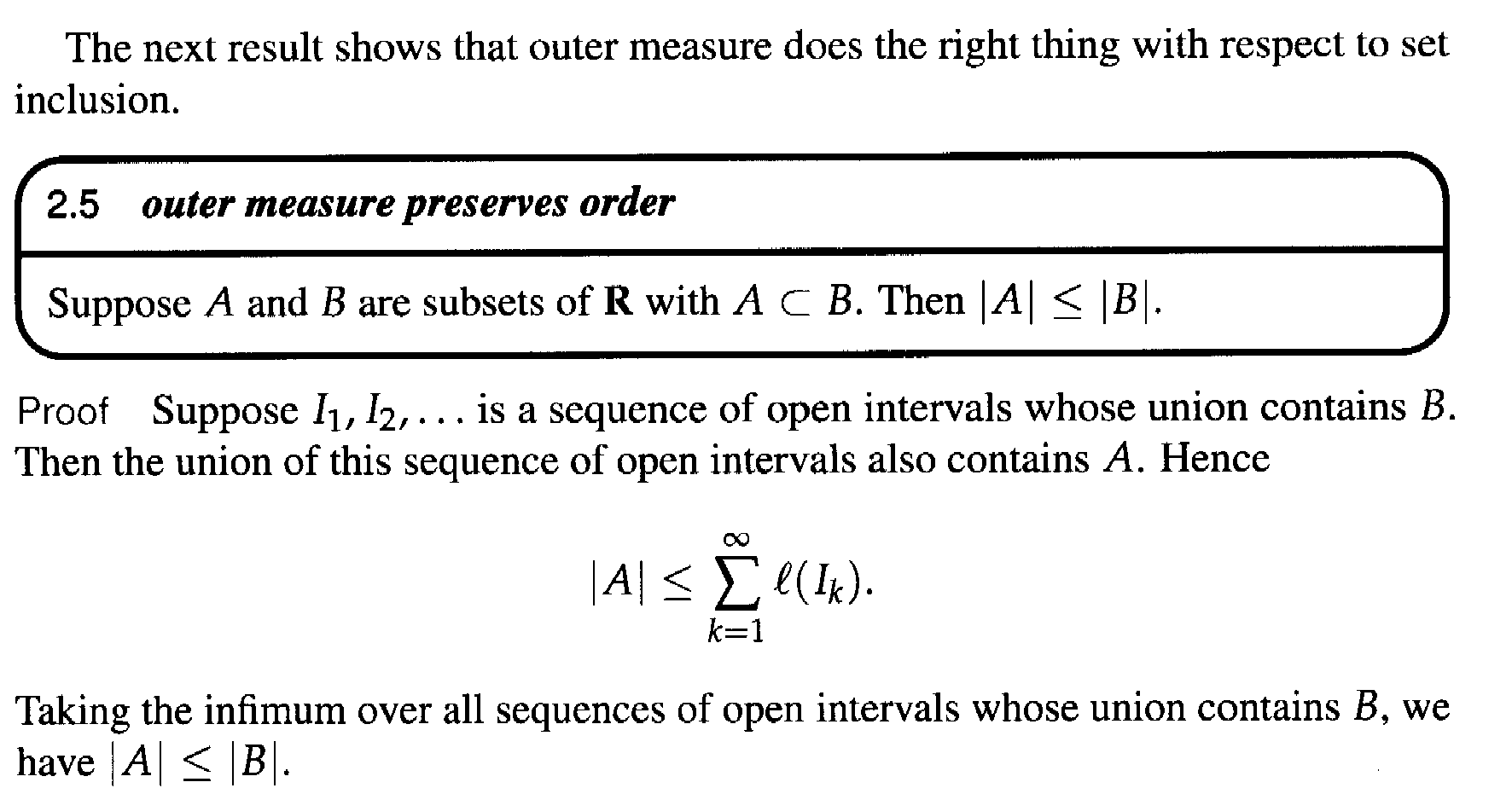
Now $$ \mid A \mid \leq \sum_{ k = 1 }^{ \infty } l(I_k)$$ follows from Axler's definition of outer measure ( is that correct?) ... see definition below ...
Then essentially we have to prove that $$ \mid A \mid \leq \sum_{ k = 1 }^{ \infty } l(I_k) \Longrightarrow \mid A \mid \leq \text{ inf } ( \sum_{ k = 1 }^{ \infty } l(I_k) \text{ where } B \subset \cup_{ k = 1 }^{ \infty } I_k ) $$ ...
But how do we rigorously prove this ...
Can someone please demonstrate a formal and rigorous proof that:
$$\mid A \mid \leq \sum_{ k = 1 }^{ \infty } l(I_k) \Longrightarrow \mid A \mid \leq \text{ inf } ( \sum_{ k = 1 }^{ \infty } l(I_k) \text{ where } B \subset \cup_{ k = 1 }^{ \infty } I_k ) $$ ...Help will be much appreciated ...===============================================My thoughts ...
Perhaps we can assume that $$\mid A \mid \ \gt \text{ inf } ( \sum_{ k = 1 }^{ \infty } l(I_k) \text{ where } B \subset \cup_{ k = 1 }^{ \infty } I_k ) $$ ... and obtain a contradiction ...
We have that $$ \mid A \mid \ \gt \text{ inf } ( \sum_{ k = 1 }^{ \infty } l(I_k) \text{ where } B \subset \cup_{ k = 1 }^{ \infty } I_k ) \Longrightarrow \ \exists \ \sum_{ k = 1 }^{ \infty } l(I_k)$$ such that $$\mid A \mid \ \gt \sum_{ k = 1 }^{ \infty } l(I_k)$$ where $$\sum_{ k = 1 }^{ \infty } I_k$$ covers $$B$$ ... Is this a contradiction ...? why exactly? How would you explain the contradiction clearly and rigorously ...
Hope that someone can help ...
Peter=============================================================================================================
Readers of the above post may be assisted by access to Axler's definition of the length of an open interval and his definition of outer measure ... so I am providing access to the relevant text ... as follows:
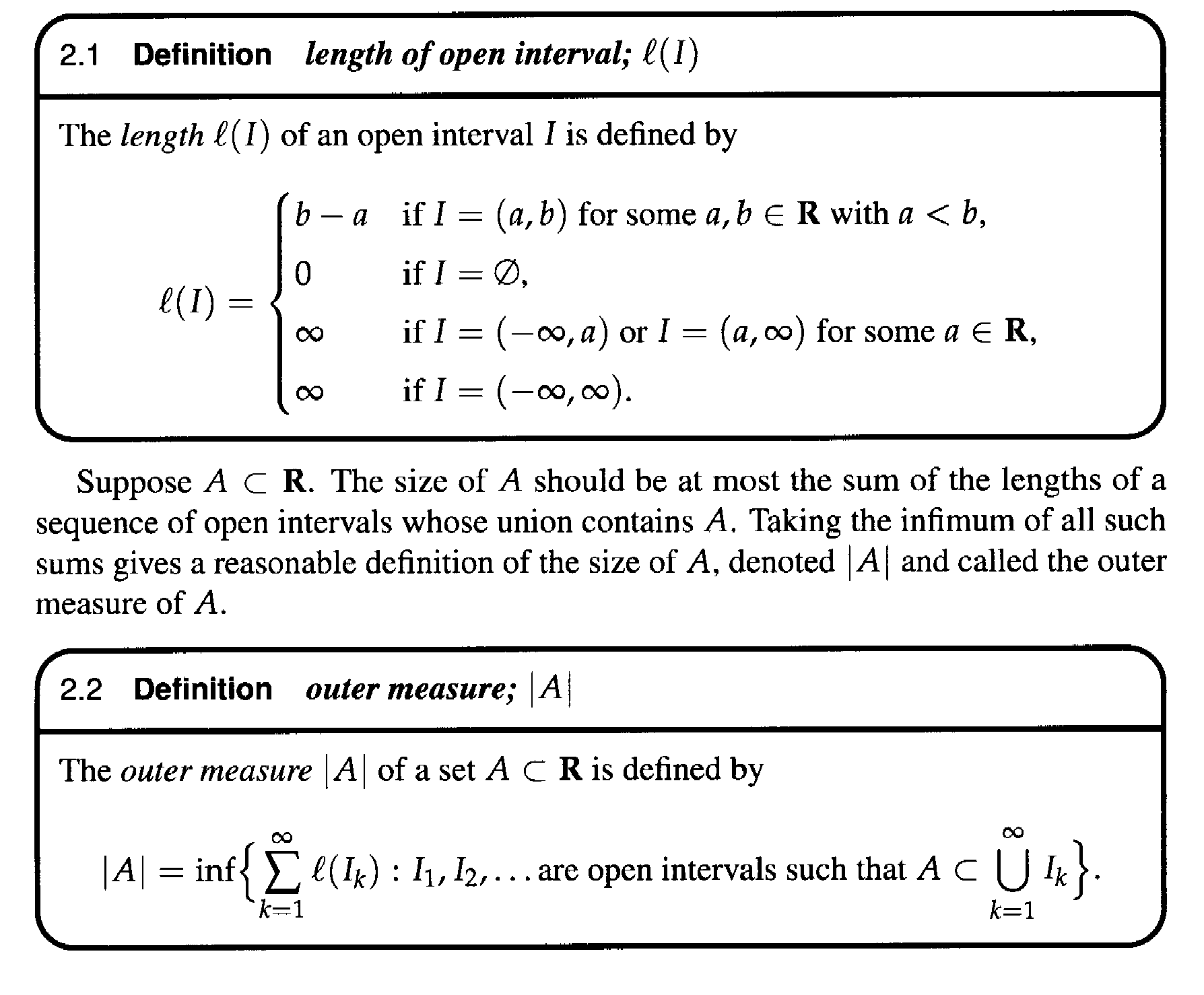
Hope that helps ...
Peter
I need help with the proof of Result 2.5 ...
Result 2.5 and its proof read as follows:
Now $$ \mid A \mid \leq \sum_{ k = 1 }^{ \infty } l(I_k)$$ follows from Axler's definition of outer measure ( is that correct?) ... see definition below ...
Then essentially we have to prove that $$ \mid A \mid \leq \sum_{ k = 1 }^{ \infty } l(I_k) \Longrightarrow \mid A \mid \leq \text{ inf } ( \sum_{ k = 1 }^{ \infty } l(I_k) \text{ where } B \subset \cup_{ k = 1 }^{ \infty } I_k ) $$ ...
But how do we rigorously prove this ...
Can someone please demonstrate a formal and rigorous proof that:
$$\mid A \mid \leq \sum_{ k = 1 }^{ \infty } l(I_k) \Longrightarrow \mid A \mid \leq \text{ inf } ( \sum_{ k = 1 }^{ \infty } l(I_k) \text{ where } B \subset \cup_{ k = 1 }^{ \infty } I_k ) $$ ...Help will be much appreciated ...===============================================My thoughts ...
Perhaps we can assume that $$\mid A \mid \ \gt \text{ inf } ( \sum_{ k = 1 }^{ \infty } l(I_k) \text{ where } B \subset \cup_{ k = 1 }^{ \infty } I_k ) $$ ... and obtain a contradiction ...
We have that $$ \mid A \mid \ \gt \text{ inf } ( \sum_{ k = 1 }^{ \infty } l(I_k) \text{ where } B \subset \cup_{ k = 1 }^{ \infty } I_k ) \Longrightarrow \ \exists \ \sum_{ k = 1 }^{ \infty } l(I_k)$$ such that $$\mid A \mid \ \gt \sum_{ k = 1 }^{ \infty } l(I_k)$$ where $$\sum_{ k = 1 }^{ \infty } I_k$$ covers $$B$$ ... Is this a contradiction ...? why exactly? How would you explain the contradiction clearly and rigorously ...
Hope that someone can help ...
Peter=============================================================================================================
Readers of the above post may be assisted by access to Axler's definition of the length of an open interval and his definition of outer measure ... so I am providing access to the relevant text ... as follows:
Hope that helps ...
Peter
Last edited: