MHB Outer measure .... Axler, Result 2.8 ....

  • Thread starter Thread starter Math Amateur
  • Start date Start date
  • Tags Tags
    Measure
Click For Summary
The discussion centers on understanding the proof of Result 2.8 from Sheldon Axler's "Measure, Integration & Real Analysis." The arrangement of the doubly indexed collection of open intervals is crucial for demonstrating that their union encompasses the sets A_k. The proof relies on the definition of outer measure as an infimum, establishing that the sum of the lengths of these intervals is bounded by ε plus the sum of the measures of A_k. This approach ensures that as ε approaches zero, the outer measure of the union of A_k is effectively shown to be less than or equal to the sum of their individual measures. The explanation clarifies the mathematical reasoning behind the grouping and the resulting inequalities.
Math Amateur
Gold Member
MHB
Messages
3,920
Reaction score
48
I am reading Sheldon Axler's book: Measure, Integration & Real Analysis ... and I am focused on Chapter 2: Measures ...

I need help with the proof of Result 2.8 ...

Result 2.8 and its proof read as follows
Axler -  Result 2-8 - Countable subadditivity of outer measure.png


In the above text from Axler we read:"The doubly indexed collection of open intervals [math] \{ I_{ j, k } : j,k \in \mathbb{Z^+} \} [/math] can be rearranged into a sequence of open intervals whose union contains [math] \bigcup_{ k = 1 }^{ \infty} A_k [/math] as follows, where in step k (start with k =2, then k = 3,4,5 ... ) we adjoin the k-1 intervals whose indices add up to k :

Axler -  Result 2-8 - Countable subadditivity of outer measure FRAGMENT.png
Inequality 2.9 shows that the sum of the lengths listed above is less than or equal to [math] \epsilon + \sum_{k=1}^{ \infty} |A_k| [/math]. Thus [math] | \sum_{k=1}^{ \infty} A_k | \leq \epsilon + \sum_{k=1}^{ \infty} |A_k| [/math] ... ..."

i really do not understand what is going on here ... can someone explain why we are arranging or grouping the intervals [math] \{ I_{ j, k } : j,k \in \mathbb{Z^+} \} [/math] in this way and why exactly it follows that the sum of the lengths listed above is less than or equal to $ \epsilon + \sum_{k=1}^{ \infty} |A_k| $ ...Hope someone can help,

Peter
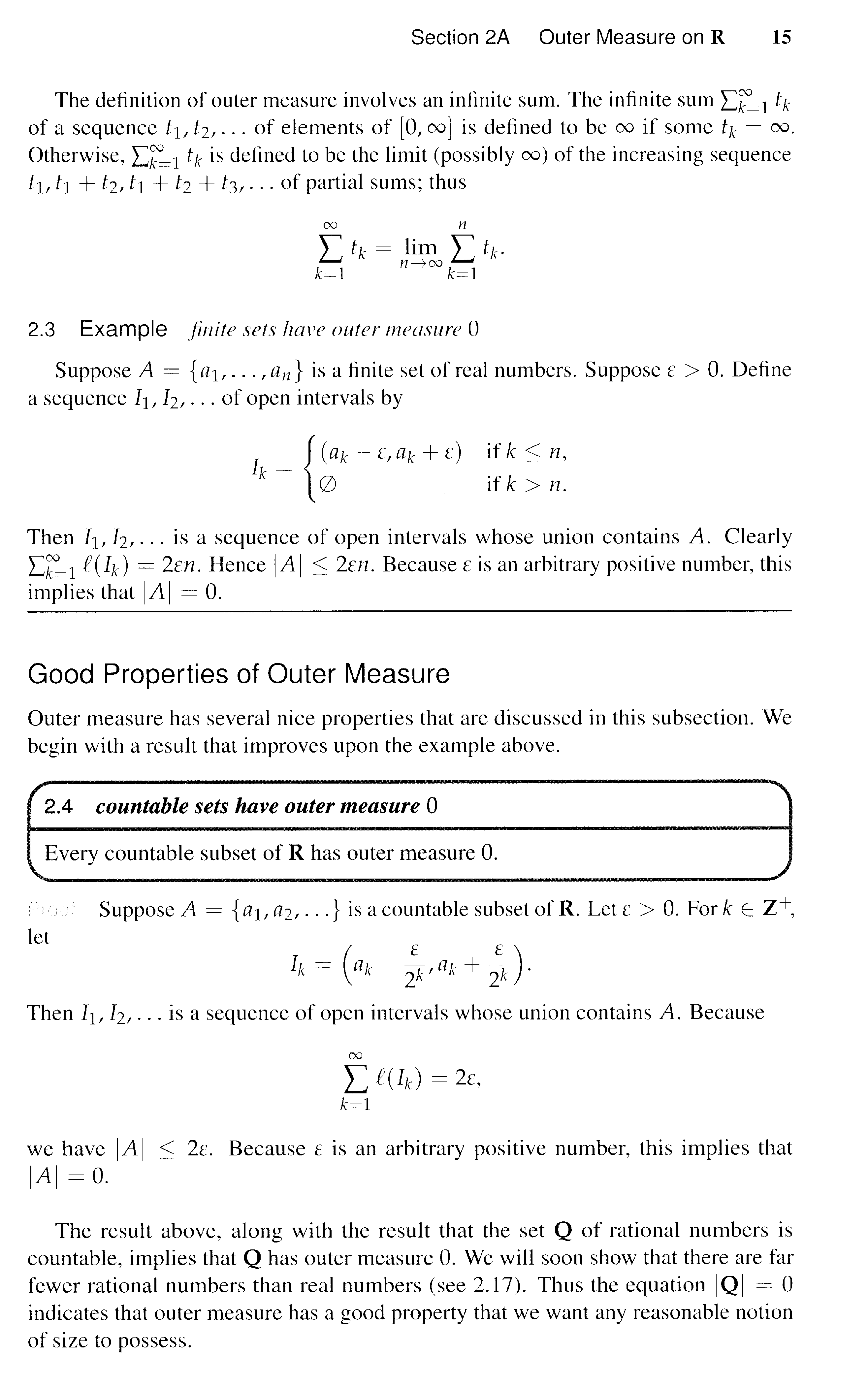
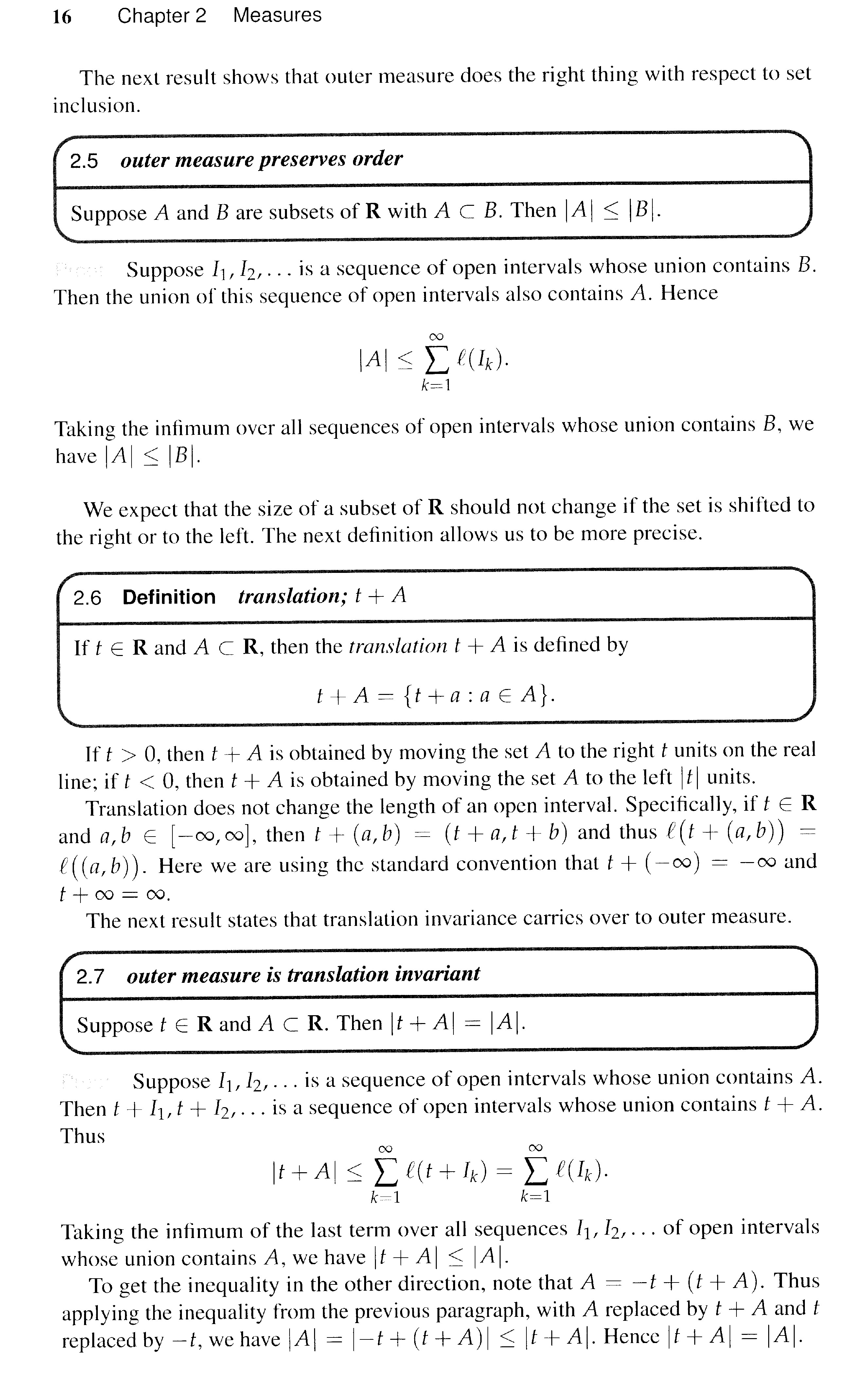
NOTE: so that readers of the above post will have enough contextual and notational information i am posting the start of Axler's Section @A on Outer Measure ... as follows:
Axler - outer measure on R - page 14.png

Axler - outer measure on R - page 15 ... .png

Axler - outer measure on R - page 16 ... .png

Hope that helps Peter
 
Last edited:
Physics news on Phys.org
Hi Peter,

The reason the author is doing things this way is because the outer measure is defined as an infimum. Recall that the infimum of a set of real numbers is the greatest lower bound of that set of real numbers.

According to Definition 2.2, if for an arbitrarily fixed $\varepsilon >0$ there is a collection of open intervals whose union contains $\displaystyle\bigcup_{k=1}^{\infty}A_{k}$ and the sum of whose lengths is less than or equal to $\varepsilon + \displaystyle\sum_{k=1}^{\infty}|A_{k}|$, then (by definition of infimum) $\left|\displaystyle\bigcup_{k=1}^{\infty}A_{k}\right|\leq \varepsilon + \displaystyle\sum_{k=1}^{\infty}|A_{k}|$. Since $\varepsilon > 0$ is arbitrary, it then follows that $ \left|\displaystyle\bigcup_{k=1}^{\infty}A_{k}\right|\leq \displaystyle\sum_{k=1}^{\infty}|A_{k}|$. This is the line of reasoning the author is following.

To establish that the union of the open intervals $I_{j,k}$ contains $\displaystyle\bigcup_{k=1}^{\infty}A_{k}$, the author is using an adapted version of Cantor's diagonal argument proving the countability of the rational numbers, where
$$I_{1,1}\quad I_{1,2} \quad I_{1,3},\,\ldots\\
I_{2,1}\quad I_{2,2}\quad I_{2,3},\,\ldots\\
\vdots$$
replaces the fractions seen in the link to Cantor's argument shared above. Since the open intervals in row $k$ are chosen specifically to cover $A_{k}$, as the author snakes their way through the sets via Cantor's diagonal argument, we can be sure the union of all $A_{k}$'s is covered, too.

According to the way the open intervals in row $k$ were chosen, we know that the sum of the lengths of the open intervals in row $k$ is bounded above by $\dfrac{\varepsilon}{2^{k}} + |A_{k}|$; i.e., $$\displaystyle\sum_{j=1}^{\infty}\mathcal{l}(I_{j,k})\leq \dfrac{\varepsilon}{2^{k}} + |A_{k}|$$
Since the above is true for all $k$, we can sum the above over $k$ and use the fact that $\displaystyle\sum_{k=1}^{\infty}\dfrac{1}{2^{k}} = 1$ (see Geometric Series - Wikipedia) to obtain
$$\sum_{k=1}^{\infty}\sum_{j=1}^{\infty}\mathcal{l}(I_{j,k})\leq \varepsilon + \sum_{k=1}^{\infty}|A_{k}|$$
Hopefully this helps. Feel free to let me know if you have any other questions.
 
Hi Peter,

I'm also currently studying Axler's book and I can try to explain the proof of Result 2.8 to you.

First, let's define some terms and notation that Axler uses in this section. The set \{ I_{j,k} : j,k \in \mathbb{Z^+} \} is a collection of open intervals, where the indices j and k represent the starting and ending point of each interval. The notation \bigcup_{k=1}^{\infty} A_k means the union of all the sets A_1, A_2, A_3, ... and so on. In step k of the rearrangement process, we are adding k-1 intervals whose indices add up to k. For example, in step 2, we add the intervals I_{1,1} and I_{2,1} since 1+1=2. In step 3, we add the intervals I_{1,2}, I_{2,1} and I_{3,1} since 1+2=3.

Now, let's look at the inequality 2.9. This inequality shows that the sum of the lengths of the intervals in the collection \{ I_{j,k} : j,k \in \mathbb{Z^+} \} is less than or equal to \epsilon + \sum_{k=1}^{\infty} |A_k|. This means that we can make the sum of the lengths of the intervals as close to \sum_{k=1}^{\infty} |A_k| as we want by choosing a small enough \epsilon. This is important because we want to show that the union of all the A_k sets is contained within the union of the open intervals.

Now, let's look at the last part of the proof where we have | \sum_{k=1}^{\infty} A_k | \leq \epsilon + \sum_{k=1}^{\infty} |A_k|. This inequality follows from the previous part of the proof where we showed that the sum of the lengths of the intervals is less than or equal to \epsilon + \sum_{k=1}^{\infty} |A_k|. Since the sum of the lengths is less than or equal to \epsilon + \sum_{k=1}^{\infty
 
We all know the definition of n-dimensional topological manifold uses open sets and homeomorphisms onto the image as open set in ##\mathbb R^n##. It should be possible to reformulate the definition of n-dimensional topological manifold using closed sets on the manifold's topology and on ##\mathbb R^n## ? I'm positive for this. Perhaps the definition of smooth manifold would be problematic, though.

Similar threads

  • · Replies 4 ·
Replies
4
Views
2K
  • · Replies 2 ·
Replies
2
Views
2K
  • · Replies 2 ·
Replies
2
Views
1K
Replies
2
Views
1K
  • · Replies 2 ·
Replies
2
Views
2K
  • · Replies 8 ·
Replies
8
Views
4K
  • · Replies 3 ·
Replies
3
Views
1K
  • · Replies 7 ·
Replies
7
Views
2K
  • · Replies 2 ·
Replies
2
Views
1K
  • · Replies 3 ·
Replies
3
Views
2K