MHB Outer measure of an open interval ....

  • Thread starter Thread starter Math Amateur
  • Start date Start date
  • Tags Tags
    Interval Measure
Click For Summary
The discussion focuses on proving that the outer measure of an open interval (a, b) is equal to b - a, as outlined in Sheldon Axler's book. Participants suggest using closed intervals to approximate (a, b) and demonstrate that the measure of these intervals is less than or equal to the outer measure of (a, b). The proof involves showing that b - a serves as a lower bound for the outer measure, while also establishing that the outer measure cannot exceed b - a. Clarifications are made regarding the terminology used in discussing lower bounds in the context of sets versus individual numbers. The conversation emphasizes the importance of rigorous definitions and careful reasoning in measure theory.
Math Amateur
Gold Member
MHB
Messages
3,920
Reaction score
48
I am reading Sheldon Axler's book: Measure, Integration & Real Analysis ... and I am focused on Chapter 2: Measures ...

I need help with proving that the outer measure of an open interval, \mid (a, b) \mid = b - a

Axler's definitions of length and outer measure are as follows:
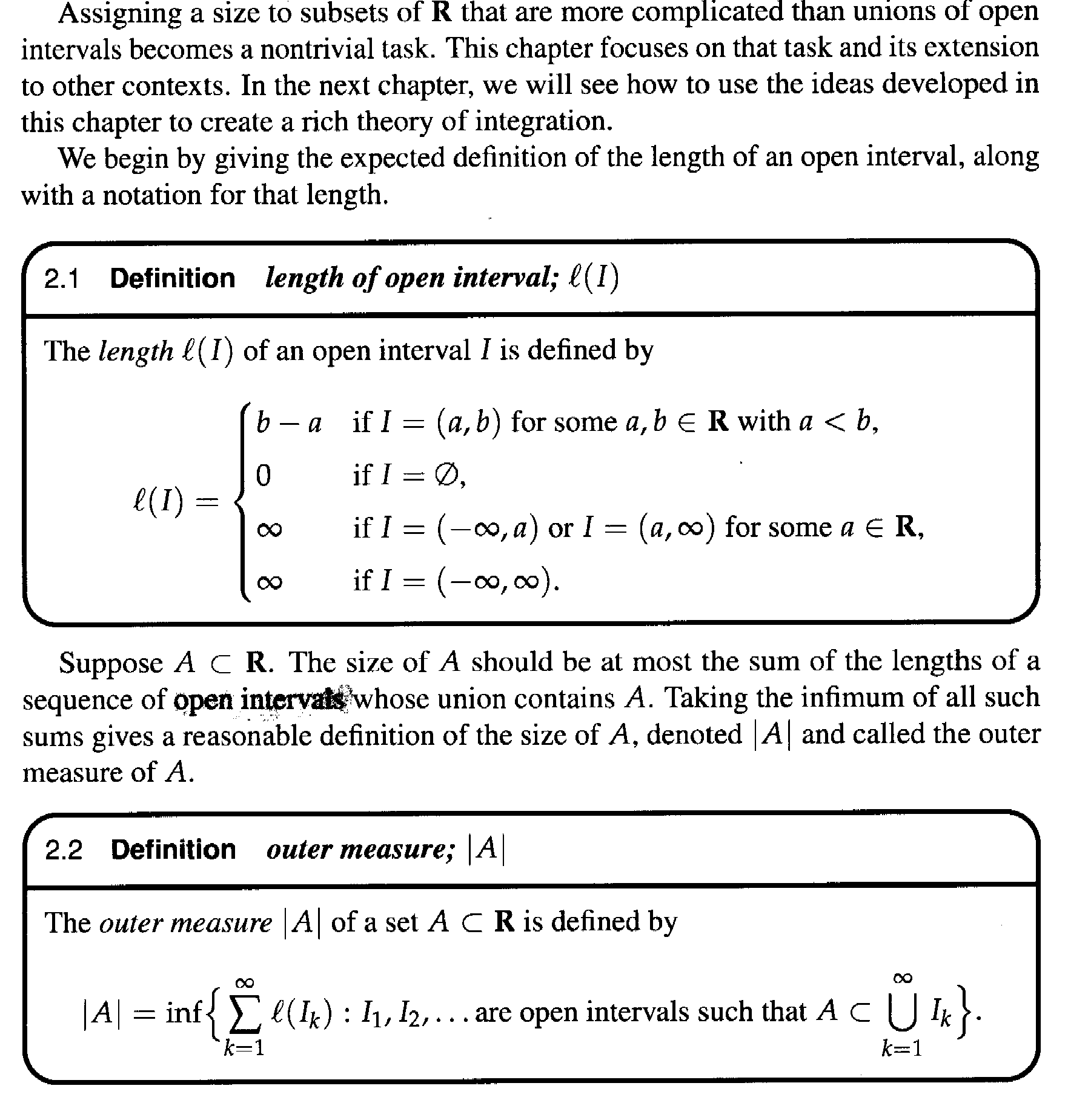
Axler - Defn 2.1 & 2.2 .png

Can someone demonstrate rigorously that $$ \mid (a, b) \mid = b - a$$ ...

I know it seems intuitively obvious but how would you express a convincing and rigorous proof of the above result ...
Help will be much appreciated ... ...

Peter
 
Last edited:
Physics news on Phys.org
Hi Peter,

I agree with you here. For something that seems so intuitively clear, the proof isn't a one-liner using only the definition. My suggestion would be to try and use the result you asked about in another post, namely that $\vert[a,b]\vert = b-a$. Also think about approximating $(a,b)$ using closed intervals contained in $(a,b)$. These two ideas together are enough to formulate a short argument proving $\vert(a,b)\vert = b-a.$ I'll leave it at this for now, but feel free to let me know if you have additional questions.
 
Thanks for the help GJA ...

BUT ... still struggling with constructing a proof ...

Can you help further ...

Peter
 
Certainly. Let's approximate $(a,b)$ via the closed intervals $[a+1/2n, b-1/2n].$ We then have $b - a - 1/n = \vert[a+1/2n, b - 1/2n]\vert\leq \vert (a,b)\vert$ for all $n$ (large enough), because $[a+1/2n, b-1/2n]\subset (a,b)$ for all $n$ (large enough). Since this holds for all $n$ (large enough), it follows that $b-a\leq \vert(a,b)\vert.$ Can you think of an argument that would show $\vert(a,b)\vert \leq b-a$? Hint: $(a,b)$ itself is an open interval that contains $(a,b)$. Think about this and the definition of outer measure.

Edit: I needed to add the qualifier "large enough" because $[a+1/2n, b-1/2n]$ may not be contained in $(a,b)$ for all $n$. However, since $a<b$, there is $N$ such that $[a+1/2n, b-1/2n]\subset (a,b)$ for all $n\geq N$; i.e., for all $n$ "large enough."
 
Last edited:
GJA said:
Certainly. Let's approximate $(a,b)$ via the closed intervals $[a+1/2n, b-1/2n].$ We then have $b - a - 1/n = \vert[a+1/2n, b - 1/2n]\vert\leq \vert (a,b)\vert$ for all $n$ (large enough), because $[a+1/2n, b-1/2n]\subset (a,b)$ for all $n$ (large enough). Since this holds for all $n$ (large enough), it follows that $b-a\leq \vert(a,b)\vert.$ Can you think of an argument that would show $\vert(a,b)\vert \leq b-a$? Hint: $(a,b)$ itself is an open interval that contains $(a,b)$. Think about this and the definition of outer measure.

Edit: I needed to add the qualifier "large enough" because $[a+1/2n, b-1/2n]$ may not be contained in $(a,b)$ for all $n$. However, since $a<b$, there is $N$ such that $[a+1/2n, b-1/2n]\subset (a,b)$ for all $n\geq N$; i.e., for all $n$ "large enough."
Thanks for the help GJA ...

To show that $\vert(a,b)\vert \leq b-a$ ... we proceed as follows ...

We have I_1, I_2, ... = $(a,b), \emptyset, \emptyset,$ ... ... is a covering of $(a,b)$ ... ...

Therefore $(a,b)$ is a lower bound for $\sum_{n=1}^{\infty} I_n = b - a$ ... ...

... so ... $\vert(a,b)\vert \leq b-a$ ...Is that correct?

Peter
 
A few things to note. First, we wouldn't say $(a,b)$ is a lower bound because it's an interval, not a number. Next, we can only say something is a lower bound for a set when it's a value below all the numbers in the set. For example $3$ is a lower bound for the set $(5,10)$ but $9$ is not. Since you chose a specific covering of $(a,b)$ and not an arbitrary one, you cannot conclude that the value you came up with is a lower bound for $\{\sum_{k}l(I_{k})\, :\,\ldots\}$, because you don't know that the covering you chose produces a value that is smaller than all the values in the set. What you have shown is that $b-a$ belongs to the set of values $\{\sum_{k}l(I_{k})\,:\,\ldots\}$ and, therefore, $\vert[a,b]\vert\leq b-a.$
 
GJA said:
A few things to note. First, we wouldn't say $(a,b)$ is a lower bound because it's an interval, not a number. Next, we can only say something is a lower bound for a set when it's a value below all the numbers in the set.
Below or equal to every number in the set.[/quote]

For example $3$ is a lower bound for the set $(5,10)$[//quote]
and so is 5.
but $9$ is not. Since you chose a specific covering of $(a,b)$ and not an arbitrary one, you cannot conclude that the value you came up with is a lower bound for $\{\sum_{k}l(I_{k})\, :\,\ldots\}$, because you don't know that the covering you chose produces a value that is smaller than all the values in the set. What you have shown is that $b-a$ belongs to the set of values $\{\sum_{k}l(I_{k})\,:\,\ldots\}$ and, therefore, $\vert[a,b]\vert\leq b-a.$
 
GJA said:
A few things to note. First, we wouldn't say $(a,b)$ is a lower bound because it's an interval, not a number. Next, we can only say something is a lower bound for a set when it's a value below all the numbers in the set. For example $3$ is a lower bound for the set $(5,10)$ but $9$ is not. Since you chose a specific covering of $(a,b)$ and not an arbitrary one, you cannot conclude that the value you came up with is a lower bound for $\{\sum_{k}l(I_{k})\, :\,\ldots\}$, because you don't know that the covering you chose produces a value that is smaller than all the values in the set. What you have shown is that $b-a$ belongs to the set of values $\{\sum_{k}l(I_{k})\,:\,\ldots\}$ and, therefore, $\vert[a,b]\vert\leq b-a.$
Thanks GJA ...

Sorry ... I have confused things with a typo ... I wrote $(a,b)$ when I meant $\mid (a, b) \mid$ ... ...

So ... my post should have read as follows:

To show that $\vert(a,b)\vert \leq b-a$ ... we proceed as follows ...

We have $I_1, I_2, ... = (a,b), \emptyset, \emptyset,$ ... ... is a covering of $(a,b)$ ... ...

Therefore $\vert(a,b)\vert$ is a lower bound for $\sum_{n=1}^{\infty} I_n = b - a$ ... ...

... so ... $\vert(a,b)\vert \leq b-a$ ...
A word about the claim that " ... Therefore $\vert(a,b)\vert$ is a lower bound for $\sum_{n=1}^{\infty} I_n = b - a$ ... ..."

... $\vert(a,b)\vert$ is a lower bound for the set of all sums of the form $\sum_{n=1}^{\infty} I_n$ ... (indeed, it is the greatest lower bound ...) ... so it is less than the particular sum mentioned ...

Is the above correct ... apart from referring to a lower bound of a number rather than a set of numbers ...

Peter
 
Last edited:

Similar threads

  • · Replies 8 ·
Replies
8
Views
4K
  • · Replies 3 ·
Replies
3
Views
1K
  • · Replies 2 ·
Replies
2
Views
2K
  • · Replies 2 ·
Replies
2
Views
1K
  • · Replies 4 ·
Replies
4
Views
2K
Replies
2
Views
1K
  • · Replies 2 ·
Replies
2
Views
2K
  • · Replies 2 ·
Replies
2
Views
3K
  • · Replies 6 ·
Replies
6
Views
3K
  • · Replies 3 ·
Replies
3
Views
3K