Seka88 Messages 1 Reaction score 0 Thread starter Apr 22, 2021 #1 I’m overall struggling. Not liking the inequalities. Any step by step would be awesome Attachments D97F9FC9-ABA4-4A78-956C-B889286E4D18.jpeg 241.5 KB · Views: 128 Last edited: Apr 22, 2021
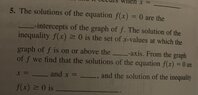
skeeter Messages 1,103 Reaction score 1 Apr 22, 2021 #2 $f(x) > 0$ is any part of the graph that is above the x-axis $f(x) = 0$ is any part of the graph that crosses or touches the x-axis $f(x) < 0$ is any part of the graph below the x-axis
$f(x) > 0$ is any part of the graph that is above the x-axis $f(x) = 0$ is any part of the graph that crosses or touches the x-axis $f(x) < 0$ is any part of the graph below the x-axis
jonah1 Messages 107 Reaction score 0 Apr 22, 2021 #3 Beer soaked query follows. Seka88 said: I’m overall struggling. Not liking the inequalities. Any step by step would be awesome Is there a specific inequality behind item #5?
Beer soaked query follows. Seka88 said: I’m overall struggling. Not liking the inequalities. Any step by step would be awesome Is there a specific inequality behind item #5?
HOI Messages 921 Reaction score 2 Apr 27, 2021 #4 Do you not understand that in "y= f(x)" any value of f is a "y" value? f(x)= 0 means y= 0 so that is a point on the x- axis. That is what goes into the first two blanks. For the other two we need to know how "f(x)" is defined here. Last edited: Apr 29, 2021
Do you not understand that in "y= f(x)" any value of f is a "y" value? f(x)= 0 means y= 0 so that is a point on the x- axis. That is what goes into the first two blanks. For the other two we need to know how "f(x)" is defined here.