rodd
- 1
- 0
- TL;DR
- How can we restore the visible double-slit interference and have SPDC-entangled light beams simultaneously?
I'm fascinated by the delayed-choice quantum eraser (DCQE) experiment from Kim et al. 1999.
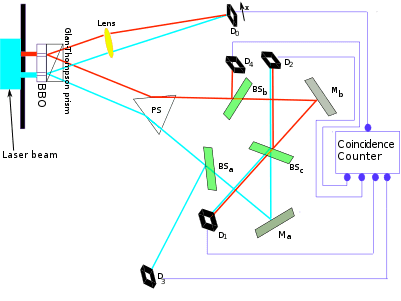
As I understand from the paper, the observer at the signal beam detector d0 (the screen) never sees an interference pattern, but the "lump" sum of all possible outcomes at the idler photon detectors. Interference can only be seen by retroactively (classically) comparing different detector results from d1, d2 (erasers) and d3, d4 (which-path).
But there's something I don't quite grasp.
Now let's suppose you completely remove all idler detectors d1 to d4 from the experiment but leave the SPDC apparatus with its entangled beams and having the idler beam undetected (ie. pointing the idler beams to space), will the observer ever experience an interference pattern at d0? Did spontaneous parametric down-conversion at the BBO crystal destroy the self-interference superposition of the signal beam? But, if yes, then where do the interference patterns in the "post-processed" detections come from exactly? As I understand the original double-slit superposition has not been destroyed and an interference pattern should be visible somehow.
In other words, is there any way to see an interference at d0 while keeping the BBO/Glan-Thompson SPDC beamsplitter positioned after the double-slit? Maybe some other type of idler beam meshing apparatus (lens, mirrors, prisms...) is needed to erase the which-path info completely?
Or maybe some marking or filtering apparatus that does not add which-way path information be added to the post-entangled signal beam so that the double signal beams, which are red and blue colored in the diagram, could form a visible interference pattern at d0?
As I understand from the paper, the observer at the signal beam detector d0 (the screen) never sees an interference pattern, but the "lump" sum of all possible outcomes at the idler photon detectors. Interference can only be seen by retroactively (classically) comparing different detector results from d1, d2 (erasers) and d3, d4 (which-path).
But there's something I don't quite grasp.
Now let's suppose you completely remove all idler detectors d1 to d4 from the experiment but leave the SPDC apparatus with its entangled beams and having the idler beam undetected (ie. pointing the idler beams to space), will the observer ever experience an interference pattern at d0? Did spontaneous parametric down-conversion at the BBO crystal destroy the self-interference superposition of the signal beam? But, if yes, then where do the interference patterns in the "post-processed" detections come from exactly? As I understand the original double-slit superposition has not been destroyed and an interference pattern should be visible somehow.
In other words, is there any way to see an interference at d0 while keeping the BBO/Glan-Thompson SPDC beamsplitter positioned after the double-slit? Maybe some other type of idler beam meshing apparatus (lens, mirrors, prisms...) is needed to erase the which-path info completely?
Or maybe some marking or filtering apparatus that does not add which-way path information be added to the post-entangled signal beam so that the double signal beams, which are red and blue colored in the diagram, could form a visible interference pattern at d0?
Attachments