Partial Fraction Decomposition—Multiple Variables

Join the discussion
Ask a follow-up here, or get your own question answered by working scientists, mathematicians and engineers — people, not an autocomplete.
Real named experts · corrections over time · the nuance an AI answer skips
2 replies · 13K views
END
Messages
36
Reaction score
4
What's the best approach to solving the partial-fraction decomposition of the following expression?

$$\frac{1}{(a-y)(b-y)}$$

The expression is not of the following forms:
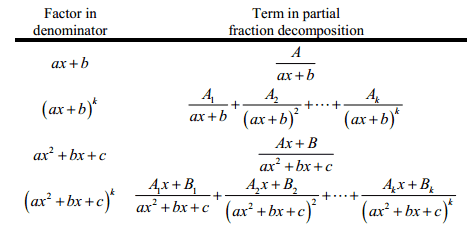
upload_2014-12-4_18-39-1.png


But I know the solution is

$$= \frac{1}{(a-b)(y-a)}-\frac{1}{(a-b)(y-b)}$$


Attachments

  • upload_2014-12-4_18-40-32.png
    upload_2014-12-4_18-40-32.png
    7 KB · Views: 2,001
  • upload_2014-12-4_18-42-39.png
    upload_2014-12-4_18-42-39.png
    6.1 KB · Views: 1,225
Physics news on Phys.org
I don't use such tables. Any time I want to do a partial fraction decomposition, I just write (e.g.) [itex]\frac{1}{(a-y)(b-y)}=\frac{A}{a-y}+\frac{B}{b-y}[/itex] and then determine A and B.
Anyway, if you multiply the factors you'll see that its in fact in the form of the third entry in the table!
 
  • Like
Likes   Reactions: Abscissas
What the table is saying is the for each distinct (i.e., not repeated) factor (ax + b) in the denominator, you'll have a term ##\frac{A}{ax + b}## in the decomposition. So ##\frac{1}{(a - y)(b - y)}## results in ##\frac{A}{a - y} + \frac{B}{b - y}##.

Equate the two expressions and solve for A and B, which is more or less what Shyan said.